

Canadian Data Residency Software: How Custom Software Reduces Compliance Risk
Canadian data residency software is software designed so organizations can choose where personal information and sensitive workloads are stored, processed, backed up, and administered, with architecture and vendor controls that support Canadian operational, contractual, and regulatory expectations. In practice, that usually means building or configuring systems so a business can keep the right data in Canada, limit unnecessary cross-border access, document vendor responsibilities, and prove how the environment is managed.
For Canadian organizations, the key issue is not whether “all data must stay in Canada.” The real question is when a specific organization, dataset, contract, or regulator creates a residency expectation, and what software architecture reduces the resulting compliance, procurement, and operational risk.
At Modall, we deliver end-to-end custom software through direct collaboration with our 100% in-house Canadian team. From custom web platforms and SaaS products to AI solutions and mobile apps, every project is built without outsourcing.
What Canadian data residency software means
Canadian data residency software is not a legal category. It is a practical buying term for software that helps an organization keep relevant data, backups, logs, integrations, and administrative workflows inside Canada when that is required by policy, contract, procurement rules, or risk management goals.
In most cases, organizations are looking for some combination of:
Canadian hosting options.
Clear control over where production, backup, and analytics data live.
Limited foreign admin access.
Audit logs and role-based access controls.
Vendor agreements that map to privacy and security obligations.
A delivery team that can collaborate directly without offshore handoffs.
For many organizations, off-the-shelf SaaS makes those controls hard to verify. A custom build can make them explicit.
Need software architecture designed around Canadian hosting, direct collaboration, and lower vendor risk? Get a free quote

When data residency requirements apply
Canada does not have one blanket national law requiring all business data to remain in Canada. In the private sector, the federal privacy framework under PIPEDA focuses on how personal information is collected, used, disclosed, protected, and retained, rather than imposing a universal “Canada-only hosting” rule by default.
That said, Canadian data residency requirements can still apply when any of the following are true:
A public-sector statute, policy, or regulator sets location or cross-border disclosure limits.
A health-sector law, custodian rule, or institutional policy imposes stricter handling expectations for personal health information.
A customer contract, procurement requirement, or enterprise security review requires Canadian hosting.
A buyer wants to reduce exposure to foreign legal access, subcontractor sprawl, or unclear support workflows.
A risk assessment concludes that certain data categories should stay in Canada even if the law does not strictly require it.
Private-sector privacy rules
For private-sector organizations, the baseline issue is usually personal information, not server nationality. PIPEDA applies fair information principles and expects organizations to collect, use, and disclose personal information for appropriate purposes, with safeguards and accountability in place.
That means many private companies can legally use non-Canadian cloud infrastructure in some scenarios, but they still need to assess notice, consent, sensitivity, vendor oversight, contractual terms, and security controls. For organizations, this is exactly where custom architecture helps, because it lets the business align the software design to the actual risk profile instead of accepting a generic vendor model.
Public-sector and regulated environments
Public-sector rules can be much stricter. British Columbia’s current guidance states that a public body may disclose personal information outside Canada only in accordance with the applicable rules and regulations, and related guidance requires assessment where sensitive personal information will be stored outside Canada.
This is why public institutions, Crown-adjacent entities, and vendors serving government organizations often ask residency questions early in procurement. They are not just buying software features. They are buying documentation, governance, deployment choices, subcontractor clarity, and operational evidence.
Health data and sensitive records
Health and medical information are generally treated as highly sensitive in Canadian privacy analysis, and the sensitivity of a data element can increase based on context, combination with other data, and the known risk environment. For healthcare-adjacent software, that means organizations should evaluate not only storage location, but also who can administer the system, where support staff sit, where logs flow, and whether third-party tools create hidden cross-border disclosures.
Data residency, sovereignty, and sovereign cloud
These terms are related, but they are not interchangeable. Organizations who mix them up often choose the wrong vendor or overestimate what a hosting region actually solves.
Term | Plain-language meaning |
|---|---|
Data residency | Where data is stored, processed, or backed up in practice. |
Data sovereignty | Which laws, legal access regimes, and jurisdictional risks may apply to that data. |
Sovereign cloud | A cloud model designed to provide stronger jurisdictional, operational, and governance control for regulated or sovereignty-sensitive workloads. |
A simple way to think about it is this:
Data residency asks, “Where is the data?”
Data sovereignty asks, “Whose laws can reach it?”
Sovereign cloud asks, “How is the cloud environment structured and governed to reduce jurisdictional and operational risk?”
Why this distinction matters
A Canadian-hosted app can improve residency, but it does not automatically eliminate sovereignty concerns. If the vendor, parent company, support layer, subprocessors, or admin tooling create foreign access pathways, the legal and operational analysis may still be more complicated than the hosting map suggests.
For enterprises, sovereign cloud is usually a higher-control design choice, not just a marketing phrase. It often matters most when the organization has public-sector obligations, sensitive health data, strict procurement terms, or a low tolerance for foreign administrative exposure.
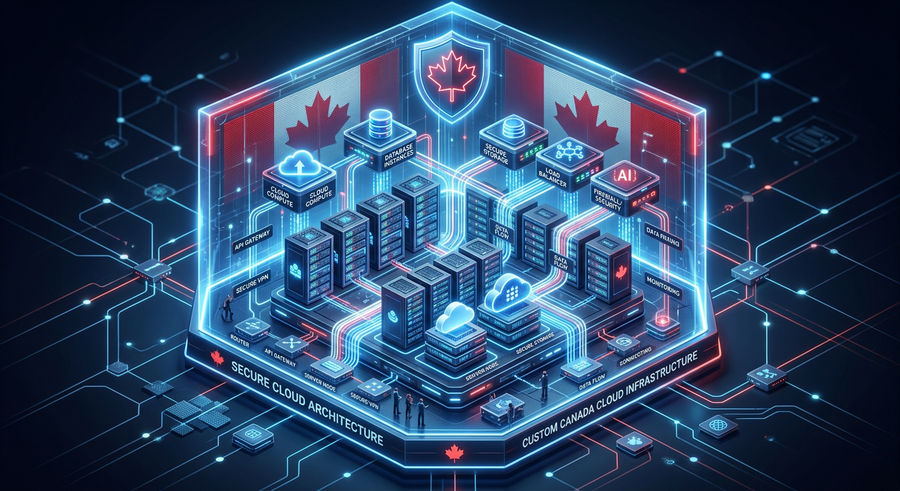
How custom software reduces compliance risk
Custom software does not remove legal obligations. What it does is let you design the system around them.
1. You can choose the right data boundary
With a custom system, you can decide which data must stay in Canada, which data can move, and which workflows need stricter controls. That is much harder when a SaaS vendor forces all tenants into one global operating model.
2. You can separate sensitive and non-sensitive workloads
Many organizations do not need every system component locked into one environment. A better approach is often to segment the architecture so personal information, personal health information, backups, and admin tools get tighter controls than low-risk content or public-facing assets.
3. You can limit hidden cross-border exposure
A common mistake is focusing only on production hosting. Real compliance risk often comes from logging tools, support desks, analytics scripts, CRM syncs, email systems, AI tools, and foreign subcontractors that quietly move data outside Canada.
4. You can document the system for procurement and audits
Enterprises and public-sector teams often need more than a security questionnaire. They need a clear explanation of where data lives, who can access it, which vendors are involved, how backups work, and what happens during support, incident response, and disaster recovery.
5. You can align technical controls with legal language
Contracts may require Canadian hosting, restricted subprocessors, audit support, or named environments. A custom build makes those requirements implementable, because the architecture, deployment model, and access controls can be designed around the actual contract instead of retrofitted later.
This is where our approach matters. As your end-to-end product and engineering partner, we work directly with you through our 100% in-house Canadian team, with no outsourcing, across custom web platforms, SaaS, mobile apps, AI solutions, and business systems. If you are worried about offshore handoffs, fragmented accountability, or unclear vendor chains, our operating model eliminates those risks before a single line of code is written.
Common vendor and cloud mistakes
Organizations usually increase compliance risk when they make one of these mistakes:
Treating “hosted in Canada” as the whole answer, even when support, logging, analytics, or subprocessors operate elsewhere.
Assuming Canada has one universal residency law for all data and all sectors.
Buying generic SaaS before mapping data classes, user roles, retention needs, and procurement obligations.
Forgetting that backup regions, disaster recovery replicas, and admin accounts can create cross-border exposure.
Letting security and legal review happen after vendor selection instead of during solution design.
Choosing a vendor with unclear outsourcing practices or weak documentation.
Failing to distinguish between personal information, personal health information, and operational data.
The safest buying approach is to ask architecture questions before procurement is locked. Where is data stored? Where are backups stored? Who can administer the system? Which tools receive logs? Which subprocessors are involved? What happens during support? If a vendor cannot answer those questions clearly, the risk is already visible.
Why Canadian-hosted software helps procurement and trust
Canadian-hosted software can improve procurement readiness because it reduces friction in security reviews, vendor risk assessments, and stakeholder approvals. Even where it is not strictly required by law, it often helps compliance, IT, legal, and operations teams get comfortable faster with a new system.
It also improves trust with customers, staff, and partners. Organizations increasingly want to know where sensitive information lives, who can access it, and whether the delivery team actually understands Canadian operational expectations.
For many organizations, the best answer is not “buy a Canadian SaaS product.” It is “build a system that fits our workflow, our risk profile, and our procurement reality.” That is especially true when:
The business has unusual approval flows or integrations.
Sensitive records sit across multiple legacy tools.
The organization needs tenant isolation or environment-level control.
Contract terms require specific hosting and support commitments.
Internal teams need direct access to the builders, not a chain of offshore intermediaries.
Quick buying comparison
Option | Best fit | Main limitation |
|---|---|---|
Off-the-shelf global SaaS | Standardized workflows and low-complexity use cases. | Residency, subprocessor, and admin-control limitations can be harder to negotiate. |
Canadian-hosted SaaS | Organizations that want faster procurement with stronger local hosting optics. | You still need to verify support access, backups, vendor chain, and contract terms. |
Custom software with Canadian delivery | Organizations with compliance-sensitive data, complex workflows, or strict procurement needs. | Requires stronger planning up front, but offers the most control over architecture and governance. |
Evaluating vendors for a compliance-sensitive build? Get a free quote
FAQ section
Does Canada have data residency requirements?
Canada does not have one blanket national rule requiring all data to stay in Canada. Residency requirements depend on the sector, the province, the regulator, the contract, the type of data involved, and whether public-sector or health-sector rules apply.
When do Canadian data residency requirements apply?
They typically apply when a public-sector rule, health-data obligation, procurement requirement, contract term, or internal risk policy requires Canadian storage, restricted cross-border disclosure, or tighter administrative controls. In many private-sector cases, the question is not “must it stay in Canada,” but “what controls are required if it does not.”
What counts as personal information in Canada?
In practice, personal information means information about an identifiable individual, directly or indirectly. Context matters, and even data like an email address can become sensitive depending on how it is used, while health, medical, financial, and detailed identity data are generally treated as highly sensitive.
Which Canadian provinces restrict certain public-sector or health data from being stored or accessed outside Canada?
British Columbia is a clear current example for public bodies, because its FOIPPA guidance addresses when personal information may be disclosed outside Canada and when extra assessment is required for storing sensitive personal information outside Canada. Beyond that, organizations should review the specific province, statute, regulator, and data type involved rather than assume one national answer.
What is data residency vs sovereignty?
Data residency is about where data is stored or processed. Data sovereignty is about which legal regimes and jurisdictional risks may still apply to that data, even if it is hosted in Canada.
What are the data retention laws in Canada?
Canada does not have one universal retention period for all business data. Under privacy principles, organizations should not keep personal information longer than necessary for the identified purpose, but actual retention schedules can also depend on sector rules, tax and employment obligations, contracts, records policies, and litigation needs.
What is a Canadian data residency requirement?
A Canadian data residency requirement is a rule, contract term, policy, or procurement condition that requires specific data or systems to be stored, backed up, or administered in Canada. Sometimes it is a hard requirement, and sometimes it is a risk-management or buyer-preference requirement tied to trust and vendor governance.
What is sovereign cloud in Canada?
Sovereign cloud in Canada generally refers to a cloud environment designed to give organizations stronger jurisdictional, operational, and governance control over sensitive workloads. It usually matters most where public-sector, regulated, or high-sensitivity data is involved.
What is the difference between cloud and sovereign cloud?
Cloud is the broad delivery model for computing infrastructure and services. Sovereign cloud is a higher-control version intended to address jurisdiction, data access, governance, and regulatory expectations more directly.
What is the difference between PIPEDA and provincial privacy laws in Canada?
PIPEDA is the federal private-sector privacy framework for commercial activity, centered on fair information principles, appropriate purposes, accountability, and safeguards. Provincial privacy laws can change the analysis depending on where the organization operates and what type of institution or data is involved, which is why Canadian residency questions are never fully answered by one statute alone.
Key takeaways
The best “Canadian data residency software” is rarely just a hosting choice. It is software architecture, vendor governance, documentation, and delivery discipline designed around the actual compliance and procurement reality of the organization.
If your organization needs custom software aligned with Canadian operational expectations, we can help. We offer direct collaboration with a 100% in-house Canadian team and no offshore outsourcing.
Next steps: get free a quote or contact Modall.