

Vibe coding problems don't surface when you're building. They surface when real users, real data, and real traffic hit an app that was never designed to handle any of it. If you used AI tools like Cursor, Replit, or Claude to generate your application, there's a good chance it looks finished. It runs locally. The demo goes well. But production is a different environment with different rules, and vibe coded apps break there in predictable, specific ways.
This isn't a warning to stop using AI for development. It's a guide for founders and operators who already built something and need to understand exactly what's going wrong, why, and what the path forward looks like. Whether you're building your first app or scaling an existing product, understanding these failure modes is the first step toward fixing them.
If your vibe coded app is already in production and showing cracks, our vibe code cleanup and recovery services are built for exactly this situation. Get a free quote on a professional code audit and vibe code recovery plan to take your product from broken to production-ready.
Vibe Coding in 2026: What It Actually Produces
Vibe coding, the practice of using AI to generate entire applications through natural language prompts, produces functional prototypes at an unprecedented speed. The problem is that speed and production readiness are not the same thing. Researchers at Columbia University's DAPLab found that vibe coding typically gets you about 70% of the way to a working application, with the first draft looking polished. But as features get added and real users interact with the product, things start breaking.
The CEO of Cursor, one of the most popular AI coding tools, recently told Fortune that vibe coding builds "shaky foundations" that eventually crumble. That's the creator of the tool itself saying it. When the person selling the shovel warns you about the hole, pay attention.
What AI code generators produce is structurally different from what a senior developer would write. LLMs generate code statistically, not architecturally. They predict the next likely token based on patterns in training data. That means the output often looks correct, follows common patterns, and passes a surface-level review. But it lacks the defensive thinking that keeps software alive in production: error boundaries, input validation, graceful degradation, and security hardening.
CodeRabbit's December 2025 analysis of 470 open-source pull requests confirmed this at scale. AI-generated code produced 1.7x more issues than human-written code, with the gaps widest in exactly the categories that matter for production: logic and correctness errors (1.75x higher), security vulnerabilities (up to 2.74x higher for XSS), and performance inefficiencies that appeared nearly 8x more frequently.
The 8 Ways Vibe Coded Apps Fail in Production
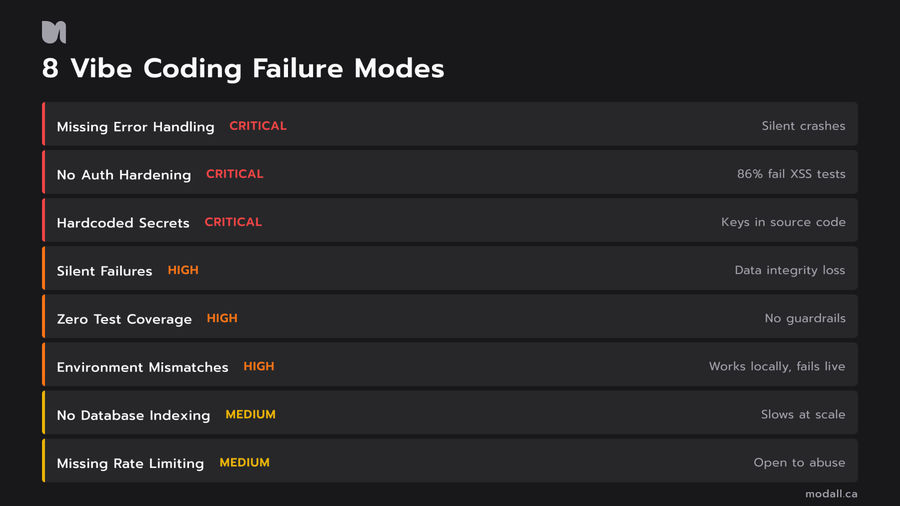
These are the specific failure modes we see when founders bring us applications that were built with AI tools and shipped without professional review. They're predictable, and they're fixable, but each one can take down a production app on its own.
Failure Mode | What Happens | Risk Level |
|---|---|---|
Missing error handling | App crashes silently on unexpected input | Critical |
No auth hardening | User data exposed, unauthorized access | Critical |
Hardcoded secrets | API keys and credentials in source code | Critical |
Silent failures | Features appear to work but don't complete | High |
Zero test coverage | Every change risks breaking something else | High |
Environment mismatches | Works locally, fails in production | High |
No database indexing | Performance degrades as data grows | Medium |
Missing rate limiting | App vulnerable to abuse and DDoS | Medium |
1. Missing Error Handling
AI-generated code routinely skips error boundaries. When an API call fails, a database query returns unexpected data, or a user submits malformed input, the application doesn't handle it. It crashes. Or worse, it silently continues with bad data. The DAPLab research at Columbia identified error handling as the most serious and common failure mode in vibe coded applications because these failures are often silent: the code runs without visible errors, but the app doesn't do what the user asked.
2. No Auth Hardening
LLMs generate authentication flows that work for the happy path. A user signs up, logs in, and accesses their data. But they rarely implement the defensive layers: session expiration, token rotation, role-based access control, or protection against common attack vectors like session hijacking. A Veracode study testing 100+ AI models found that 86% of AI-generated code samples failed to defend against cross-site scripting, and 88% were vulnerable to log injection attacks.
3. Hardcoded Secrets
API keys, database credentials, third-party service tokens: AI tools regularly embed these directly in source code. If that code is pushed to a public repository, or even a private one with broad team access, those secrets are exposed. According to Snyk's research, nearly 80% of developers admitted to bypassing security policies when using AI coding tools, and only 10% scan most of the AI-generated code they ship.
4. Silent Failures
This is the failure mode that founders miss entirely. The app looks like it works. The UI updates. The user sees a confirmation. But behind the scenes, the database write failed, the webhook didn't fire, or the payment processing call returned an error that was swallowed without logging. These failures compound over time and create data integrity issues that are expensive to untangle.
5. Zero Test Coverage
Vibe coded apps almost never include automated tests. AI tools generate the feature, not the safety net around it. This means every subsequent change, whether made by AI or a human developer, has no guardrails. A fix in one area can break three others, and nobody finds out until a customer reports it. This is especially dangerous for mobile applications where app store review processes add days of delay to every bug fix.
6. Environment Mismatches
The app runs perfectly on your machine. It crashes in production. This happens because AI-generated code often hardcodes local paths, uses development-only configurations, or makes assumptions about server environments that don't hold in deployment. Database connections, file system access, environment variables, and service URLs all behave differently in production.
7. No Database Indexing
AI-generated database queries work fine with 100 rows of test data. With 10,000 or 100,000 rows, the same queries slow to a crawl. LLMs rarely add database indexes because the performance impact isn't visible during development. Once real data accumulates, page load times spike, API responses time out, and the application becomes unusable.
8. Missing Rate Limiting
Without rate limiting, your API endpoints are open to abuse. A single bad actor, or even an overzealous user, can flood your server with requests and take the application down. AI-generated code almost never implements throttling, request quotas, or IP-based blocking because these aren't part of the "make it work" prompt.
According to CodeRabbit's analysis of 470 open-source pull requests, AI-generated code creates 1.7x more issues overall, with security vulnerabilities up to 2.74x higher and performance inefficiencies appearing nearly 8x more often than in human-written code.
Why These Problems Stay Hidden Until Launch Day
The core issue is that vibe coding optimizes for the demo, not for production. AI tools are trained to produce code that works under ideal conditions: clean inputs, single users, local environments, and small datasets. Production is the opposite of all of those things.
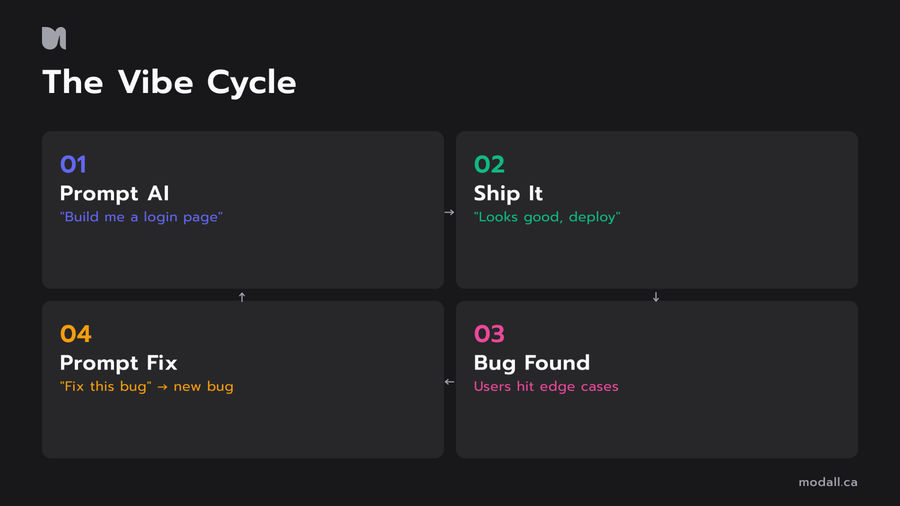
There's also what developers call the "vibe cycle." You prompt the AI to build a feature. It works. You find a bug and prompt the AI to fix it. The fix introduces a new bug somewhere else. You prompt the AI to fix that one. As The New Stack reported, security experts warn that this cycle of unreviewed AI code in production could cause catastrophic failures as more vibe coded apps hit real users in 2026.
The Stack Overflow Blog described the fundamental gap: vibe coding without code knowledge means building applications without the ability to evaluate what you've built. It's like constructing a building by describing rooms to someone who's never seen a blueprint. The rooms exist, but nobody checked whether the load-bearing walls are in the right places.
The Real Cost of Fixing Vibe Coded Software
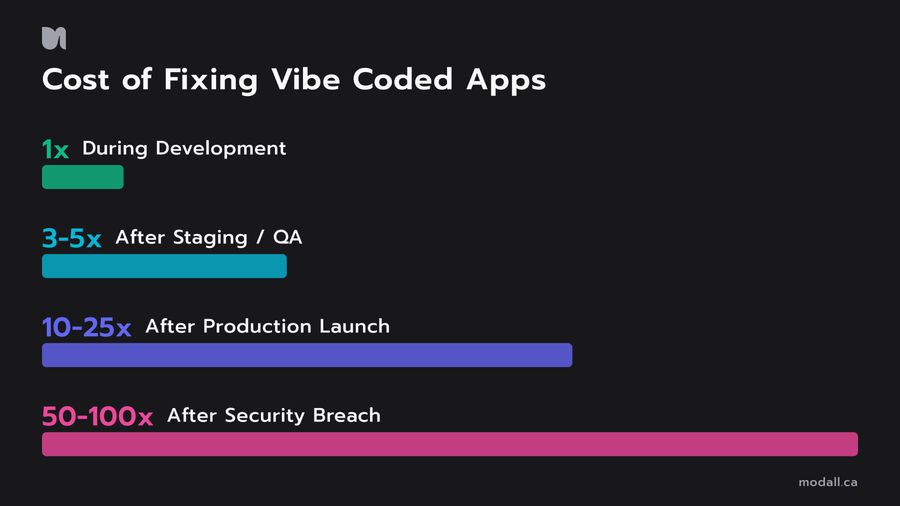
Remediating a vibe coded application after it's in production costs significantly more than building it correctly from the start. The longer these failure modes persist, the more expensive they become.
When You Fix It | Relative Cost | What's Involved |
|---|---|---|
During development | 1x | Code review, refactoring |
After staging/QA | 3-5x | Regression testing, architecture changes |
After production launch | 10-25x | Data recovery, security patches, downtime |
After a security breach | 50-100x | Legal, compliance, customer notification |
These aren't theoretical numbers. Between December 2025 and March 2026, Amazon experienced at least four Sev-1 production incidents following its AI-assisted development mandate, including a 6-hour outage with an estimated 6.3 million lost orders. That's an enterprise with thousands of engineers and established review processes. For a startup or mid-size company shipping a vibe coded app without any review layer, the risk is proportionally higher.
Amazon experienced at least four Sev-1 production incidents in 90 days following its AI-assisted development mandate, including an outage that cost an estimated 6.3 million lost orders.
Forbes reported that a December 2025 CodeRabbit study found security vulnerabilities were up to 2.74 times more common in AI-generated code, with logic and correctness issues appearing 75% more frequently. For applications handling customer data, financial transactions, or healthcare information, a single unpatched vulnerability can trigger regulatory penalties, breach notification costs, and permanent reputation damage. This is why understanding your SaaS business model and its compliance requirements matters before you ship.
How to Find These Issues Before Your Users Do
You don't need to be a developer to catch most of these problems. You need to know what to look for and which tools to point at your codebase. Here's a practical checklist mapped to each failure mode.

1. Run a Security Scan
Tools like Snyk, Semgrep, or GitHub's built-in code scanning can flag hardcoded secrets, authentication gaps, and common vulnerabilities in minutes. This catches the three critical failure modes (missing auth hardening, hardcoded secrets, and missing rate limiting) before a real attacker does. If your repository is on GitHub, enable Dependabot and secret scanning today. It's free.
2. Add Error Monitoring Before You Need It
Services like Sentry, LogRocket, or Datadog catch silent crashes and unhandled exceptions in real time. Without monitoring, the only way you find out about missing error handling and silent failures is when a customer tells you. Install monitoring on day one, not after the first support ticket.
3. Load Test with Real Data Volumes
Spin up a dataset that's 10x or 100x your current size and watch what happens. If your app slows to a crawl, you've found your missing database indexes and unoptimized queries. Tools like k6 or Artillery can simulate concurrent users hitting your API endpoints, exposing the rate limiting gaps that won't show up with a single tester clicking through the UI.
4. Set Up a Staging Environment That Mirrors Production
Environment mismatches only surface when there's a real difference between where you develop and where you deploy. Your staging environment should use the same database engine, the same environment variable structure, and the same hosting configuration as production. If it works in staging and breaks in production, your staging environment is lying to you.
5. Write Tests for the Critical Paths First
You don't need 100% test coverage on day one. Start with the flows that handle money, authentication, and user data. If your payment processing, login, and data export features have automated tests, you've covered the highest-risk surface area. Every change you make going forward has a safety net where it matters most.
6. Audit Your Codebase with a Fresh Set of Eyes
The most effective check is the simplest: have someone who didn't write the code read it. AI-generated code is especially prone to patterns that look correct but aren't, because LLMs optimize for plausibility, not correctness. A senior developer reviewing the critical sections of your application for two to four hours can identify more issues than weeks of automated scanning alone.
If this checklist feels overwhelming, that's normal. Most founders didn't plan to become their own QA department. That's where a structured vibe code recovery engagement makes sense.
How We Approach Vibe Code Recovery at Modall
At Modall, we're a custom software development agency based in Ontario, Canada, founded in 2019. We've seen a growing number of founders come to us with applications that were vibe coded to a working prototype and now need professional engineering to become production-grade products.
Our vibe code cleanup and recovery process follows a structured approach:
Strategic refactoring and decoupling. We audit the existing codebase to identify tightly coupled components, circular dependencies, and architectural patterns that won't scale. Then we refactor incrementally, preserving the features that work while rebuilding the foundation underneath them.
Full security audit and vulnerability patching. Every authentication flow, data access pattern, and API endpoint gets reviewed against OWASP standards. We patch the critical vulnerabilities first, then systematically harden the rest.
Performance optimization and scalable architecture. Database indexing, query optimization, caching strategies, and infrastructure configuration to ensure the application performs under real load, not just demo conditions.
Code cleanup, standardization, and dependency fixes. We bring the codebase to a maintainable state: consistent patterns, proper error handling, automated test coverage, and secure dependency management.

The goal isn't to throw away what you've built. It's to take the 70% that works and close the gap to a production-ready application that your team can maintain and scale. Book a free consultation to get a clear picture of where your vibe coded app stands and what it takes to get it to production quality.
Frequently Asked Questions
What are the biggest vibe coding problems in production?
The most critical vibe coding problems in production are missing error handling, no authentication hardening, and hardcoded secrets. These three failure modes can each independently take down an application or expose user data. Columbia University's DAPLab research confirmed that error handling and business logic failures are the most common and most dangerous because they're often silent: the app appears to run correctly while producing incorrect results.
Why do vibe coded apps fail after working fine in development?
Vibe coded apps fail in production because AI tools generate code optimized for ideal conditions: clean inputs, single users, and small datasets. Production introduces concurrent users, malformed inputs, network failures, and data volumes that expose every missing error boundary and unoptimized query. The environment itself is fundamentally different, with different database connections, server configurations, and security requirements that development environments don't replicate.
Is it cheaper to fix a vibe coded app or rebuild from scratch?
In most cases, remediation is cheaper and faster than a full rebuild. The features, user flows, and business logic already exist; they just need professional engineering underneath them. At Modall, we typically scope remediation as a structured engagement, starting with a discovery process that maps exactly what needs to change. Full rebuilds are only necessary when the architecture is so fundamentally broken that patching it would cost more than starting fresh.
Is vibe coding declining in 2026?
Vibe coding adoption peaked around mid-2025, and the conversation has shifted from "this replaces developers" to "this needs professional oversight." The tools themselves are getting better, but the gap between a working prototype and a production application hasn't closed. What's changing is that more founders and teams understand that gap now, and they're building review and remediation processes around AI-generated code instead of shipping it directly.
Your Vibe Coded App Isn't Broken Beyond Repair
The vibe coding problems outlined here are serious, but they're not death sentences. Every one of these failure modes has a known fix and a proven remediation path. The question isn't whether your vibe coded app has these issues; statistically, it almost certainly does. The question is whether you find and fix them before your users do.
The smartest path forward is an honest assessment of where your application stands today, followed by a structured plan to close the gaps. That's exactly what we do at Modall. Get a free quote on a code audit and remediation plan for your vibe coded application.