

Co-founder matching platforms solve one expensive problem: most founders with an idea cannot build it themselves, and the wrong technical partner can sink a company faster than a bad market. Harvard Business School research found that 65% of high-potential startups fail because of conflict between co-founders, not because the product flopped. That makes where, and how, you look for a technical co-founder one of the highest-stakes decisions you make before writing a single line of code.
This guide ranks the nine best co-founder matching platforms in 2026, compares cost and format side by side, and covers the option most lists ignore: when hiring a proven development team beats finding a co-founder at all.
How these platforms were ranked: match quality and network size, cost, the strength of profile verification (how much you can trust who you are talking to), format (algorithmic matching, community, or accelerator), and track record.
Looking for a development team that works with first-time founders? Reach out to Modall for a free quote to see if we're the right fit for your project.
The 9 Best Co-Founder Matching Platforms at a Glance
Rank | Platform | Best for | Cost | Format |
|---|---|---|---|---|
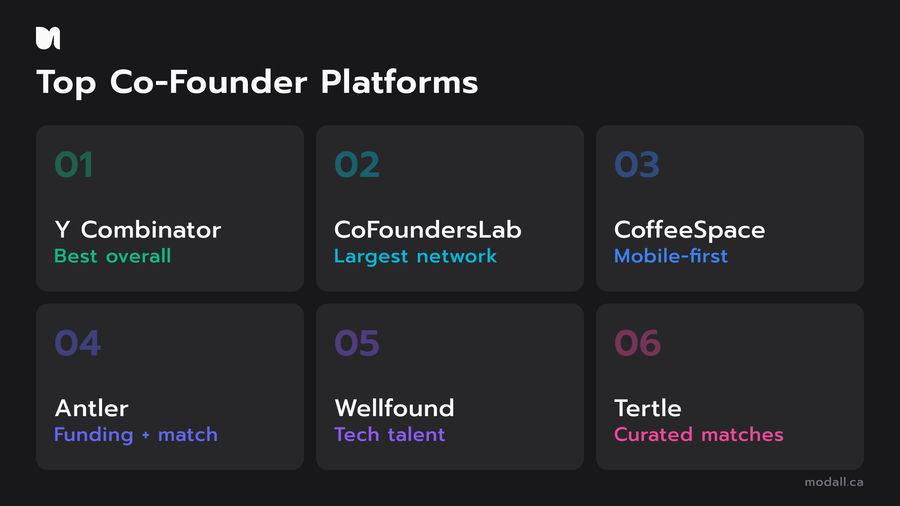
1 | Y Combinator Co-Founder Matching | Most founders, highest match volume | Free | Algorithmic |
2 | CoFoundersLab | The largest dedicated network | Freemium | Algorithmic |
3 | CoffeeSpace | A modern, mobile-first search | Freemium | Swipe + algorithm |
4 | Antler | Funding and a matched co-founder together | Equity-based | Accelerator / residency |
5 | Wellfound | Technical talent open to equity roles | Free | Hiring marketplace |
6 | Tertle | Curated weekly introductions | Freemium | Curated / algorithmic |
7 | Indie Hackers | Bootstrappers and solo builders | Free | Community |
8 | StartHawk | A simple, focused matcher | Freemium | Algorithmic |
9 | Reddit r/cofounder | Free, direct outreach | Free | Community |
The 9 Best Co-Founder Matching Platforms in 2026
1. Y Combinator Co-Founder Matching
Best for: the widest pool of serious, vetted founders, at no cost.
Y Combinator's Co-Founder Matching is the strongest starting point for most founders, and it is completely free. The platform has facilitated more than 100,000 introductions, more match volume than any other dedicated service, and its algorithm pairs founders on skills, work style, values, and long-term goals rather than skills alone. Anyone can use it, whether the idea is fully formed or still an exploration.
The trade-off is that high volume rewards effort. The median time from joining to matching with an eventual co-founder is around 100 days, and the founders who succeed are the ones who message proactively and run short, time-boxed trial projects before committing. There is no equity requirement and no obligation, which makes it the default first stop in 2026.
2. CoFoundersLab
Best for: reaching the largest dedicated co-founder network.
CoFoundersLab is the biggest matchmaking service built specifically for co-founders, with more than 650,000 registered members worldwide. Its algorithm recommends matches by complementary skills, location, and industry focus, and the community has been running long enough to have deep coverage across non-technical and technical profiles alike.
Scale is both the strength and the catch. The free tier lets you create a profile and browse, but serious searching usually needs a premium subscription for unlimited messaging, advanced filtering, and networking features. Expect more noise than on a curated platform, and plan to vet hard, but few places put as many candidates in front of you.
3. CoffeeSpace
Best for: founders who want a modern, mobile-first experience.
CoffeeSpace is the best option for founders who want co-founder matching to feel like a well-built consumer app. Designed mobile-first with a Hinge-style interface, it serves daily personalized recommendations and uses thoughtful prompts that surface personality traits and working styles before you ever message someone. Granular filters let you sort by expertise, industry, and commitment level.
The platform connects more than 10,000 founders across 100-plus countries and is venture-backed, with TechCrunch covering its launch as a "Hinge-like app" for co-founders. For the under-35 builder crowd, the signal-to-noise ratio tends to beat older directory-style sites.
4. Antler
Best for: founders who want funding and a co-founder from the same program.
Antler is the right choice when you want more than an introduction. It is a global early-stage VC and residency that builds companies from scratch, running structured sessions to match technical and commercial founders, then investing in the teams that form. The residency typically lasts ten to twelve weeks, and teams that clear the investment committee raise pre-seed capital, commonly in the range of $100,000 to $150,000 for roughly 10 to 12 percent equity.
This is not a casual browse. Antler is highly selective, accepting a small fraction of applicants, and the program is a full-time commitment. But for a founder who has skills and drive yet no team and no capital, it compresses co-founder matching, validation, and a first cheque into one structured path. Founders weighing this route should also look at broader startup incubators and accelerators to compare terms.
5. Wellfound
Best for: finding technical talent who would consider a co-founder or founding-engineer role.
Wellfound, formerly AngelList Talent, is the largest startup hiring marketplace, with more than 5 million candidates and over 35,000 companies. It is not a pure co-founder matcher, but that is the point: many strong engineers on Wellfound are open to founding-engineer or co-founder roles when the equity is right, and you reach them inside a platform built for startup hiring.
Use it when you would accept a founding engineer who earns equity through contribution rather than a 50/50 partner you met cold. The candidate quality skews technical and startup-minded, which is exactly the profile most idea-stage founders are missing. The flip side is that you are competing with funded companies offering salaries, so your pitch and your equity story have to be sharp.
6. Tertle
Best for: founders who want curated introductions instead of endless swiping.
Tertle is built for quality over volume. Applicants create a detailed profile, get accepted into a vetted community, then receive weekly curated matches based on their stated preferences. The platform adds practical tooling that most matchers lack: a meeting scheduler, pre-written introduction templates, and a dashboard to track conversations with ratings and personal notes.
The result is a smaller, more deliberate pipeline. If sorting through hundreds of mismatched profiles drains you, a short weekly shortlist of relevant candidates is a far better use of time. Tertle works best as a focused complement to a high-volume platform rather than a sole source.
7. Indie Hackers
Best for: bootstrappers and solo builders who want a co-founder without VC pressure.
Indie Hackers is the best fit for founders building profitable online businesses rather than venture-scale moonshots. It is a community first, not an algorithm, with active forums, "looking for a co-founder" threads, and a culture centered on shipping and sharing revenue numbers. Matches happen through participation: you build reputation by posting, helping, and showing traction.
That community model is a feature for the right founder. The people you meet have usually shipped something, and shared values around bootstrapping reduce the chance of the strategic conflict that kills so many partnerships. It rewards founders who are willing to be visible and contribute before they ask.
8. StartHawk
Best for: a clean, focused co-founder search to run alongside a larger platform.
StartHawk is a purpose-built co-founder platform with a matching algorithm, an intuitive messaging system, and filters to narrow down the type of partner you want. The community is smaller than the market leaders, so it works best as a supplement rather than your only channel, but the experience is simple and free of the clutter that builds up on older directories.
For founders who want to widen their net without learning another sprawling interface, StartHawk is a low-friction addition. Set up a profile, run your filters, and treat any matches as a bonus on top of your primary search.
9. Reddit r/cofounder
Best for: free, direct outreach with zero gatekeeping.
The r/cofounder subreddit is the most no-frills option on this list, and that is its appeal. Founders post co-founder-wanted ads, respond to others, and start conversations within hours, all for free. There is no matching algorithm and no profile verification, so the quality varies widely and you do the filtering yourself.
Treat it as a fast, zero-cost supplement to a structured platform. The lack of verification means you should vet anyone you meet carefully, but for getting your search in front of motivated builders quickly, few channels move faster or cost less.
How to Choose the Best Co-Founder Matching Platform
The best co-founder matching platform is the one that fits your stage, your budget, and how much risk you are willing to take on a stranger. Weigh these factors before you commit time to any single site.
Match quality versus volume. Big networks like CoFoundersLab and Wellfound put more candidates in front of you, but curated platforms like Tertle and selective programs like Antler trade volume for fit. If your time is the constraint, lean curated.
Cost and equity. Most platforms are free or freemium. The real cost is equity. A co-founder is not a line item; they own a permanent slice of the company, often 30 to 50 percent. Price that against the alternative before you decide a partner is the only way forward.
Verification and signal. YC and Antler attract serious, often vetted founders. Open communities like Reddit and Indie Hackers offer reach with little verification. The less a platform verifies, the more diligence falls on you.
Format fit. Decide whether you want an algorithm (YC, CoFoundersLab, CoffeeSpace, StartHawk), a community (Indie Hackers, Reddit), or an accelerator that matches and funds (Antler). Each suits a different kind of founder.
Whether you need a co-founder at all. This is the question most founders skip. If your goal is a built, launched product and you have some capital, a co-founder is not the only path, and it may not be the best one.
When Hiring a Dev Team Beats Finding a Technical Co-Founder
If you have funding or early revenue and a clear product spec, hiring a development team is often faster, cheaper over the life of the company, and lower-risk than giving away a third of your equity to a co-founder you met online.
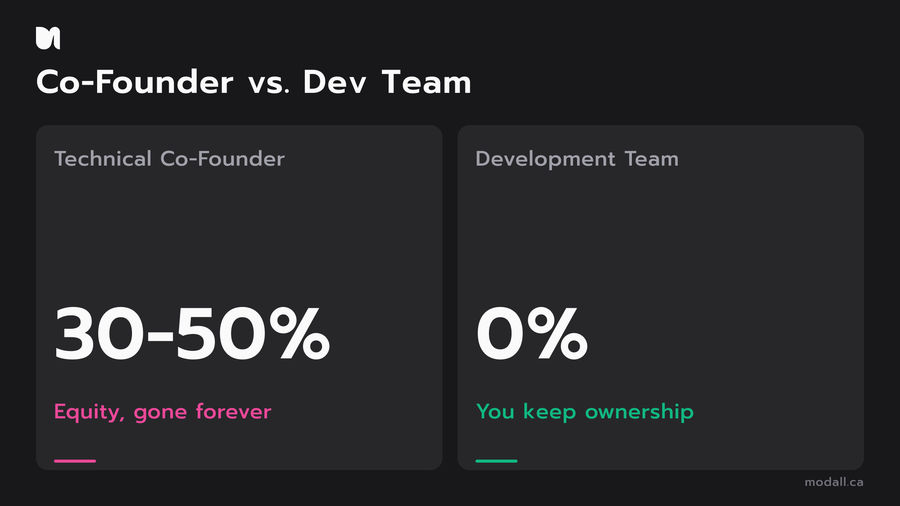
The math is straightforward once you separate the two costs. A technical co-founder is paid in equity, forever, and carries the conflict risk behind that 65% failure statistic. A development team is paid in cash now, and you keep full ownership and control. For many founders, the search itself is the hidden cost: the median co-founder match takes around 100 days, and that is before you discover whether you can actually work together. According to CB Insights research on why startups fail, poor product-market fit is a leading root cause, cited in 43% of shutdowns, and that is solved by shipping and testing a product quickly, not by spending three months interviewing potential partners.

This is where a development company like Modall fits. Modall is a custom software development company in Toronto, Ontario, with a fully in-house Canadian team and no outsourcing. It builds the exact products founders typically go looking for a technical co-founder to build: SaaS platforms, mobile apps, web3 and financial platforms, and AI-integrated products, using React, Next.js, React Native, Node.js, PostgreSQL, and Prisma. Our company holds a 5.0 rating on Google & Clutch, and works with clients ranging from pre-launch startups to SMBs and professional athletes.
The engagement model is built for founders who need to move. A structured development process, and a sprint-based model scales the work up or down month to month, so you are not locked into a permanent equity split to get a product shipped. Founders deciding what to build first should start with the difference between a proof of concept, a prototype, and an MVP, then weigh a partner against a team by reading how the best custom software development companies actually work.
You can check out real examples in our case studies, and if you think we may be a good fit, reach out for a free quote.
None of this means a co-founder is the wrong call. If you need a long-term partner to share the company-building load and you have no capital, the platforms above are the right tools. But if what you actually need is a product in market and have some capital, hiring is can be the smarter first move.
Frequently Asked Questions
What is the best co-founder matching platform?
For most founders, Y Combinator Co-Founder Matching is the best platform because it is free, has the largest pool of serious founders, and has driven more than 100,000 introductions. CoFoundersLab is the strongest choice for sheer network size, and CoffeeSpace is best for a modern, mobile-first experience. Founders who already have funding often skip the search entirely and hire a development team instead, so they can launch without giving away equity.
Are co-founder matching platforms free?
Many are. Y Combinator Co-Founder Matching, Wellfound, Indie Hackers, and Reddit r/cofounder are free to use. CoFoundersLab, CoffeeSpace, Tertle, and StartHawk run freemium models where a subscription unlocks unlimited messaging and advanced matching. Antler is different: it takes equity in exchange for funding rather than charging a fee.
How long does it take to find a co-founder?
There is no fixed timeline, but the data gives a useful benchmark. On Y Combinator's platform, the median time between joining and matching with an eventual co-founder is about 100 days. Some founders connect within days; others take many months. The pace depends on how clear your vision is and how proactively you reach out.
Do co-founder matching platforms actually work?
Yes, for founders who treat them as the start of a vetting process rather than a guaranteed match. The platforms reliably produce introductions; the harder part is compatibility. Because conflict between co-founders sinks a majority of high-potential startups, the founders who succeed run short trial projects together before committing and align on equity, roles, and vision early.
Is it better to find a technical co-founder or hire a developer?
It depends on capital and stage. A technical co-founder makes sense when you have no funding and need a committed long-term partner to build and run the technology. Hiring a development team makes sense when you have some capital and a clear spec, because you keep your equity and control while still getting a built product. Many founders hire to launch, prove demand, and only then bring on a technical partner from a position of strength.
How much equity does a technical co-founder get?
Technical co-founders typically receive a large equity stake, often between 30 and 50 percent for an equal early partner, with the exact split depending on timing, contribution, and whether they join before or after traction. That permanent cost is the main reason founders with capital compare a co-founder against hiring a team, where the cost is cash rather than ownership.
The Bottom Line
The best co-founder matching platforms in 2026 give idea-stage founders real ways to find a technical partner, from Y Combinator's free, high-volume matching to Antler's funded residency and CoffeeSpace's modern app. Pick the one that fits your stage and how much equity you are prepared to trade. And if what you really need is a launched product rather than a permanent partner, hiring a proven team is often the faster, lower-risk path. Our team at Modall works with many first-time founders and if you want to learn more, reach out for free quote today!