

Proof of concept vs prototype vs MVP comes down to one question each: can we build it, how should it look, and do people actually want it? A proof of concept tests technical feasibility. A prototype tests the design and flow. A minimum viable product tests real market demand with a working product in users' hands.
Confusing the three is one of the most expensive mistakes an early team makes. Spend four months and six figures building an MVP when a two-week proof of concept would have answered your real question, and you have not validated anything. You have just bought an expensive way to learn what a cheap experiment would have told you first.
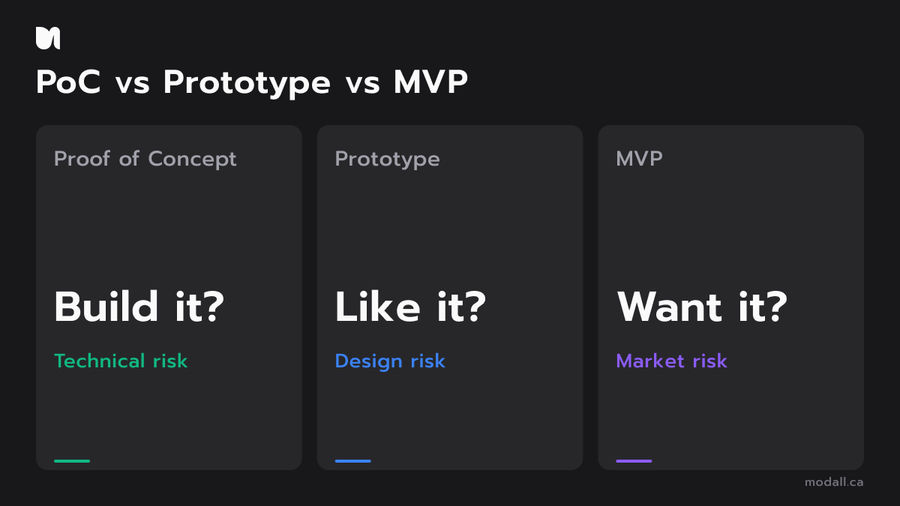
Proof of concept vs prototype vs MVP: the short answer
A PoC proves an idea is technically possible, a prototype shows how the product will look and behave, and an MVP is a launched product that tests whether the market wants it. They are not interchangeable, and they are not competing options. Each removes a different kind of risk, and most products move through them in sequence.
Here is the full comparison in one view.
Proof of Concept (PoC) | Prototype | Minimum Viable Product (MVP) | |
|---|---|---|---|
Question it answers | Can we build it? | How will it look and work? | Do people actually want it? |
What it is | A small technical test of one risky assumption | A clickable, designed model of the experience | A functional, launched product with only the core features |
Who sees it | Your internal and technical team | Investors, internal teams, a few target users | Real customers and early adopters |
Main output | A yes or no answer on feasibility | An interactive design to align and pitch | Usage data, feedback, and first revenue |
Typical timeline | Days to two weeks | One to three weeks | Two to four months |
Typical cost | Internal time to roughly $10k | Roughly $5k to $20k | Roughly $30k to $150k+ |
Risk it removes | Technical risk | Design and usability risk | Market risk |
The rest of this guide breaks down each stage, shows the order they belong in, and helps you decide which one your product actually needs right now.
What is a proof of concept?
A proof of concept is a small, focused test that answers one question: is this idea technically feasible? It is not a product. It is an experiment, often a script, a backend test, or a rough integration, built to prove that the hardest technical part of your idea can actually work before you invest in building the rest.
TechTarget defines a proof of concept as a demonstration focused on determining whether an idea can be turned into reality, testing feasibility and viability rather than building the finished thing. The audience is internal. A PoC is usually seen by your engineers and technical stakeholders, not by customers or investors.
You need a PoC when your idea depends on something unproven: a novel machine learning model hitting an accuracy threshold, a tricky third-party integration, real-time performance at scale, or hardware talking to software. A fintech team might build a PoC to confirm a bank's API can support the transaction flow they have in mind. An AI startup might run one to check whether a model can summarize medical records accurately enough to be useful. Get a no, and you have saved yourself months. Get a yes, and you move forward with confidence.
A proof of concept is usually quick and cheap. Most take a few days to two weeks, and the code is often thrown away once it has answered the question.
What is a prototype?
A prototype is an interactive model of your product that shows how it will look and flow, without the working engineering underneath. It answers a design question, not a feasibility or a market one: is this the right experience? The Interaction Design Foundation describes prototyping as building scaled-down or simulated versions of a product to test ideas and gather feedback before committing to full development.
Prototypes range in fidelity. A low-fidelity prototype can be a paper sketch or a basic wireframe. A high-fidelity prototype is a clickable Figma model that looks and behaves like the real app, so a user can tap through screens and you can watch where they get stuck. Most teams use the high-fidelity version to pitch investors, align internal stakeholders, and run early usability tests.
What a prototype does not do is process real data or serve real users. Nothing behind the screens is functional. That is the point: you learn whether the design works before paying to build the backend. A clickable prototype typically takes one to three weeks and is far cheaper than engineering a live product.
What is a minimum viable product (MVP)?
An MVP is a real, working product with only the core features needed to launch, released to real users so you can learn whether the market actually wants it. Unlike a PoC or a prototype, an MVP is live. People use it, and ideally pay for it. Eric Ries, who popularized the term, defines an MVP as the version of a product that lets a team collect the maximum amount of validated learning about customers with the least effort.
The concept was coined in 2001 by Frank Robinson and popularized by Steve Blank and Eric Ries through the lean startup movement. The goal is to test your core business hypothesis with the smallest functional product you can ship, then iterate based on what real usage tells you. Atlassian frames the MVP as having just enough features to satisfy early customers and provide feedback for future development.
The famous examples were all MVPs, not prototypes. Airbnb started as a barebones site renting out air mattresses in the founders' apartment. Zappos began with photos of shoes from local stores to see if people would buy footwear online before holding any inventory. Each tested demand with a real, if minimal, product. An MVP usually takes two to four months to build and is the most involved of the three. For a full breakdown of scope and budget, see our guide to MVP development for startups, or explore our MVP development services.
The real difference: which risk are you reducing?
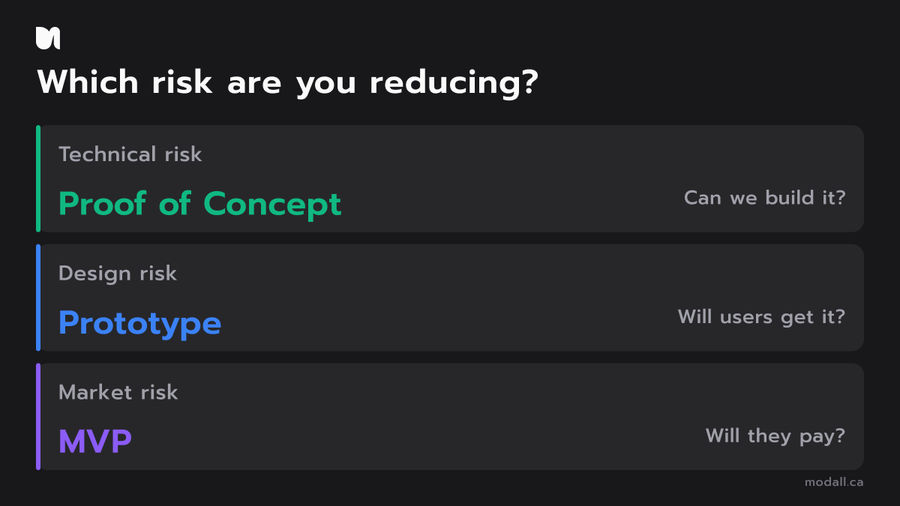
The cleanest way to tell these three apart is to ask which risk is keeping you up at night. Each artifact exists to kill a specific kind of uncertainty, and naming yours points you straight to the right one.
Technical risk lives in a proof of concept. You are not sure the thing can be built at all. The PoC answers it.
Design and usability risk lives in a prototype. You know it can be built; you are not sure people will understand or enjoy using it.
Market risk lives in an MVP. You know it works and looks right; you are not sure anyone will pay for it.
You will sometimes hear a fourth term, the pilot, which is a limited release of a near-finished product to a controlled group. That comes later, once an MVP has already proven demand. For most early teams, the three that matter are the PoC, the prototype, and the MVP.
Which comes first, a PoC, a prototype, or an MVP?
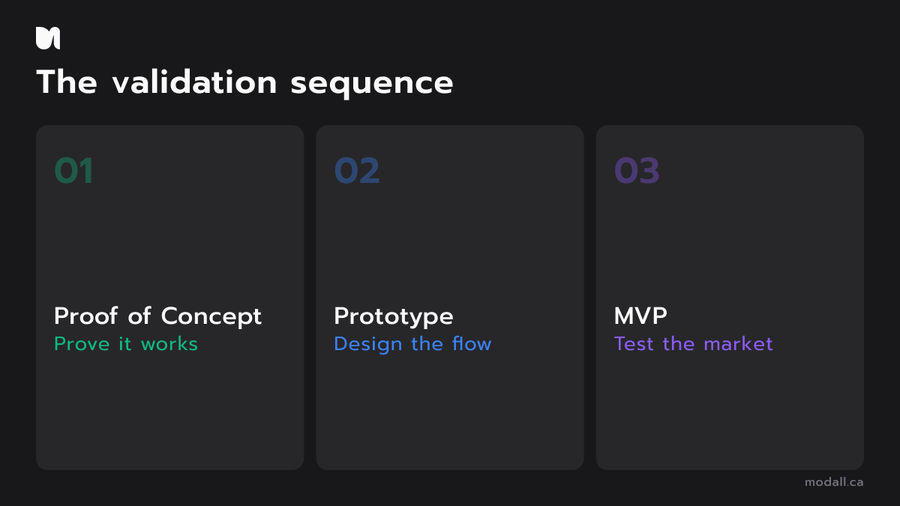
The usual order is proof of concept first, then prototype, then MVP, but you skip any stage whose risk you do not have. In practice, a minimum viable product comes after a successful proof of concept, with the prototype bridging the two by defining the experience before any engineering begins.
Think of it as a funnel that removes risk in order. The PoC clears technical doubt. The prototype clears design doubt. The MVP clears market doubt and starts generating real data. Move through them in sequence and each stage de-risks the next, so you never build on an assumption you have not checked.
Most products do not need all three. If your idea uses well-understood technology, like a standard web app or a CRUD-style SaaS tool, you can skip the PoC entirely; feasibility is not in question. If your design direction is obvious or already validated, you might go straight from a quick wireframe to an MVP. The sequence is a guide, not a tax. Build only the stages that answer a question you genuinely cannot answer yet.
Which one does your startup actually need?
Pick the stage that matches your biggest open question, then build the smallest version that answers it. Here is how that maps in practice:
Choose a PoC when the core of your idea is technically unproven: a new AI capability, a complex integration, or performance most teams have not cracked.
Choose a prototype when you need to raise money, align a team, or test a user flow, and the engineering is not the risky part.
Choose an MVP when feasibility and design are settled and the only real question left is whether the market will pay.
The expensive errors come from skipping the wrong stage. Founders who build a full MVP before running a two-week PoC can sink months into a product whose core never worked. Teams that over-polish a prototype for months mistake a pretty design for proof that anyone wants it; a prototype cannot generate revenue or retention data, so it cannot validate a market. And shipping a raw proof of concept as if it were a launched product puts throwaway code in front of paying users, which is one reason so many rushed builds break in production.
The stakes are real. CB Insights, analyzing post-mortems from 400+ failed startups, found that poor product-market fit was a top root cause in 43% of shutdowns, while running out of capital was the final blow 70% of the time. Building the wrong artifact at the wrong time is how teams burn the capital they needed to find that fit. Validating in the right order is how you protect it. If you are weighing partners for this work, our guide on how to choose an MVP development company walks through the vetting questions that matter.
How we approach PoC, prototype, and MVP at Modall
We treat these three as one continuous path, not three disconnected projects. Modall is a custom software development company in Toronto, Ontario, founded in 2019, and we build products from first validation to launched MVP with a single in-house team. No handoffs to an offshore shop between stages, and no re-staffing every time the work changes shape.
That continuity is the practical advantage. The engineer who runs your proof of concept is on the team that designs your prototype and ships your MVP, so the technical learnings carry forward instead of getting lost in translation. We build on a modern, scalable stack, TypeScript, React, Next.js, React Native, Node.js, Prisma, and PostgreSQL, so the MVP you launch is architected to grow rather than be rebuilt at your first thousand users.
We have done this across very different products. Sceene, a nightlife discovery app founded by an NFL athlete, shipped as a polished cross-platform MVP on React Native. Vault Club, a private golf networking app, went from concept to launched iOS product. Endorsa, a review automation platform we built in-house, started as a focused MVP and grew from there. Others, each began with the same question: what is the smallest thing we can build to learn the most? If you want a partner who can take you from a risky assumption to a launched product without changing teams, book a free consultation.
Frequently asked questions
Is an MVP the same as a proof of concept?
No. A proof of concept is an internal test of whether an idea is technically feasible, and it is usually discarded once it answers that question. An MVP is a real, launched product that tests whether the market wants what you built. A PoC answers "can we build it"; an MVP answers "should we, and will people pay."
Which comes first, a PoC or an MVP?
The proof of concept comes first. You confirm the idea is technically possible with a PoC, often move through a prototype to settle the design, and only then build an MVP to test market demand. Building an MVP before validating feasibility is a common and costly mistake.
Is a prototype the same as an MVP?
No. A prototype is a clickable design model with nothing functional behind it; it shows how the product will look and flow. An MVP is a working product that real users can actually use. A prototype cannot generate revenue or real usage data, which is exactly what an MVP exists to capture.
What are the four types of prototypes?
Prototypes are commonly grouped by fidelity and purpose: low-fidelity (paper sketches or basic wireframes), high-fidelity (clickable, realistic designs in a tool like Figma), feasibility prototypes (testing a technical approach), and role or experience prototypes (testing how a product fits into a user's workflow). Most startups use a high-fidelity clickable prototype to pitch and test.
Do I need all three before launching?
No. You only build the stages that answer a question you cannot already answer. If your technology is well understood, skip the PoC. If your design is validated, move quickly to the MVP. The sequence is a risk-reduction tool, not a required checklist.
How much does each one cost?
A proof of concept often costs from internal engineering time up to around $10,000. A clickable prototype typically runs $5,000 to $20,000. A minimum viable product usually starts around $30,000 and rises with complexity. See our full custom software cost breakdown for detail.
Start with your riskiest assumption
The choice in proof of concept vs prototype vs MVP is not about which one is best. It is about which question you most need answered right now. Name your biggest unknown, whether it is technical, design, or market, and build the smallest thing that resolves it. Then move to the next stage with real evidence instead of a guess.
That discipline is the difference between a product that learns its way to traction and one that runs out of money proving nothing. If you would rather not navigate it alone, get a free quote from our team and we will help you figure out exactly what to build first.