

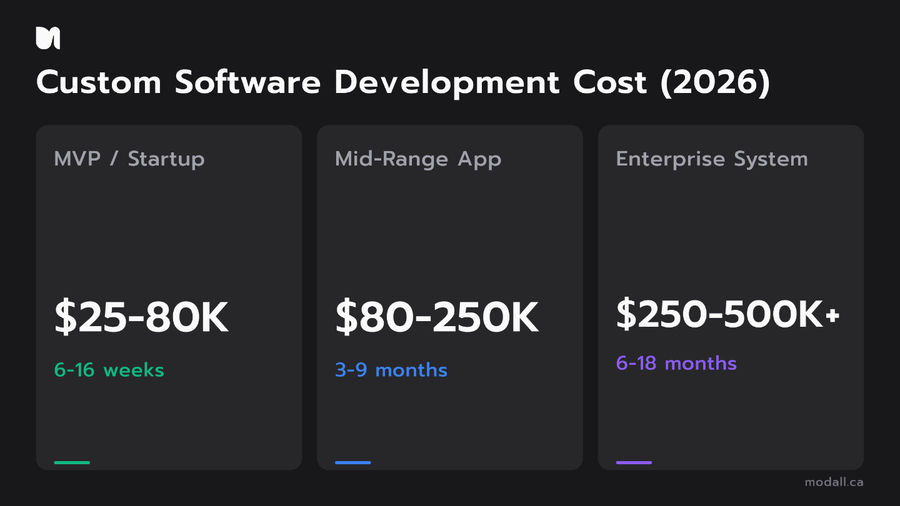
Custom software development cost ranges from $30,000 for an MVP to well over $500,000 for enterprise-grade systems, depending on project type, team location, and feature complexity. That range is wide because custom software covers everything from a single-screen internal tool to a multi-tenant SaaS platform serving thousands of users.
The market for custom software is growing fast. Gartner forecasts worldwide IT spending to reach $6.15 trillion in 2026, with enterprise software spending alone growing 14.7% year over year to more than $1.4 trillion. More organizations are investing in purpose-built systems because off-the-shelf products cannot keep pace with unique compliance requirements, operational workflows, and competitive differentiation.
This guide breaks down real 2026 pricing data across eight project types, hourly rates by region, cost allocation by development phase, and the hidden expenses most guides leave out. Every number here is sourced from industry surveys, verified pricing databases, and market research, not from any single agency's rate card. Your project will have its own variables, so treat these as informed benchmarks, not fixed quotes.
If you want an estimate based on your specific scope and requirements, get a free quote from our team at Modall.
How Much Does Custom Software Development Cost in 2026?
The average cost of a custom software development project in 2026 is $132,480, with a typical delivery timeline of about 13 months, according to Clutch's verified project review data. That average is useful as a baseline, but it masks significant variation across project types.
A GoodFirms survey of 100+ software development companies found that 66% of projects fall in the $30,000 to $100,000 range for small and medium-sized builds. Enterprise and AI-integrated projects push well beyond that ceiling.
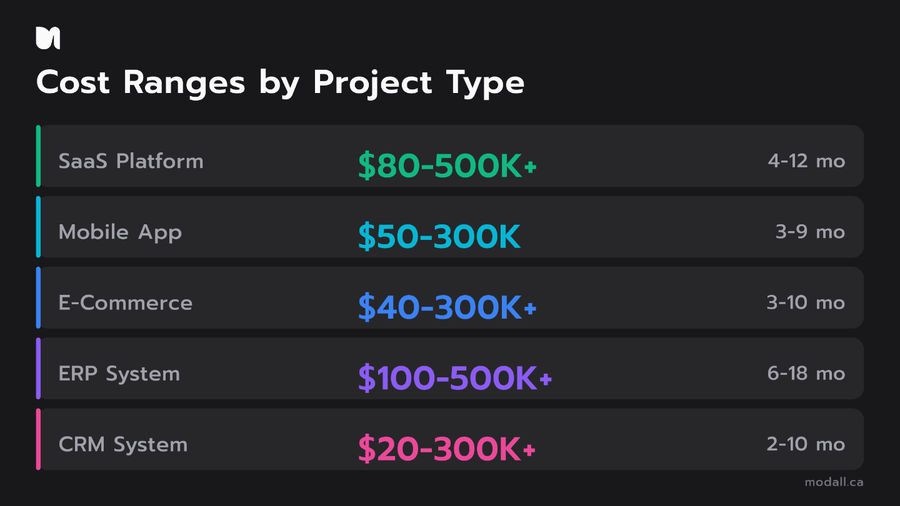
Here is what you can expect to pay across the major project categories in North America:
Project Type | Cost Range (USD) | Typical Timeline |
|---|---|---|
MVP / Proof of Concept | $25,000 - $80,000 | 6 - 16 weeks |
SaaS Platform | $80,000 - $500,000+ | 4 - 12 months |
Mobile App (iOS + Android) | $50,000 - $300,000 | 3 - 9 months |
Web Application / Portal | $40,000 - $200,000 | 2 - 8 months |
E-Commerce Platform | $40,000 - $300,000+ | 3 - 10 months |
ERP System | $100,000 - $500,000+ | 6 - 18 months |
CRM System | $20,000 - $300,000+ | 2 - 10 months |
Internal Tool / Dashboard | $15,000 - $80,000 | 4 - 12 weeks |
These ranges reflect North American market rates and include design, development, QA, and deployment. They do not include ongoing maintenance, hosting, or third-party licensing, which we cover later in this guide. Every project is different, and your actual cost depends on scope, integrations, compliance requirements, and team composition.
Custom Software Development Cost by Project Type
The table above gives you the quick answer. Below is the detailed breakdown for each project type, including what drives costs up or down within each range.
MVP / Proof of Concept ($25,000 - $80,000)
An MVP validates a product idea with the minimum set of features needed to test market demand. At the lower end, you are building a single-platform app with core functionality and basic UI. At the upper end, you are adding user authentication, payment processing, third-party integrations, and polished design.
MVP development cost scales primarily with the number of user-facing features and integrations. A single-feature proof of concept for investor demos can come in under $30,000. An MVP with real users, data persistence, and API connections will push toward $50,000 to $80,000.
SaaS Platform ($80,000 - $500,000+)
SaaS products require multi-tenancy, subscription billing, role-based access, and infrastructure that scales with usage. The cost range is wide because a basic SaaS tool with a few core features sits at the lower end, while a full-scale platform with custom dashboards, integrations, advanced analytics, and enterprise security features can exceed $500,000.
According to Ptolemay's SaaS cost analysis, a focused SaaS MVP runs $30,000 to $80,000, while a full-scale platform with multi-tenancy, security layers, and deep integrations reaches $150,000 to $500,000 or more. The cost multiplier from MVP to full platform is typically 3x to 5x.
Mobile App ($50,000 - $300,000)
Mobile app development cost depends heavily on platform strategy. A single-platform app (iOS or Android only) using cross-platform frameworks like React Native costs less than building two native apps separately. According to Business of Apps research, simple apps cost $40,000 to $80,000, medium-complexity apps run $80,000 to $180,000, and complex enterprise apps exceed $200,000.
AI-integrated mobile apps add $60,000 to $200,000 depending on whether you use pre-trained models or build custom machine learning algorithms. HIPAA or GDPR compliance adds another $20,000 to $50,000 in security and audit requirements.
Web Application / Portal ($40,000 - $200,000)
Web applications cover everything from customer portals and internal dashboards to data-heavy platforms with real-time features. A straightforward web portal with user authentication, basic CRUD operations, and a clean UI starts around $40,000. A complex application with real-time data, multiple user roles, third-party integrations, and advanced reporting can reach $200,000.
The technology stack influences cost here. Server-side rendered frameworks like Next.js deliver better performance and SEO out of the box, which can reduce long-term costs compared to client-side-only architectures that require additional optimization work.
E-Commerce Platform ($40,000 - $300,000+)
Custom e-commerce ranges from a semi-custom build on an existing framework ($40,000 to $80,000) to a fully bespoke marketplace with multi-vendor management, advanced inventory systems, and custom checkout flows ($150,000 to $300,000+). According to Conception Labs' e-commerce cost analysis, architecture choice determines roughly 60% of total cost.
Multi-vendor marketplaces with payment splits, vendor dashboards, and sophisticated search/filtering sit at the top of this range. A direct-to-consumer storefront with standard payment integration and CMS-managed content sits at the lower end. If you are migrating from a platform like Shopify or WooCommerce to a fully custom build, factor in data migration costs of $5,000 to $20,000 depending on catalog size and customer data complexity.
ERP System ($100,000 - $500,000+)
Custom ERP development is consistently the most expensive category because these systems touch every part of a business: finance, inventory, HR, operations, and reporting. According to Top10ERP's 2026 pricing analysis, mid-market ERP implementations range from $150,000 to $750,000 for year-one total investment including software, services, data migration, integrations, and training.
Industry-specific compliance requirements are the single biggest cost multiplier in custom ERP development. Businesses in regulated sectors should add 20% to 40% to standard estimates. Each custom integration typically costs $3,000 to $15,000, and complex ERPs can require dozens of them. The global ERP software market is expected to reach approximately $101 billion by 2026, reflecting the scale of enterprise investment in these systems.
CRM System ($20,000 - $300,000+)
Custom CRM development costs vary dramatically based on scope. A basic contact management system with pipeline tracking starts around $20,000 to $40,000. A mid-market CRM with automation, reporting, and third-party integrations runs $40,000 to $80,000. Enterprise CRMs with AI-powered analytics, custom workflows, and deep integrations exceed $250,000, according to Cleveroad's CRM cost analysis.
The build vs. buy calculation matters here more than most project types. Off-the-shelf CRMs charge per-user licensing that scales with headcount. For growing businesses with 50+ users, custom CRM development often becomes more cost-effective within two to three years. On average, businesses see a return of $8.71 for every dollar invested in CRM technology, according to Nucleus Research.
Internal Tool / Dashboard ($15,000 - $80,000)
Internal tools are the most predictable category because scope is usually well-defined: a specific team needs a specific workflow automated or a specific dataset visualized. Simple admin panels and reporting dashboards start around $15,000. Complex tools with role-based access, workflow automation, and integrations with existing systems reach $60,000 to $80,000.
These projects benefit the most from phased delivery. Launch with core functionality, then add features based on real team feedback. Internal tools also have the highest ROI per dollar spent because they directly reduce manual work hours for your team. A $30,000 dashboard that saves 10 hours of manual reporting per week pays for itself within a year.
Custom Software vs. Off-the-Shelf: When the Numbers Make Sense
The decision between building custom software and buying an off-the-shelf product is ultimately a financial calculation tied to your specific situation. Here is how the economics break down.
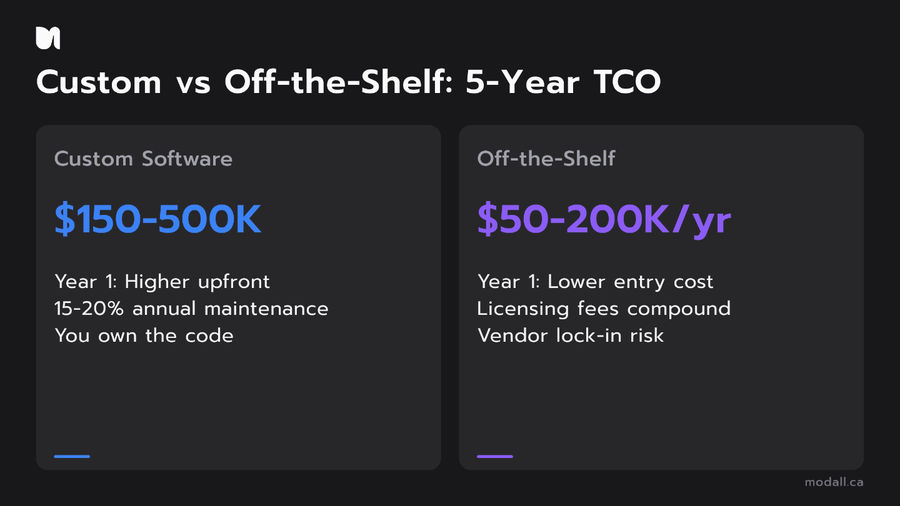
Off-the-shelf SaaS products charge per-user per-month licensing. For a team of 100 users on a mid-tier business tool at $50 per user per month, that is $60,000 per year in licensing alone, increasing annually as the vendor raises prices. Gartner's 2026 IT spending forecast found that CIOs now set aside 9% of their IT budget just to cover price increases on existing software. Enterprise software spending is projected to reach $1.4 trillion in 2026, growing 14.7% year over year, and a significant portion of that growth comes from vendors raising prices on renewals.
Custom software has zero per-user licensing costs. The investment is front-loaded in Year 1, then drops to maintenance levels (15% to 25% of initial cost annually). For the same 100-user scenario, a $200,000 custom build with $40,000 in annual maintenance costs $280,000 over three years. The off-the-shelf alternative costs $180,000 or more over the same period, and that gap narrows or reverses every year as SaaS licensing compounds and custom maintenance stays flat.
Factor | Off-the-Shelf SaaS | Custom Software |
|---|---|---|
Upfront Cost | Low ($0 - $5,000) | High ($30,000 - $500,000+) |
Annual Licensing | $500 - $1,500+ per user | $0 |
Annual Maintenance | Included in license | 15 - 25% of build cost |
Customization | Limited to vendor roadmap | Unlimited |
Data Ownership | Vendor-dependent | Full ownership |
Break-Even Point | N/A | Typically 2 - 3 years |
The break-even calculation tilts faster toward custom when any of these conditions apply: you have 50+ users, your workflows require significant customization beyond what the SaaS vendor offers, you operate in a regulated industry with specific compliance requirements, or you need integrations the off-the-shelf product does not natively support.
Software Development Hourly Rates by Region (2026)
Where your development team is located is one of the biggest cost variables. Here are current hourly rate benchmarks aggregated from Clutch, FullStack Labs, and GoodFirms pricing data:
Region | Hourly Rate (USD) |
|---|---|
North America (US + Canada) | $100 - $250 |
Western Europe | $70 - $150 |
Central & Eastern Europe | $40 - $80 |
Latin America | $30 - $65 |
South & Southeast Asia | $20 - $50 |
North American developers command the highest rates globally, but that premium reflects timezone alignment, regulatory familiarity, direct communication, and stronger IP protection. According to the GoodFirms 2026 survey, 56% of software development companies price their work in the $20 to $50 per hour range globally, while North American firms average $100 to $250 or more.
Within North America, seniority level creates significant rate variation. Junior developers (one to three years of experience) typically bill $50 to $100 per hour. Mid-level developers (three to seven years) range from $100 to $150. Senior engineers and architects (seven-plus years) command $150 to $250 or more, particularly in specialized domains like AI integration, fintech, or healthcare compliance.
Specialist premiums also apply. AI and machine learning engineers add 12% to 15% above general development rates. Fintech developers add 10% to 20%. Cybersecurity specialists add 10% to 15%, according to Keyhole Software's 2026 benchmark data.

How Your Industry Affects Custom Software Development Cost
Not all $200,000 projects are created equal. The industry you operate in significantly impacts both the initial build cost and ongoing expenses.
Healthcare and life sciences carry the highest compliance overhead. HIPAA in the US and PHIPA in Ontario require encrypted data storage, detailed audit logging, role-based access controls, and regular penetration testing. These requirements can add 25% to 40% to a standard project budget. A healthcare portal that would cost $80,000 in a non-regulated industry can reach $100,000 to $112,000 once compliance is built in.
Financial services and fintech require SOC 2 compliance, PCI DSS certification for payment handling, and often state or provincial licensing requirements. Fintech developers command a 10% to 20% rate premium over general developers, and audit documentation adds weeks to the timeline.
Government and public sector projects include accessibility requirements (WCAG 2.1 AA compliance), bilingual support in Canada, specific procurement documentation, and extended security clearance timelines. These add cost not through technical complexity but through process overhead.
Retail and e-commerce projects face lower compliance burdens but higher performance and scalability requirements. Handling traffic spikes during sales events, managing real-time inventory across channels, and integrating with shipping and fulfillment APIs all increase engineering complexity.
Startups and general SaaS projects carry the lightest compliance overhead, allowing more of the budget to go directly toward features and user experience. This is why MVP development is often the most cost-efficient starting point: you can validate your market before investing in the compliance, scalability, and enterprise features that regulated industries require from day one.
Cost Breakdown by Development Phase
Understanding where your budget goes across each phase helps you evaluate quotes and spot red flags. Here is the standard cost allocation for a custom software project, based on industry benchmark data:
Phase | % of Total Budget | What It Covers |
|---|---|---|
Planning & Discovery | 5 - 15% | Requirements gathering, architecture, specifications |
UI/UX Design | 10 - 20% | Wireframes, prototyping, visual design, user testing |
Development | 40 - 60% | Front-end and back-end engineering, API integrations |
Quality Assurance | 15 - 25% | Testing, bug fixes, performance optimization |
Deployment & DevOps | 5 - 10% | Infrastructure setup, CI/CD pipelines, launch |
For a $150,000 project, that means roughly $7,500 to $22,500 on discovery, $15,000 to $30,000 on design, $60,000 to $90,000 on development, $22,500 to $37,500 on QA, and $7,500 to $15,000 on deployment.
Projects in regulated industries (healthcare, financial services, government) should expect QA costs at the higher end of the range or above it. For critical systems, testing can consume 40% to 50% of the total budget because of compliance validation, security auditing, and penetration testing requirements.
The development phase consumes the largest share of the budget, but skipping or underfunding discovery is the most common cause of cost overruns. According to the Standish Group's CHAOS research, only 16.2% of software projects are delivered on time and on budget, and poor requirements definition is a leading contributor to the other 83.8%.
What Drives Custom Software Development Cost Up
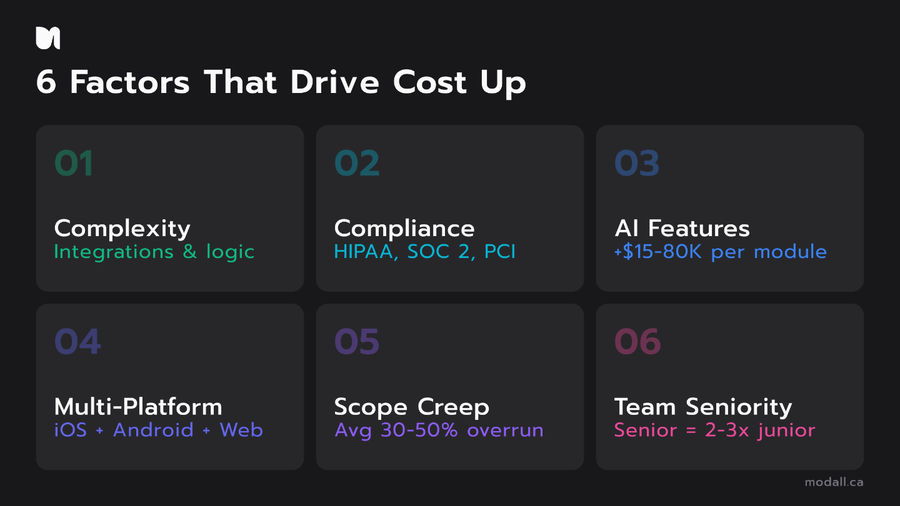
Several factors can push your project toward the higher end of these ranges, or beyond them entirely.
Feature complexity and integrations. Every third-party integration (payment processing, CRM connectors, mapping APIs, notification services) adds development and testing time. A system processing 100,000 API calls per month can also incur $500 to $5,000 in monthly API fees beyond the build cost.
Compliance requirements. Building for HIPAA, SOC 2, PIPEDA, or GDPR adds encryption, audit logging, access controls, and documentation requirements. Annual compliance audits alone cost $5,000 to $50,000 depending on scope.
AI and machine learning features. The GoodFirms 2026 survey found that 71.9% of AI-focused projects cost between $50,000 and $125,000 for small to mid-scale builds. Custom ML models cost significantly more than pre-built API integrations.
Multi-platform deployment. Supporting web, iOS, and Android simultaneously increases development scope. Cross-platform frameworks like React Native reduce this gap compared to building separate native apps, but testing and platform-specific optimization still add cost.
Scope creep. Undefined or shifting requirements are the silent budget killer. The GoodFirms survey found that scope creep increases total project costs by 10% to 25%, reinforcing the need for a thorough discovery phase before development begins.
Team seniority and specialization. A team of senior engineers at $150 to $250 per hour delivers faster and with fewer defects than a junior team at $50 to $100, but the hourly cost is two to three times higher. The net cost can be similar or even lower with experienced teams because they write fewer bugs, make better architectural decisions, and avoid the rework cycles that junior teams often encounter. Projects requiring niche skills (blockchain, embedded systems, real-time data processing) carry an additional premium because of limited talent supply.
The Hidden Costs Most Guides Skip
The numbers above cover initial development. What they do not cover is what happens after launch, and that is where many organizations get surprised.
Ongoing maintenance runs 15% to 25% of the initial build cost annually. This is the most widely cited benchmark across IEEE software engineering studies and industry surveys. For a $200,000 project, budget $30,000 to $50,000 per year for updates, bug fixes, security patches, and minor feature additions. Legacy codebases with high technical debt can push this to 30% to 40%.
Hosting and infrastructure adds $200 to $5,000+ per month depending on traffic, data volume, and cloud provider. AWS, Azure, and Google Cloud costs scale with usage, and fast-growing products can see infrastructure costs climb quickly.
Third-party licensing includes API subscriptions, monitoring tools, analytics platforms, and security services. These recurring costs are easy to overlook during initial budgeting. A typical mid-scale application uses five to ten third-party services, each costing $50 to $500 per month. That adds $3,000 to $60,000 per year in recurring costs before you touch your own code.
Security and compliance audits are ongoing costs for regulated industries. HIPAA, SOC 2, and PCI DSS compliance require annual assessments, with penetration testing alone costing $5,000 to $20,000 per assessment. Organizations handling sensitive data should budget $10,000 to $50,000 annually for combined compliance costs.
Year-one total cost of ownership can exceed the initial build by 26% to 52%, according to Keyhole Software's TCO analysis. For a $200,000 build, that means $251,000 to $304,000 in total first-year spend when you factor in maintenance, hosting, licensing, and training.
Roughly 60% of all software lifecycle costs go toward maintenance, not initial development. The build is the beginning of the investment, not the end.
How to Reduce Custom Software Development Cost
Cost reduction does not mean cutting corners. It means making smarter structural decisions early.
Start with a funded discovery phase. Investing 5% to 15% of your total budget in a structured discovery process produces a detailed specification, architecture plan, and accurate estimate. This eliminates the ambiguity that causes scope creep and budget overruns. Projects that skip discovery are significantly more likely to land in the 83.8% that miss their timelines or budgets.
Build in phases. Launch with core functionality first, then add features based on real user feedback and business performance. A phased MVP approach reduces upfront risk and ensures you are investing in features that users actually want.
Choose the right team model. North American agencies cost more per hour but offer timezone alignment, direct communication, and familiarity with local compliance requirements (PIPEDA, SOC 2, state-level regulations). Blended teams that pair senior North American architects with implementation developers in lower-cost regions can save 35% to 42% on total development costs, according to Index.dev's 2026 rate analysis.
Use proven technology. Custom does not mean everything from scratch. Frameworks like React, Next.js, and PostgreSQL are battle-tested, well-documented, and supported by large developer ecosystems. Building on proven infrastructure reduces development time and long-term maintenance costs compared to exotic or proprietary stacks. At Modall, our entire stack is built on these technologies specifically because they reduce project risk and make it easier to find qualified developers for long-term maintenance.
Negotiate fixed-price milestones for predictable budgets. Time-and-materials pricing gives flexibility but makes budgets unpredictable. Fixed-price contracts for well-defined phases (discovery, design, core development) give you cost certainty where scope is clear, with time-and-materials reserved for iterative phases where requirements may evolve.
Budget for AI integration strategically. The GoodFirms survey found that 61% of development companies expect AI to reduce project budgets by 10% to 25% through code generation, automated testing, and workflow automation. AI tools are already reducing development timelines for specific tasks, and that trend is accelerating.
How We Approach Custom Software Pricing at Modall
At Modall, we are a custom software development company based in Ontario, Canada, founded in 2019, and we work with a 100% in-house team. No outsourcing, no offshoring.
The cost ranges in this article reflect the broader North American market, not our specific pricing. Every project we take on starts with a conversation about scope, goals, and constraints, and we provide a detailed estimate based on your specific requirements.
Our process starts with a structured Discovery phase that produces a technical specification, architecture plan, and accurate cost breakdown before any development begins. This is how we eliminate the ambiguity that causes overruns. From there, we work in sprints, delivering working software on a predictable cadence so you can see progress and adjust priorities as needed.
We have built SaaS platforms, mobile applications, ERPs, e-commerce systems, and AI-integrated products across industries including fintech, social networking, food service, fitness, and travel.
If you are evaluating costs for a software project and want an estimate based on your actual scope, get a free quote from our team. We will walk through your requirements and give you a clear picture of what it will take.
Frequently Asked Questions
How much does custom software development cost on average?
The average custom software development project costs $132,480 with a 13-month timeline, according to Clutch's 2026 pricing data. However, that average spans a wide range of project types. MVPs and internal tools can cost $15,000 to $80,000, while enterprise systems and SaaS platforms routinely exceed $200,000.
What is the 40-20-40 rule for software engineering?
The 40-20-40 rule is a cost allocation guideline suggesting that 40% of effort goes to planning and design, 20% to coding, and 40% to testing and maintenance. In practice, modern projects follow a different split: 5% to 15% on planning, 10% to 20% on design, 40% to 60% on development, and 15% to 25% on QA. The exact allocation depends on project complexity and regulatory requirements.
How much do software development agencies charge per hour?
Hourly rates vary significantly by region. North American agencies charge $100 to $250 per hour, Western European firms charge $70 to $150, Eastern European developers charge $40 to $80, and South Asian teams charge $20 to $50. Within any region, seniority and specialization (AI, fintech, security) push rates higher.
What hidden costs should I budget for beyond initial development?
Plan for annual maintenance at 15% to 25% of the initial build cost, hosting and infrastructure at $200 to $5,000+ per month, third-party API and licensing fees, compliance audits ($5,000 to $50,000 annually for regulated industries), and team training. Year-one total cost of ownership typically exceeds the initial build by 26% to 52%.
Is it cheaper to build custom software or buy off-the-shelf?
It depends on your user count, customization needs, and time horizon. Off-the-shelf SaaS is cheaper upfront but carries per-user licensing that compounds over time. For organizations with 50+ users or unique workflow requirements, custom software often becomes more cost-effective within two to three years. A detailed cost comparison for your specific scenario is the only way to get a real answer.
How long does custom software development take?
Timelines range from 6 weeks for a simple MVP to 18+ months for complex enterprise systems. The most common range for mid-scale projects is 4 to 8 months. The biggest timeline risk is not development speed; it is unclear requirements. Projects that invest in a thorough discovery phase before development consistently deliver closer to their original estimates.
Does AI reduce custom software development cost?
Yes, and the effect is growing. The GoodFirms 2026 survey found that 90.6% of development companies now use AI tools across the development lifecycle, and 61% expect AI to reduce project budgets by 10% to 25%. AI is most effective at accelerating code generation, automated testing, and documentation, though complex architecture and business logic decisions still require experienced engineers.
How do I get an accurate cost estimate for my project?
Start with a detailed requirements document that outlines features, integrations, compliance needs, and user roles. Then get estimates from two to three agencies. The most reliable approach is a paid discovery phase that produces a technical specification and architecture plan before committing to a full build. This converts a rough estimate into a detailed, scope-locked budget. Book a free consultation to start that process.
What Your Custom Software Investment Should Actually Buy You
Custom software development cost is not just about the sticker price. It is about what that investment produces: a system built around your business processes, your compliance requirements, and your growth trajectory, not someone else's generic product.
The data in this guide gives you a framework for evaluating quotes, setting realistic budgets, and understanding where your money goes. Use the project-type breakdowns to benchmark proposals. Use the phase allocation to spot red flags in any quote that dramatically over- or under-weights a particular phase. And budget for total cost of ownership, not just the initial build.
At Modall, we help organizations navigate these decisions with clear scoping, transparent pricing, and a development process designed to deliver on time and on budget. Get a free quote to find out what your project will actually cost.