

Custom Software Development in Canada: The Complete Guide
Most off-the-shelf software solves about 70% of the problem. The other 30% is where companies lose money, lose time, and lose customers to workarounds that were never supposed to become permanent.
Canada's software market hit CAD $23.06 billion in 2025, and the fastest-growing segment is custom-built solutions designed around specific business processes (Statista). That growth makes sense: organizations dealing with PIPEDA compliance, provincial health regulations, or Canadian data residency requirements often can't find a SaaS product that checks every box.
This guide covers what custom software development actually costs in Canada, how timelines break down, what compliance frameworks matter, and how to evaluate a custom software development company before signing anything.
Already have a project in mind? Get a free quote from Modall and we'll scope it out together.
What Custom Software Development Actually Means
Custom software development is the process of designing, building, and maintaining applications purpose-built for a specific organization's needs. Unlike off-the-shelf products that serve a broad market, custom software addresses the exact workflows, integrations, and compliance requirements a business operates under.
The distinction matters more than it used to. According to the Standish Group's CHAOS Report, only 31% of software projects are delivered successfully, 50% are "challenged" (late, over budget, or missing features), and 19% fail outright (Standish Group). Those failure rates climb higher when companies try to force-fit generic tools into complex, regulated environments.
Custom software development services typically fall into a few categories:
Web applications built on frameworks like Next.js or React that handle everything from internal dashboards to customer-facing platforms.
Mobile applications for iOS and Android, either native or cross-platform using React Native.
Enterprise systems like ERPs, CRMs, and workflow automation tools built around how a company actually operates.
SaaS products for companies building their own subscription software from scratch.
API integrations connecting existing tools into a unified system.
The common thread: the business defines the software, not the other way around.
Why Canadian Companies Choose Custom Over Off-the-Shelf
The buy vs. build decision comes down to three factors: fit, control, and long-term cost.
Regulatory compliance is the biggest driver. Canada's privacy landscape is more complex than most businesses realize. PIPEDA governs federal privacy obligations. Provincial laws like Ontario's PHIPA add healthcare-specific requirements. Quebec's Law 25 introduced stricter consent rules in 2023. And if your business touches European customers, GDPR applies on top of everything else.
Off-the-shelf software rarely handles multi-jurisdictional compliance natively. A Canadian data residency requirement alone can disqualify most US-hosted SaaS products.
Operational efficiency gains are measurable. Organizations that invest in custom software report a 35% boost in operational efficiency and 20% revenue growth over three years, according to Deloitte's Digital Transformation research. Those numbers reflect the difference between adapting your process to fit someone else's tool and building a tool that fits your process.
Total cost of ownership favours custom at scale. SaaS licensing for a 200-person company can run $50,000 to $150,000+ per year, increasing annually. Custom software has a higher upfront cost but no per-seat licensing. After year two or three, the economics often flip.
Companies in automotive, fitness, travel, and social networking tend to hit the limits of off-the-shelf tools faster than most because their workflows are inherently unique.
Custom Software Development Cost in Canada
This is the question every business asks first. The honest answer: it depends on scope. But here are real ranges based on the Canadian market in 2026.
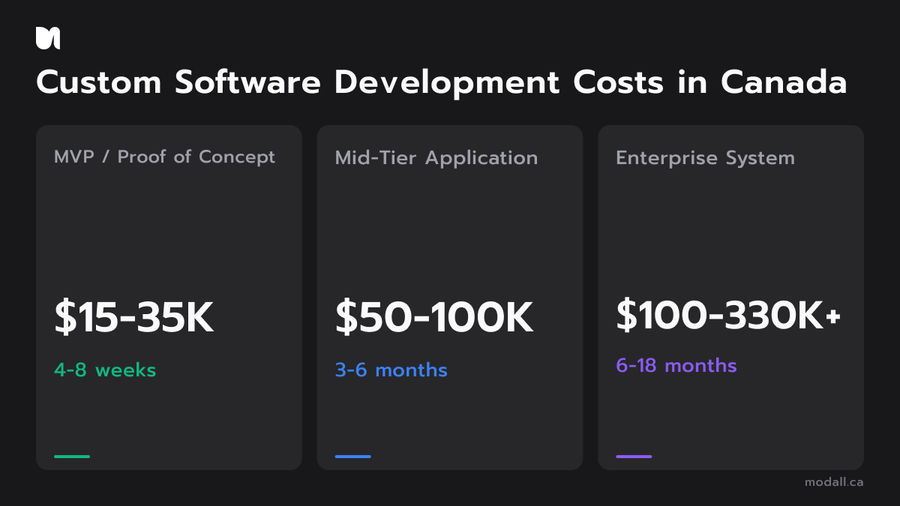
Cost Ranges by Project Tier
Project Type | Estimated Cost (CAD) | Timeline | Example |
|---|---|---|---|
MVP / Proof of Concept | $15,000 - $35,000 | 4 - 8 weeks | Single-feature app to validate a market hypothesis |
Mid-Tier Application | $50,000 - $100,000 | 3 - 6 months | Multi-feature web app with user auth, dashboards, integrations |
Enterprise System | $100,000 - $330,000+ | 6 - 18 months | ERP, multi-tenant SaaS, or compliance-heavy platform |
Hourly Rate Benchmarks
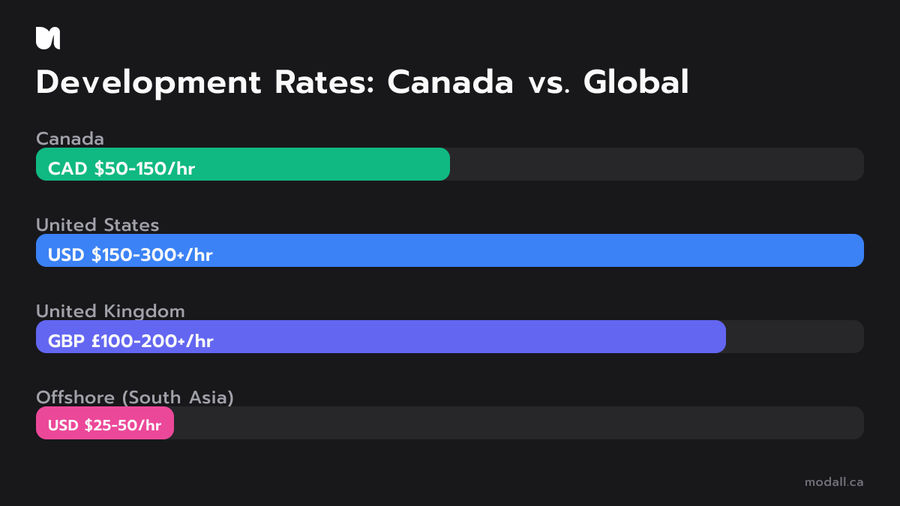
Canadian custom software development firms typically charge between CAD $50 and $150+ per hour, depending on seniority and specialization:
Developer Level | Hourly Rate (CAD) |
|---|---|
Junior (1-3 years) | $50 - $75 |
Mid-Level (3-7 years) | $75 - $100 |
Senior / Lead (7+ years) | $100 - $150+ |
These rates are competitive globally. For comparison, US agencies charge USD $150 to $300+, UK firms charge GBP £100 to £200+, and offshore teams in South Asia charge USD $25 to $50 but with trade-offs in communication, timezone overlap, and IP protection.
What Drives Cost Up (and Down)
Costs increase with: the number of integrations (each API connection adds development and testing time), compliance requirements (HIPAA, PIPEDA, SOC 2), real-time features, complex user permission structures, and multi-platform deployment.
Costs decrease with: a well-defined scope before development starts, using proven frameworks instead of building from scratch, phased delivery where you launch the core product first and add features iteratively, and choosing a team that has built something similar before.
One approach that saves money and reduces risk: start with a paid discovery phase before committing to a full build. A structured one-to-two week scoping engagement produces a detailed specification, architecture plan, and accurate estimate, so you know exactly what you're paying for.
The Custom Software Development Process
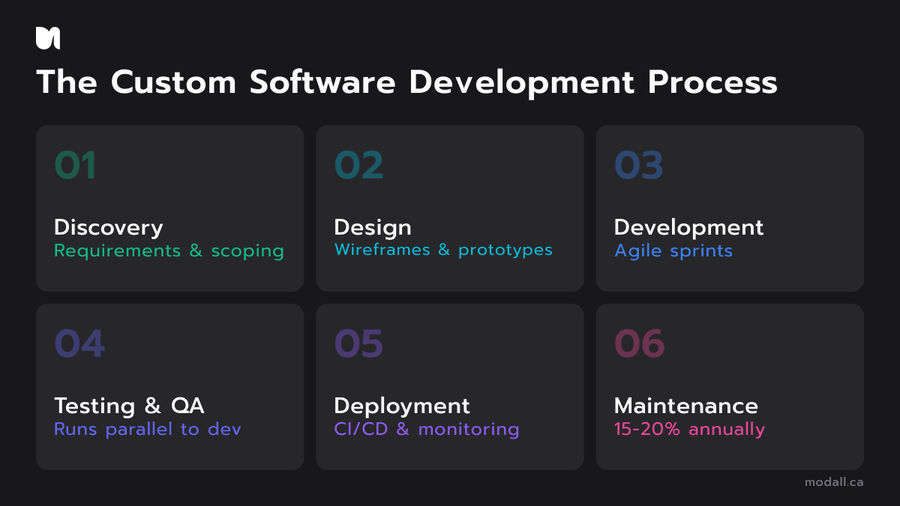
Every reputable custom software development company follows some version of this lifecycle. The specific methodology varies (agile, waterfall, hybrid), but the phases are consistent.
Phase 1: Discovery and Requirements
This is the most important phase and the one most frequently skipped. Discovery produces: a detailed requirements document, user personas and workflows, technical architecture decisions, a realistic timeline and budget, and risk identification.
Skipping discovery is the single biggest predictor of project failure. The Standish Group data backs this up: projects with poor requirements gathering fail at 3x the rate of those with thorough upfront scoping.
Phase 2: Design and Prototyping
UX/UI design translates requirements into something users can see and interact with before any code is written. This phase should produce wireframes, interactive prototypes, and a design system that guides the development team.
The goal is to catch usability problems when they cost hours to fix (in Figma) rather than weeks (in code).
Phase 3: Development
Modern custom software development typically uses an agile or sprint-based approach. Work is broken into one-to-four week sprints, each delivering working, testable features. This means the client sees progress continuously instead of waiting months for a "big reveal."
Technology choices matter here. A custom software development firm should recommend a stack based on the project's requirements, not just what they're comfortable with. That said, most Canadian web and mobile projects in 2026 are built on TypeScript, React or Next.js for frontend, Node.js for backend, and PostgreSQL for data, with React Native for cross-platform mobile.
Phase 4: Testing and Quality Assurance
QA is not a phase that happens at the end. In a well-run project, testing runs parallel to development: unit tests catch bugs at the code level, integration tests verify that components work together, and user acceptance testing (UAT) confirms the software does what the business needs.
Phase 5: Deployment and Launch
Deployment to production, monitoring setup, performance tuning, and a launch plan. For SaaS products, this includes infrastructure scaling decisions and CI/CD pipeline configuration.
Phase 6: Maintenance and Iteration
Software is never "done." Post-launch maintenance covers bug fixes, security patches, performance optimization, and feature additions based on real user feedback. Budget 15 to 20% of initial development cost annually for ongoing maintenance.
Compliance-Focused Development in Canada
Compliance is not an afterthought you bolt on at the end. It needs to be architected into the software from day one.
PIPEDA (Personal Information Protection and Electronic Documents Act)
Canada's federal privacy law applies to all private-sector organizations that collect, use, or disclose personal information in the course of commercial activity. Key requirements for software, as outlined by the Office of the Privacy Commissioner of Canada: meaningful consent for data collection, data minimization (collect only what you need), breach notification within 72 hours, and the right of individuals to access and correct their data.
Provincial Privacy Laws
Ontario's PHIPA governs health information. Quebec's Law 25 (fully enforced as of September 2024) introduced privacy impact assessments, a designated privacy officer requirement, and consent rules stricter than PIPEDA. Alberta and British Columbia have their own PIPA legislation.
If your software handles data across provinces, you need to comply with all applicable regimes simultaneously.
Industry-Specific Standards
Healthcare projects often need HIPAA compliance (for US patient data) or PHIPA compliance (Ontario). Financial services may require SOC 2 Type II audits. Government contracts frequently mandate Canadian data residency, meaning all data must be stored and processed on Canadian soil, per the Treasury Board's Directive on Service and Digital.
A custom software development company that understands these frameworks saves months of rework. One that doesn't will cost you more than the initial quote suggests.
How to Choose a Custom Software Development Company in Canada
The Canadian market has hundreds of software development firms. Here's how to evaluate them without wasting time.
Technical Capability
Ask about their stack. A strong web development or front-end development team should be able to explain why they chose their tools, not just list them. Look for experience with the specific platforms and frameworks your project requires.
Ask for architecture decisions from past projects. Any firm can show you a polished portfolio. Fewer can walk you through the technical trade-offs they made and why.
Portfolio and Case Studies
Look for projects similar to yours in complexity, industry, or compliance requirements. A firm that has built ERP systems is better positioned for enterprise work than one whose portfolio is all marketing websites. A team that has shipped SaaS products understands multi-tenancy, subscription billing, and scaling challenges.
Team Structure
Canada will need an additional 250,000 digitally skilled workers by 2025 according to ICTC's Digital Talent Outlook, and that shortage has only deepened. This means many agencies pad their teams with offshore contractors or subcontractors without disclosing it.
Ask directly: who will write the code? Are they employees or contractors? Are they in-house or distributed? The answer affects communication speed, IP security, and accountability.
Process and Communication
Red flags: no discovery phase, no project manager or single point of contact, vague timelines, and a reluctance to show working software until the project is "complete."
Green flags: a structured scoping process, regular sprint demos, transparent time tracking, and a willingness to let you talk directly to the developers.
Pricing Model
Fixed-price works for well-defined, smaller projects. Time-and-materials (hourly) is better for larger or evolving projects where requirements may shift. Retainer models suit ongoing development partnerships.
Be cautious of any firm that quotes a fixed price for a complex project without a discovery phase. They're either padding the estimate heavily or planning to cut corners.
Custom Software Development for Startups vs. Enterprises
The development approach should change based on who's building and why.

Startups: Speed to Market
Startups need to validate a concept before scaling it. The right approach is an MVP (Minimum Viable Product) that tests core assumptions with real users. An MVP is not a half-built product; it's a focused version that delivers the single most important value proposition.
The MVP development process typically runs 4 to 8 weeks and costs CAD $15,000 to $35,000. From there, you iterate based on user feedback rather than assumptions.
Key startup considerations: choosing between MVP, MLP, and MAP approaches, defining success metrics before building, finding the right MVP development company, and connecting with Toronto incubators and accelerators for funding and mentorship.
Enterprises: Integration and Scale
Enterprise custom software development focuses on reliability, security, compliance, and integration with existing systems. Projects are larger, timelines are longer, and the stakeholder map is more complex.
Enterprise projects benefit from: phased rollouts (department by department), change management planning alongside technical delivery, dedicated testing environments that mirror production, and SLA-backed maintenance agreements.
The cost difference reflects the complexity. Enterprise projects typically start at CAD $100,000 and can exceed $330,000 for multi-module systems.
AI Integration in Custom Software
AI software development has moved from experimental to expected. In 2026, 78% of enterprises use AI in at least one business function, according to McKinsey's State of AI report (McKinsey).
The most common AI integrations in custom software include: natural language processing for customer support automation, predictive analytics for demand forecasting and decision support, document processing and extraction for compliance-heavy industries, and recommendation engines for e-commerce and content platforms.
AI integration adds value when it solves a specific, measurable problem. It adds cost and complexity when it's included because someone said "we should add AI."
The practical question is always: does this feature save enough time or generate enough revenue to justify the development and ongoing API costs?
The Canadian Advantage for Software Development
Canada offers several structural advantages for custom software development:
Talent quality. Canadian universities produce strong computer science graduates, and the country's immigration policies attract global tech talent. Toronto, Vancouver, Montreal, Ottawa, and Waterloo all have deep tech ecosystems. Innovation, Science and Economic Development Canada (ISED) reports that the digital economy now accounts for over 5% of Canada's GDP, fuelling continued investment in talent pipelines.
Cost competitiveness. Canadian developers cost 30 to 50% less than their US counterparts at comparable skill levels, partly due to the exchange rate and partly due to lower cost of living outside major metros.
Timezone alignment. For North American companies, working with a Canadian team means real-time collaboration during business hours. No 12-hour delays waiting for responses.
Data sovereignty. For companies that need Canadian data residency, working with a Canadian development firm simplifies compliance. The data stays in Canada, the team is in Canada, and the legal jurisdiction is clear.
IP protection. Canada has strong intellectual property laws and is a signatory to major international IP treaties. This matters when you're building proprietary software with a development partner.
Real-World Examples of Custom Software in Action
To make this concrete, here are examples of what custom software development looks like in practice:
Multi-location operations need centralized systems that account for regional differences. A custom ERP system can unify inventory, ordering, scheduling, and reporting across dozens of locations while adapting to each site's specific configuration.
Content-heavy platforms serving millions of page views need performance-optimized architecture. A headless CMS built specifically for speed and SEO can outperform generic WordPress or Drupal setups by orders of magnitude.
Review and reputation management for multi-location businesses requires automation that generic tools don't offer. A custom platform can automate review requests, aggregate feedback, and surface actionable insights across hundreds of locations.
Consumer apps in competitive markets need polished UX and fast iteration. A mobile MVP can validate demand quickly, while a more complex SaaS product can scale to thousands of users with the right architecture.
How to Get Started
Starting a custom software project doesn't require a 50-page requirements document. It requires clarity on three things: what problem you're solving, who the users are, and what success looks like.
From there, the typical path is:
Step 1: Have an initial conversation with a custom software development company to discuss the project at a high level. This call should be free and should help both sides determine fit.
Step 2: Enter a paid discovery phase where the development team documents requirements, maps workflows, defines the technical architecture, and produces an accurate scope and estimate.
Step 3: Review the discovery output. If the plan, timeline, and budget work, move into development with a clear statement of work.
Step 4: Build in sprints, reviewing working software every one to two weeks.
This approach de-risks the project for both sides. The client gets a detailed plan before committing to a full budget. The development firm gets the context they need to build something that actually works.
FAQs
How much does custom software development cost in Canada?
Most projects fall between CAD $15,000 and $330,000+, depending on scope. An MVP runs $15,000 to $35,000 over 4 to 8 weeks. A mid-tier application costs $50,000 to $100,000 over 3 to 6 months. Enterprise systems with compliance requirements and complex integrations start at $100,000 and can exceed $330,000.
How long does it take to build custom software?
Timeline depends on complexity. A focused MVP takes 4 to 8 weeks. A full-featured application takes 3 to 6 months. Enterprise systems with multiple modules, integrations, and compliance requirements can take 6 to 18 months. Discovery and design typically add 2 to 4 weeks at the start.
Should I hire an in-house team or a custom software development firm?
For most companies, a custom software development firm is more cost-effective for the initial build. Hiring a full in-house team (developers, designers, QA, project manager) costs $500,000+ per year in Canada. A development firm gives you that entire team for the duration of the project without the long-term overhead. Consider bringing development in-house once the product is stable and your ongoing development needs justify full-time headcount.
What's the difference between custom software and SaaS?
SaaS (Software as a Service) is a pre-built product you subscribe to monthly. Custom software is built specifically for your business. SaaS works when your needs are standard. Custom software makes sense when your workflows, compliance requirements, or competitive advantages demand something purpose-built. Here's a deeper comparison of B2B vs. B2C SaaS models and how they relate to custom builds.
Do I need custom software for PIPEDA compliance?
Not always, but often. If your business collects personal data from Canadians and your current tools don't provide the consent management, data minimization, breach notification, and access controls PIPEDA requires, custom software may be the most reliable path to compliance. This is especially true for companies operating across multiple provinces, where data residency requirements vary.
How do I protect my intellectual property when working with a development firm?
Your contract should specify that all code, designs, and documentation are owned by your company upon delivery. Look for a Software Development Agreement (SDA) that includes IP assignment clauses, non-disclosure terms, and non-compete provisions. Avoid firms that retain ownership of "reusable components" without clearly defining what that means.
What technologies are most common for custom software in Canada?
The dominant stack for Canadian custom software projects in 2026 includes TypeScript, React or Next.js for frontend, Node.js for backend, PostgreSQL for databases, and React Native for cross-platform mobile apps. For AI-powered applications, OpenAI API integrations are the most common. For content-heavy sites, headless CMS architectures outperform traditional monolithic setups.
Key Takeaways
Custom software development in Canada is a growing market for good reason. Off-the-shelf tools hit a ceiling fast when your business operates under PIPEDA, PHIPA, or provincial data residency rules. The companies pulling ahead are the ones building systems around their actual workflows instead of bending their operations to fit someone else's product.
Here's what matters most:
Start with discovery, not development. The Standish Group data is clear: projects that skip requirements gathering fail at 3x the rate. A one-to-two week paid discovery phase costs a fraction of what a failed build costs.
Scope determines cost, not the other way around. Canadian custom software ranges from CAD $15,000 for an MVP to $330,000+ for enterprise systems. The difference is complexity, compliance requirements, and integration depth.
Compliance needs to be built in, not bolted on. PIPEDA, PHIPA, Law 25, and federal data residency directives aren't optional. A development partner that understands these frameworks from day one saves you months and tens of thousands in rework.
Ask who's writing the code. Canada's tech talent shortage means many agencies quietly outsource. Know whether your team is in-house, on-site, and accountable before you sign.
Think in phases, not big bangs. Launch an MVP, validate with real users, then scale. This approach reduces risk and keeps budgets under control.
The right custom software partner doesn't just write code. They understand your business, your compliance landscape, and your growth trajectory, and they build accordingly.
Get a free project quote from Modall and find out what a purpose-built solution looks like for your business.
Sources: Statista Canada Software Market, Standish Group CHAOS Report, McKinsey State of AI, ICTC Digital Talent Outlook 2025, Deloitte Digital Transformation Survey, Office of the Privacy Commissioner of Canada, Innovation, Science and Economic Development Canada, Treasury Board Directive on Service and Digital