
MVP development for startups is the single most important investment a founder can make before going to market. Every billion-dollar company you admire, Uber, Airbnb, Dropbox, started as something far smaller. They didn't launch with a full platform. They launched a Minimum Viable Product (MVP), validated demand, and scaled from there.
For startups in 2026, building an MVP is no longer just a "good idea"; it is a survival mechanism. In a market where 90% of startups fail, often due to a lack of market need, an MVP is your insurance policy against building something nobody wants.
If you are a founder, you are likely wrestling with questions: How much does it cost? Which features do I cut? Should I use no-code or hire a firm?
This comprehensive guide covers everything you need to know about startup MVP development: from deep-dive definitions and cost breakdowns to a granular 10-step build process that minimizes risk and maximizes your chances of finding product-market fit.
Looking for a quote on your MVP? Contact Modall for a free consultation.
What is a Minimum Viable Product (MVP)?
In startup development, a Minimum Viable Product (MVP) is the simplest version of a product you can launch that still solves a real problem for real users and gives you reliable feedback.
Definition: A minimum viable product is a small but complete product that delivers value, tests your core assumptions, and can safely be released to early customers.
An effective MVP:
Solves one clearly defined problem
Delivers real value to a specific group of users
Can be released and tested in the real world
This is the foundation of MVP development for startups.

We partnered with NFL running back Chase Edmonds to build and launch the MVP for Sceene, a nightlife discovery app focused on connecting users with the best local venues.
The "Viable" Misconception
The definition often gets misinterpreted. The idea is not "cheap and ugly." The idea is minimum scope that is still truly viable to get enough feedback to make informed decisions.
For startups, this means deliberately cutting everything that is not essential to testing your core value proposition, while still providing a usable, coherent product experience.
The "Cupcake" Analogy
To understand an MVP, think of your product vision as a wedding cake.
A prototype might be a sketch of the cake.
A dry base layer (functionality without design) is barely edible.
An MVP is a cupcake. It is small, but it has the cake, the icing, and the flavor. It is a complete, satisfying experience that proves people like your recipe before you bake a multi tier wedding cake.

What an MVP is NOT
It is important to distinguish an MVP from other common artifacts:
It is not a full blown product with every feature you can imagine
It is not just a pitch deck or a static design
It is not a rough proof of concept that only works in a lab
Key Takeaway: An MVP must be viable. If it’s too minimal to solve the user's problem, it’s not an MVP; it’s just a failed experiment.
MVP vs. Prototype vs. Proof of Concept (PoC)
Founders often confuse these terms, leading to wasted budget. Here is the definitive breakdown to help you decide what you need.
Feature | Proof of Concept (PoC) | Prototype | Minimum Viable Product (MVP) |
|---|---|---|---|
Goal | Verify technical feasibility. | Visualize the look & feel. | Validate market demand. |
Audience | Internal team / Investors. | Stakeholders / Test groups. | Real, paying users. |
Functionality | Partial / Hard-coded. | Clickable dummy (no code). | Fully functional core features. |
Cost | Low | Low-Medium | Medium-High |
Which one do you need?
Proof of Concept (PoC): If you are building a complex tech product (e.g., a new AI algorithm) and aren't sure if the tech will work, you need AI software development for a PoC first.
Prototype: If you need to raise seed money or align your co-founders on the vision, build a clickable prototype in Figma.
MVP: If you know the tech works and you have the vision, but need to prove users will pay for it, you must build an MVP.

We partnered with NFL wide receiver Alex Bachman to build the MVP for Vault Club, a private golf social networking app on iOS. The product is currently in the active testing phase to validate the concept.
Why Startups Must Build an MVP First
Startups operate with limited time, budget, and attention. Building a full product in stealth for 12 to 18 months is the most expensive way to find out you are wrong.
Building an MVP isn't about "being cheap", it's about being smart by turning your startup into a learning engine, not just a feature factory. If you're evaluating agencies, our guide on how to choose an MVP development company, it covers what to look for and what to avoid.
1. Validate Product-Market Fit
The biggest risk for a startup is building a product no one wants. CB Insights reports that "no market need" is the #1 reason startups fail (42%). An MVP allows you to test your value proposition with real users. If they don't engage, you can pivot without having burned your entire budget. According to a McKinsey and Oxford University study, IT projects without proper validation run an average of 45% over budget and 7% over time, while delivering 56% less value than predicted. MVP development exists to counter exactly this risk.
2. Reduce Development Costs
By focusing only on core features, you significantly lower your initial investment. Instead of spending $150,000+ on a full-scale SaaS development project, you might spend $20,000–$60,000 to get into the market. This liquidity is crucial for early-stage survival. You can learn more here about SaaS development costs in Canada.
3. Attract Early Investors
Investors in 2026 rarely fund "ideas" on a napkin. They fund traction. A live MVP with active users, even a small number, proves you can execute and that there is a market for your solution. It shifts the conversation from "what if" to "what is."
4. Build Relationships with Early Adopters
Your first users are your most valuable asset. They are forgiving of bugs if the value is there, and they provide the feedback roadmap for your v2. Engaging them early builds a community that champions your product as it scales.
From 0 to 70 Million Users: Vivino founder Heini Zachariassen shares 6 battle-tested principles for MVP success. Watch to learn why "speed trumps perfection" and how to use the "Loom MVP" approach to escape development hell.
How AI Is Changing MVP Development in 2026
The MVP development landscape in 2026 looks fundamentally different from even two years ago. AI-assisted development tools have compressed timelines by 40 to 60 percent for teams that know how to use them effectively (McKinsey, 2025).
What's actually changed:
AI doesn't replace your development team. It makes skilled engineers dramatically faster. At Modall, we use AI tooling across the stack to accelerate specific parts of the build process: boilerplate code generation, test writing, documentation, and initial UI scaffolding. The architectural decisions, business logic, security, and quality assurance still require experienced developers.
Where AI helps most in MVP development:
Code generation for repetitive patterns: Authentication flows, CRUD operations, and API integrations that used to take days now take hours.
Automated testing: AI can generate test suites alongside feature code, catching regressions earlier in the sprint cycle.
Design-to-code translation: Tools like Figma-to-React plugins have matured enough to produce usable component code from mockups.
Documentation and onboarding: Auto-generated API docs and inline code comments reduce handoff friction.
Where AI falls short:
Complex business logic, multi-service architecture, database design, and performance optimization still require human expertise. Startups that rely entirely on AI-generated code without experienced oversight end up with fragile systems that break under real user load.
The practical takeaway: AI has made custom MVP development more accessible and faster, but it hasn't eliminated the need for strong engineering fundamentals. The startups seeing the best results in 2026 are pairing AI tooling with experienced development teams, not replacing one with the other.
5 Types of MVPs (Choose the Right One)
You don't always need to code a full app to have an MVP. Depending on your industry and budget, one of these models might fit better.
1. The "Concierge" MVP
You manually perform the service for the customer.
How it works: You promise a solution (e.g., "Personalized Meal Plans"), but instead of an AI generating it, you write it yourself.
Best for: Service-based startups, consulting, and algorithm-heavy ideas where you need to learn the logic first.
Example: Food on the Table (manually creating grocery lists for users).
2. The "Wizard of Oz" MVP
The front end looks like a fully working product, but humans do the work behind the scenes.
How it works: The user clicks "Buy," and you manually buy the item and ship it to them. The user believes the system is automated.
Best for: E-commerce, marketplaces, and booking platforms.
Example: Zappos (the founder took photos of shoes at local stores and bought them at full price when someone ordered online).
3. The "Landing Page" MVP
Before building anything, you sell the concept.
How it works: Create a high-converting landing page describing the product. Run ads to it. If people click "Buy" or "Join Waitlist," you have demand.
Best for: Validating messaging and pricing.
Example: Buffer (created a landing page with pricing plans before writing a line of code).
4. The "Single-Feature" MVP
You build one specific feature perfectly and ignore the rest.
How it works: Identify the single most valuable thing your product does and build only that.
Best for: Software products in crowded markets.
Example: Spotify (focused solely on streaming speed and ignored playlists/social features initially).
5. The "Piecemeal" MVP
You combine existing tools to create a functioning product.
Best for: Bootstrapped founders with limited tech skills.
Example: Groupon (started as a WordPress blog where they manually posted deals).
How to Build an MVP for Your Startup: A Detailed 10-Step Process
Ready to build? Whether you are working with an internal team or a specialist MVP development company like Modall, this is the practical playbook to go from idea to launch.

Step 1: Define the Problem and Target User
Your MVP exists to solve one clear problem for one clear audience.
The Mistake: Targeting "everyone."
The Fix: Create a specific User Persona. (e.g., "Manager Mike, 35, works in automotive, struggles with scheduling mechanics").
Action: Write down your hypothesis: "We believe [Persona] has a problem with [Pain Point] and will pay for [Solution]."

Step 2: Conduct Deep Market Research
Don't guess, know. You need to ensure the problem is painful enough that people are searching for a solution.
Competitor Analysis: Who else is solving this? If there are no competitors, there might be no market. If there are too many, you need a unique angle. In our experience at Modall, the most successful startups we’ve built entered markets that were already full of competitors. Why? Because competition proves a paying market exists (validated PMF). You don't need to be the first; you just need to provide a significantly better solution.
Community & Keyword Research: Go beyond simple guessing. Are people searching for "how to fix [problem]"? Use tools like Ahrefs or Google Trends to track problem-related searches. Explore forums like Reddit, Quora, or niche communities to see if people are actively complaining about the issue.
Direct Interviews: If you are building Automotive software, go to auto shops. Ask them, "How do you handle this problem today?" If they all say, "It's not really a big deal," stop. You just saved $50k.
The more evidence you gather, the stronger your foundation for a successful MVP.

Sizing the Opportunity: TAM, SAM, and SOM
When conducting market research, it's not enough to just know who your competitors are; you need to understand the scale of the opportunity. Investors and stakeholders want proof that you are targeting a quantifiable market, not just a vague idea.
This is where market sizing comes in. You need to define your TAM, SAM, and SOM to show you know exactly where to start.
TAM (Total Addressable Market): The total worldwide market demand for your product category. (The "Big Dream").
SAM (Serviceable Available Market): The segment of the TAM within your specific geographical reach or niche. (The "Realistic Reach").
SOM (Serviceable Obtainable Market): The portion of the SAM you can realistically capture in the near term with your MVP and initial resources. (The "Immediate Focus").
Crucial MVP Strategy: Do not try to capture the entire TAM with your first release. Your MVP must be laser-focused on winning the SOM first. Prove traction there, then expand outwards.

Step 3: Map the User Journey
Visualize how a user moves through your app. Keep it linear and simple.
The Flow: Landing Page -> Sign Up -> Onboarding -> Core Value Action -> Result.
Tip: Any step that doesn't lead directly to the "Core Value Action" should be cut. Complex user flows increase churn.
Step 4: Prioritize Features (The MoSCoW Method)
Feature creep is the enemy of the MVP. You need a ruthless filter. Use the MoSCoW method:
Must-Have: The product fails without these. (e.g., For Uber: GPS location, Payment, Request Ride).
Should-Have: Important but not vital for launch. (e.g., For Uber: Ride scheduling, Split fare).
Could-Have: Nice to have if time permits. (e.g., Profile pictures, Dark mode).
Won't-Have: Explicitly agreed to save for V2.0.
Pro Tip: If you have more than 3-4 "Must-Have" features, your MVP is too big.

Step 5: Choose the Right Tech Stack
Your tech stack determines your scalability. Choosing the wrong one can lead to a complete rewrite later.
For Speed (Validation): No-code tools (Bubble, Webflow). Great for simple apps but hard to scale or export code later.
For Scalability (Custom):
Frontend: React.js, Vue.js, or Next.js.
Backend: Node.js, Python (Django/Flask).
Mobile: React Native or Flutter (allows you to build iOS and Android simultaneously).
For a deeper breakdown of what mobile development costs in Canada, see our mobile app development cost guide.
Recommendation: If you plan to scale into a major platform or have complex IP, partner with a dedicated software development team like Modall to ensure your code is robust.

Choosing the Right Stack for Your MVP Type
Startup Type | Recommended Frontend | Recommended Backend | Database | Timeline |
|---|---|---|---|---|
SaaS Platform | React + Next.js | Node.js + Prisma | PostgreSQL | 10-16 weeks |
Mobile App (iOS + Android) | React Native + Expo | Node.js | PostgreSQL | 12-16 weeks |
Marketplace / Two-Sided | Next.js + Tailwind | Node.js + Prisma | PostgreSQL | 14-20 weeks |
AI/ML Product | React + Next.js | Python (FastAPI) + Node.js | PostgreSQL + Vector DB | 16-24 weeks |
Simple Directory / Tool | No-code (Bubble/Webflow) | Built-in | Built-in | 4-6 weeks |
This is the exact stack we use at Modall for the majority of our MVP builds. TypeScript across the full stack (React, Next.js, Node.js, Prisma, PostgreSQL) keeps the codebase consistent and makes it easier to hire additional developers or bring developers in-house as you scale.
Step 6: Design and Prototyping
Before writing code, create wireframes.
Wireframes: Low-fidelity sketches to structure the layout.
Mockups: High-fidelity designs showing colors and fonts.
Interactive Prototype: A clickable version in Figma.
Why this matters: Changing a design in Figma takes 30 minutes. Changing it in code takes 3 days.
Step 7: Agile Development & Testing
Adopt an Agile approach. Do not lock your developers in a room for 3 months. This isn't just a suggestion, it's a survival tactic. Recent data shows that 72% of startups use an MVP approach to validate their product, with the vast majority leveraging Agile to iterate faster
Sprints: Build in 2-week cycles.
Review: At the end of every sprint, review the working software.
Testing: QA (Quality Assurance) should happen continuously, not just at the end.
Read More: Understanding the Difference: MVP vs MLP vs MAP.

AI tools are compressing MVP timelines significantly. Pull request cycle times have dropped 75% for teams using AI coding tools, meaning more iterations per sprint and faster time to launch.
Step 8: The Soft Launch (Beta)
Don't launch to the whole world on Day 1. Do a "Soft Launch."
Alpha: Internal team and friends.
Beta: A waitlist of 50-100 strangers.
Goal: Find the bugs that crash the app and fix the confusing UX flows before you spend money on any marketing.

The profile, connections, and messaging feature we developed to validate Vault Club's core networking concept.
Step 9: Measure Success (Metrics that Matter)
Launch is not the finish line; it is the starting line. You need to implement the Build-Measure-Learn (BML) feedback loop. But what do you measure?
Activation Rate: % of users who sign up and actually use the core feature.
Retention Rate: % of users who come back after Day 1, Day 7, and Day 30.
Churn: % of users who stop using the product.
CAC (Customer Acquisition Cost): How much you spend to get one user.
NPS (Net Promoter Score): "How likely are you to recommend us?"

Step 10: Pivot, Persevere, or Scale
Based on data, decide your next move.
Pivot: If users love the problem but hate your solution, change the features. If they don't care about the problem, change the audience.
Persevere: If metrics are "okay" but improving, keep iterating.
Scale: If retention is high and users are referring friends, pour gas on the fire (marketing spend).
Real-World MVP Examples from Modall
We don't just preach this methodology; we practice it. Here is how we applied these exact principles to our own products and clients.
Example 1: Endorsa (Our Own SaaS MVP)
The Problem: We noticed businesses struggle to collect and respond to Google reviews manually.
The MVP Scope: We deliberately cut complex features like multi-channel messaging (Facebook/Yelp) and deep analytics. We built only the review request automation and a simple dashboard.
The Result: This narrow scope allowed us to launch Endorsa quickly to validate the demand before we invested more resources into developing any additional features.

Read the full case study: Endorsa Google Review Automation SaaS
Example 2: High Clean Pro (Laundromat SaaS)
The Problem: A local business was hindered by "outgrown legacy software" that was rigid and caused "inefficient operations," such as time-consuming manual printing and "payment tracking difficulties".
The MVP Scope: While the client's long-term vision was a scalable SaaS for other laundromats, we intentionally excluded multi-tenant features for the MVP. We focused strictly on optimizing operations for his specific store first, implementing features like dynamic pricing and instant printing to solve immediate pain points.
The Result: By testing the software live at his own location, we collected real-world feedback and validated the core features before investing in the complex architecture needed to scale it as a SaaS product.
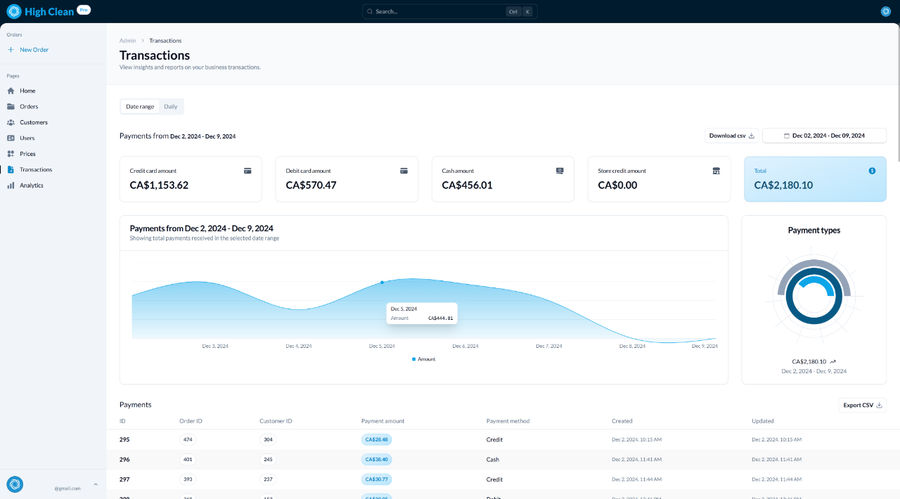
Read the full case study: High Clean Pro MVP
How Much Does MVP Development Cost in 2026?
MVP development costs range from $5,000 to $150,000+ depending on complexity, tech stack, and team structure. Simple no-code MVPs typically run $5K to $15K over 4 to 6 weeks, while complex AI or fintech builds can reach $60K to $150K+ over 4 to 8 months. Here are realistic 2026 ranges based on what we see across our client projects.
If you want an exact estimate tailored to your specific project, contact our team for a free consultation!
MVP Cost Overview Table
MVP Complexity | Est. Cost | Timeline | Best For... |
|---|---|---|---|
Simple / No-Code | $5k - $15k | 4-6 Weeks | Validating ideas, directories, internal tools. |
Medium Custom | $30k - $60k | 2-4 Months | SaaS, mobile apps, marketplaces. |
Complex / AI | $60k - $150k+ | 4-8 Months | Fintech, AI, Real-time social apps. |
For context, the average seed-stage startup in North America raised $3.6 million in 2025 (Crunchbase, 2025), meaning even a complex MVP at $150K represents roughly 4% of a typical seed round. The ROI math heavily favors building an MVP over a full product launch.
We also published a ranked list of the best MVP development companies, if you want to compare options.
Detailed Breakdown by Complexity
1. Simple / No-Code MVP
Ideal for: Founders who need to test a concept fast with minimal budget.
What you get: Standard UI components and basic functionality (e.g., a booking form or directory) built on tools like Bubble or Webflow.
Limitations: Scaling is difficult; you are locked into the platform's constraints.
Examples: Content apps, simple directories, basic booking forms.
2. Medium Complexity / Custom MVP
Ideal for: Most seed-stage startups needing a scalable foundation.
What you get: A custom-coded backend, custom UI design, and essential integrations like Stripe or Twilio.
Why invest here: You own the code, meaning you can scale without rebuilding from scratch later.
Examples: Mobile app development, basic SaaS tools, social platforms with limited features.
3. Complex / AI / High-Scale MVP
Ideal for: Startups with high technical risk or security needs (Fintech, Healthtech).
What you get: Advanced algorithms, real-time data processing, and cross-platform native apps (iOS + Android).
Examples: Uber-like apps, Social networking apps, Fintech apps.
Hidden Costs to Watch: Don't forget to budget for Server costs (AWS/Digital Ocean), Third-party API fees (Twilio, Mapbox, OpenAI), and ongoing maintenance.

Image of Sceene, a social venue discovery app developed by our team at Modall.
Common MVP Mistakes That Kill Startups
Even with a great idea, execution errors can sink you. Avoid these traps.
1. The "Feature Kitchen Sink"
Adding "just one more feature" delays your launch. Every week you delay is a week you aren't learning. Cut until it hurts. In software development, this is referred to as scope creep.
2. Ignoring User Feedback
If users say your UI is confusing, believe them. Don't defend your design; fix it. Founders who fall in love with their solution (rather than the problem) usually fail.
3. Hiring the Cheapest Devs
You get what you pay for. A $15/hour freelancer might build code that works today but breaks as soon as 100 users log in. This creates "Technical Debt" that costs 3x more to fix later.
We see this more often than you’d think. We have had to step in and practically "save" several projects after founders were burned by outsourced overseas developers who promised the world but couldn't ship a functional product.
In the end, you save money by building it right the first time. If you want to avoid the headache, partner with a reputable development team like Modall.
4. Solving a Non-Existent Problem
Building a beautiful app for a problem nobody cares about is a hobby, not a business. Validate Step 1 and Step 2 vigorously.
Moving Beyond the MVP: Scaling Your Product
Once your MVP gains traction, you enter the "Growth" phase. This involves:
Refining UX/UI: Moving from "Viable" to "Lovable" (MLP).
Scaling Infrastructure: Optimizing cloud hosting to handle traffic spikes.
Expanding Features: Adding those "Should-Have" features you cut earlier.
Team Growth: Moving from outsourced dev to an in-house team or a hybrid model.
Understanding your SaaS business model before scaling ensures you're building toward a revenue structure that works.

Source: Tinder
When to Hire an MVP Development Company vs. Build In-House
If your founding team includes a senior full-stack developer with experience shipping production products, building in-house can work for simple MVPs. For everything else, hiring a specialized MVP development company is typically faster and cheaper than recruiting, onboarding, and managing a dev team from scratch.
Consider hiring an agency if: your MVP requires mobile + web, you need to ship in under 4 months, your founding team is non-technical, or you're building in a regulated space (fintech, healthtech) where architectural mistakes are expensive. We wrote a full guide on how to choose an MVP development company that covers what to look for and red flags to avoid.
Consider building in-house if: you have a technical co-founder with relevant experience, your MVP is a single simple web app, or you're planning to make engineering your core competitive advantage from day one.
Frequently Asked Questions (MVP FAQs)
What is the MVP in startup development?
In startup development, an MVP (Minimum Viable Product) is a version of a new product with just enough features to satisfy early customers and provide feedback for future product development. It is a strategy to avoid wasting time building features nobody wants.
Why is MVP important for startups?
It minimizes financial risk. By launching small, you validate your business idea before spending your entire budget. It also allows you to start building a user base and brand awareness much earlier.
What are the benefits of using the minimum viable product method?
Faster Time-to-Market: Launch in months, not years.
Cost Efficiency: Spend money only on what is necessary.
User-Centric Design: Build what users actually ask for, not what you think they want.
Investor Validation: Proof of traction makes raising capital easier.
How to develop an MVP?
The process involves identifying a problem, defining your target audience, prioritizing core features (MoSCoW method), designing and prototyping, developing and testing (Agile), and launching to measure success.
What's the difference between MVP and PoC?
A PoC (Proof of Concept) tests if a specific technology is feasible (e.g., "Can this AI actually read handwriting?"). An MVP tests if the market wants the product (e.g., "Will people pay for an app that reads handwriting?"). PoC comes before MVP.
What is an EVP vs MVP?
EVP stands for "Exceptional Viable Product." While an MVP focuses on "minimal" features to test the market, an EVP aims to launch with a high level of polish and completeness to impress users immediately. EVP is riskier and more expensive, usually reserved for established companies with large budgets protecting their brand reputation.
Is MVP part of Agile?
Yes. MVP is a core concept within the Agile and Lean Startup methodologies. It relies on iterative development, where you release a version, gather feedback, and improve it in short cycles (sprints).
When should you pivot after an MVP?
You should pivot if your data shows that users are not solving their problem with your product, or if the market size is too small. If you see high churn or low engagement despite product improvements, it is time to pivot.
How long should it take to develop an MVP?
For most startups, an MVP should take 2 to 4 months to develop. If it takes longer than 6 months, you are likely over-building. The goal is speed to market.
What features should an MVP include?
An MVP should only include features that are essential to solving the core problem for your target user. Use the MoSCoW method to filter: Must-Have features are the ones your product fails without (typically 3 to 4 maximum). Everything else, including scheduling, notifications, analytics dashboards, and social sharing, gets pushed to v2. If you're unsure whether a feature is essential, cut it. You can always add it back after launch based on real user feedback.
What tech stack is best for building a startup MVP in 2026?
For most startups, a TypeScript-based stack offers the best balance of speed and scalability: React or Next.js on the frontend, Node.js on the backend, Prisma as the ORM, and PostgreSQL for the database. For mobile MVPs, React Native with Expo lets you ship to both iOS and Android from a single codebase. No-code tools like Bubble work for simple validation, but limit your ability to scale or customize later.
Should I use no-code or custom development for my MVP?
It depends on your long-term goals. No-code platforms (Bubble, Webflow) are great for testing a concept in 4 to 6 weeks at $5K to $15K. But if your product needs custom logic, integrations, or you plan to raise funding and scale, custom development gives you full ownership of the codebase and no platform lock-in. Most startups we work with at Modall start with custom development to avoid rebuilding from scratch 6 months later.
How much does MVP development cost for a startup?
MVP development typically costs between $5,000 and $150,000+ depending on complexity. A simple no-code MVP runs $5K to $15K over 4 to 6 weeks. A custom-coded MVP with integrations and custom UI runs $30K to $60K over 2 to 4 months. Complex builds involving AI, real-time data, or cross-platform native apps range from $60K to $150K+ over 4 to 8 months.
What is the difference between an MVP and a prototype?
A prototype is a visual mockup, usually a clickable design in Figma, that shows how the product will look and feel. It has no real functionality behind it. An MVP is a working product with real code, real features, and the ability to serve actual users. You use a prototype to align stakeholders and raise seed funding. You use an MVP to test whether real customers will pay for your solution.
Should I hire an MVP development company or build in-house?
Hire a development company if your team is non-technical, you need both mobile and web, you're working within a 4-month timeline, or you're in a regulated industry like fintech or healthtech. Build in-house if you have a technical co-founder who has shipped production software before and your MVP is a straightforward web app. Most early-stage startups save time and money by partnering with a specialized MVP development company rather than hiring and managing developers from scratch.
What is an MVP example?
Dropbox is a classic example. Instead of building the complex sync software first, the founder made a simple 3-minute video showing how it would work. The video went viral, validating the demand before he wrote the complex code.
Need Help Building Your MVP?
You have a vision. We have the engineering power to build it.
At Modall, we specialize in turning startup ideas into market-ready products. We don't just write code; we act as your strategic technical partner to validate, build, and scale. Whether you need a complex AI app or a streamlined loyalty platform, our team helps you navigate the MVP journey successfully.
Our Toronto-based development team works entirely in-house. We are proud to be a 100% Canadian team. We never outsource, which guarantees clear communication, no timezone headaches, and direct access to the engineers building your product from start to finish.
Proven Results: We don't just talk about shipping; we do it. In 2025 alone, we launched:
3 Mobile Apps: Sceene, Vault Club, 4RGE.
4 Web Platforms: PizzaForno ERP, Endorsa, New Market Trading, Winning Method.
Plus continuous feature deployments for our long-term partners.
Quality is our priority. We are selective with our client list and only take on projects where we know we can hit a grand slam, because your success directly reflects ours.
Ready to launch? Submit our free quote form to discuss your MVP!