

AI in Software Development Is Rewriting How Teams Build Products
AI in software development has shifted from experimental tooling to standard practice in under three years. In 2026, 85% of developers regularly use AI tools for coding, debugging, and code review, and enterprise AI spending is projected to increase by double digits across every major industry. For founders, CTOs, and product leaders evaluating how to build software today, these AI trends and statistics tell you exactly where the industry stands and where it's heading.
This guide compiles 25+ current statistics on AI in software development, drawn from McKinsey, Stanford HAI, JetBrains, Stack Overflow, Deloitte, and GitHub. Every number is sourced and linked.

This article is updated regularly as new data is published. If you're exploring how AI fits into your next build, our team works with these tools daily. Get a free quote to see if we're the right fit.
Key Takeaways
85% adoption: 85% of developers regularly use AI tools for coding and software design, according to the JetBrains 2025 Developer Ecosystem Survey of 24,534 developers.
$2.5 trillion in AI spending: Gartner forecasts worldwide AI spending will total $2.5 trillion in 2026, a 44% increase year-over-year.
46% of code is AI-assisted: Over 46% of newly written code is AI-assisted, projected to reach 60% by end of 2026.
Trust is falling: Only 29% of developers trust AI tool output, down from 70%+ in 2023, according to the Stack Overflow 2025 Developer Survey.
Security risks are real: AI-generated code contains 2.74x more vulnerabilities than human-written code, with 45% of AI code samples failing security tests.
Productivity is nuanced: A METR randomized controlled trial found AI tools made experienced developers 19% slower on familiar codebases, contradicting self-reported productivity gains.
25 AI Software Development Trends for 2026
AI adoption among software developers has crossed the mainstream threshold. The question is no longer whether teams are using AI tools, but how deeply those tools are embedded in daily workflows, how fast the market is consolidating, and what the data says about real productivity versus marketing hype.
Metric | 2023 | 2024 | 2026 |
|---|---|---|---|
Developers using AI tools | ~44% | 76% | 85-92% |
AI-assisted code share | ~15% | ~25% | 46%+ |
Worldwide AI spending | $154B | $300B+ | $2.5T |
Developer trust in AI | 70%+ | 40% | 29% |
The 25 trends below cover every major shift: coding tool adoption, agentic AI workflows, enterprise investment patterns, workforce changes, and security risks. Each one is sourced and linked.
AI Coding Tools and Developer Productivity Trends
AI coding assistants have gone from novelty to infrastructure in under two years. The data below tracks exactly how fast adoption is moving, where the productivity gains are real, and where the gaps remain.
1. 85% of Developers Now Use AI Coding Tools
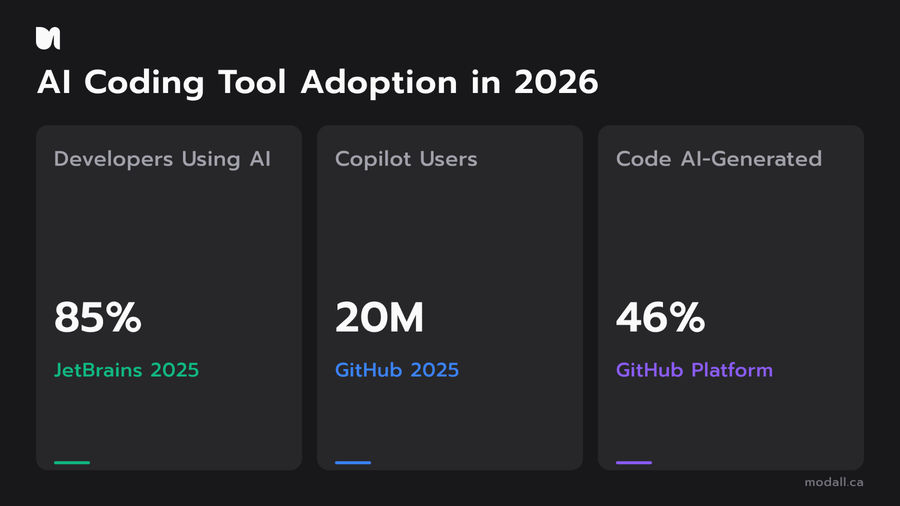
AI-assisted development crossed the mainstream threshold in 2025. According to the JetBrains State of Developer Ecosystem 2025, 85% of professional developers regularly use AI tools for coding and development, with 62% relying on at least one AI coding assistant in their daily workflows.
Stack Overflow's 2025 Developer Survey puts the figure at 84% using or planning to use AI tools, up from 76% in 2024. The gap between "experimenting" and "using daily" is closing fast: 51% of professional developers now report using AI tools every single day.
2. GitHub Copilot Reaches 20 Million Users and 90% of the Fortune 100
GitHub Copilot hit 20 million cumulative users in July 2025, adding 5 million users in just three months. By January 2026, the tool had 4.7 million paid subscribers, a 75% year-over-year increase. More than 50,000 organizations now use Copilot, including 90% of Fortune 100 companies.
This isn't a developer side project anymore. When nine out of ten Fortune 100 companies are paying for AI coding tools, the technology has moved from "nice to have" to procurement line item.
3. Four Tools Now Dominate a $7.37 Billion Market
The AI coding tools market isn't a one-horse race anymore. It's a four-way battle. Cursor surpassed $2 billion ARR in Q1 2026, doubling its revenue in three months and entering talks for a $50 billion valuation. GitHub Copilot holds 37 to 42% enterprise market share, making it the most widely deployed tool by headcount. Anthropic's Claude Code, launched in May 2025, became the most-loved AI coding tool with a 46% developer satisfaction rating versus Cursor's 19% and Copilot's 9%. And OpenAI's Codex grew to over 2 million weekly active users by March 2026, tripling since its desktop app launch in February.
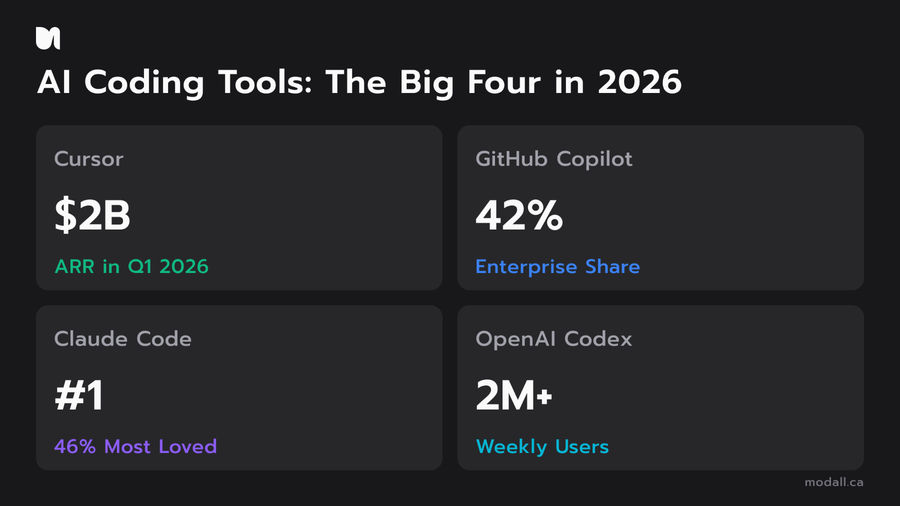
The broader market reached $7.37 billion in 2025, projected to hit $23.97 billion by 2030. Developers now use an average of 2.3 tools simultaneously, meaning these platforms compete less on exclusivity and more on where they fit in the workflow. For teams evaluating which tools to standardize on, the answer increasingly is: more than one.
4. AI Now Generates 46% of All New Code
GitHub reports that AI coding assistants now generate 46% of code written by developers on the platform. Gartner projects this will reach 60% of all new code by the end of 2026.
The implication for custom software development is significant: code generation is increasingly automated, but code quality, architecture decisions, and system design are where human developers add the most value. The ratio of "writing code" to "designing systems" is shifting permanently.
5. Developers Complete Tasks 55% Faster With AI Assistance
A GitHub study of 4,800 developers found that tasks were completed 55% faster when using Copilot. Developers using AI tools daily merge roughly 60% more pull requests than those who don't. The average developer saves 3.6 hours per week with AI coding assistants.
These numbers are real, but they come with a caveat: the biggest gains appear on well-defined, repetitive tasks (boilerplate code, test scaffolding, documentation). Complex architecture work and novel problem-solving see smaller improvements.
The most rigorous counterpoint comes from METR's randomized controlled trial, the only study using true experimental methodology rather than self-reported surveys. METR tested 16 experienced open-source developers working on their own repositories (averaging 22,000+ stars and 1 million+ lines of code), randomly assigning tasks to allow or disallow AI tool use. The result: AI tools made these developers 19% slower (confidence interval: +2% to +39%). Critically, the developers themselves estimated they were 20% faster with AI, when they were actually slower.
This doesn't invalidate the 55% gains. It clarifies where they apply. AI helps most on unfamiliar codebases and routine tasks. On codebases developers know deeply, the overhead of prompting, reviewing, and correcting AI output can exceed the time it saves. McKinsey found that 57% of top-performing organizations invested in hands-on AI workshops and coaching, compared to only 20% of bottom performers, suggesting the productivity gap is as much about training and process as it is about tooling.
6. Pull Request Cycle Times Drop 75%
One of the most concrete productivity metrics: pull request turnaround dropped from 9.6 days to 2.4 days for teams using AI coding tools, a 75% reduction. This isn't just about writing code faster. AI assists with PR descriptions, code review suggestions, and automated test generation, compressing the entire review cycle.
For teams running agile development sprints, this means more iterations per sprint, faster feedback loops, and shorter time to production.
7. The Trust Gap: Only 29% of Developers Trust AI Output
Speed gains don't mean blind trust. Developer trust in AI tools has declined sharply: from over 70% positive sentiment in 2023, to 40% in 2024, to just 29% in 2025, according to Stack Overflow's year-over-year survey data. The steeper the adoption curve, the steeper the trust decline.
The biggest frustration, cited by 66% of developers, is dealing with "AI solutions that are almost right, but not quite." 45% say debugging AI-generated code is more time-consuming than writing it manually. This trust decline likely reflects increased experience: developers who have used AI tools longer understand their failure modes better.
The practical takeaway: AI tools are accelerating specific parts of development, but code review, security scanning, and human validation remain non-negotiable. Teams that skip review to capture speed gains end up paying for it in production bugs and security vulnerabilities.
Agentic AI and Development Workflow Trends
The shift from AI copilots to AI agents represents the most significant change in software development workflows since the move to cloud infrastructure. Agents don't just suggest code; they research, execute, iterate, and validate across multi-step tasks.
8. Agentic AI Replaces Copilots as the Primary Development Model
In 2024, the industry was dominated by copilots: tools that draft, suggest, and assist. In 2026, the standard is shifting to agents: tools that research, act, and iterate without step-by-step human direction. Anthropic's 2026 Agentic Coding Trends Report documents this shift, noting that developers now function more as AI orchestrators who direct agents, validate results, and make strategic decisions.
The distinction matters for anyone building software. A copilot writes a function when asked. An agent refactors an entire module, writes tests, runs them, fixes failures, and opens a pull request. The human reviews outcomes, not inputs.
9. Multi-Agent System Inquiries Surge 1,445%
Gartner reported a 1,445% surge in multi-agent system inquiries from Q1 2024 to Q2 2025. Organizations aren't just curious about single AI assistants anymore. They want systems where multiple specialized agents coordinate: one handles code generation, another runs tests, a third manages deployment pipelines.
McKinsey's data supports this: 62% of organizations are experimenting with AI agents, with 23% already scaling agentic AI systems within their organizations.
10. Coding Agent Sessions Grow From 4 Minutes to 23 Minutes
Anthropic's data shows that average coding agent session length increased from 4 minutes to 23 minutes between Q1 2025 and Q1 2026. Agents are handling longer, more complex tasks rather than quick one-off completions. The average session now involves 47 tool calls, meaning the agent is reading files, writing code, running commands, and iterating autonomously across dozens of steps.

This is a fundamental shift in how developers interact with AI. Instead of asking for a function, they're delegating entire features.
11. 78% of Agent Coding Sessions Now Involve Multi-File Edits
In Q1 2025, only 34% of Claude Code sessions involved multi-file edits. By Q1 2026, that number reached 78%. Agents are no longer limited to editing a single file. They're making coordinated changes across codebases, updating imports, modifying tests, and adjusting configurations in a single session.
For teams building complex SaaS platforms or multi-service architectures, this changes the calculus on what can be delegated to AI versus what requires human coordination.
12. 57% of Organizations Deploy Multi-Step Agent Workflows
More than half of organizations (57%) now deploy multi-step AI agent workflows in their development processes, according to industry surveys. These aren't simple autocomplete tools. They're structured pipelines where agents handle sequential tasks: analyze requirements, generate code, write tests, execute tests, fix failures, and prepare deployment artifacts.
The organizations seeing the biggest returns are those that treat agent workflows as infrastructure, building repeatable pipelines rather than relying on ad-hoc prompting.
13. Task Horizons Expand From Minutes to Days
Early AI coding tools operated in seconds or minutes: generate a function, complete a line. Anthropic's report documents that agent task horizons are expanding to hours and even days, with agents building entire features, running comprehensive test suites, and managing complex refactoring projects with minimal human intervention.
Organizations like TELUS report saving over 500,000 hours through agentic coding, while Rakuten achieved 99.9% accuracy on massive codebase migrations that would have taken human teams weeks.
Enterprise AI Adoption and Investment Trends
Enterprise adoption of AI in software development is accelerating, but the gap between investment and execution remains wide. The data shows where the money is going, where the returns are materializing, and where organizations are getting stuck.
14. 88% of Organizations Use AI in at Least One Business Function
McKinsey's 2025 global survey found that 88% of organizations are using AI in at least one business function, up from 78% the previous year and 55% in 2023. AI has crossed the adoption threshold faster than cloud computing, mobile, or any previous enterprise technology wave.
The most advanced AI initiatives are concentrated in IT (28%), operations (11%), marketing (10%), customer service (8%), and cybersecurity (8%). Software development sits at the center of the IT function where AI investment is heaviest.
15. Generative AI Business Use Doubles in a Single Year
Stanford HAI's AI Index Report confirmed the acceleration: generative AI use in business functions jumped from 33% to 71% between 2023 and 2024. That's not incremental adoption. It's a doubling in 12 months.
For software teams, this means that the applications they build increasingly need to integrate AI capabilities. Building software without considering AI integration is like building web applications without considering mobile in 2015. The market has shifted.
16. AI Projected to Drive 30-35% Productivity Gains Across Software Development
Deloitte's 2026 Software Industry Outlook projects that AI could drive productivity gains of 30% to 35% across the software development process. The report notes that established software companies are moving from adding AI features to adopting AI-first engineering, a fundamental change in how software organizations operate.
These gains aren't evenly distributed. Code generation and testing see the largest improvements, while requirements gathering and system design show smaller gains. The teams that benefit most are those that restructure their workflows around AI capabilities rather than bolting AI onto existing processes.
17. 78% of Organizations Plan to Increase AI Spending This Year
Nearly 78% of organizations expect to increase their overall AI spending this fiscal year, according to Deloitte. CIOs plan to increase software spending by 3.9% in 2026, with AI capabilities driving much of that growth. About half of global venture capital in 2025 was directed to AI-focused companies, with funding reaching $211 billion.
The investment is real. The question for most organizations is whether their development teams can absorb and operationalize the AI tools that leadership is buying.
18. Only 16% of Enterprises Have Scaled AI Organization-Wide
Here's the gap. While 88% of organizations use AI somewhere and 78% are increasing spend, IBM's CEO study found that only 16% have scaled AI across the enterprise. Only 25% of AI initiatives have delivered expected ROI in recent years.
The bottleneck isn't technology or budget. It's implementation: integration with existing systems, change management, talent gaps, and unclear ownership. For companies evaluating custom software projects, this data argues for starting with focused, high-impact AI integrations rather than trying to transform everything at once.

19. Custom Software Development Market Growing at 22.71% CAGR
The global custom software development market is projected to grow from $53 billion in 2025 to $334 billion by 2034, a 22.71% CAGR according to Precedence Research. AI is the primary catalyst: organizations need custom solutions to integrate AI into their specific workflows, and off-the-shelf software can't deliver the differentiation they need.
This growth rate outpaces nearly every other segment of the IT industry, signaling that demand for specialized, AI-capable software is accelerating even as AI tools make certain types of development faster.
Workforce, Talent, and Developer Role Trends
AI is not replacing software developers. It's restructuring what they do, who joins the profession, and what skills matter most. The labor market data tells a story of expansion and transformation, not contraction.
20. 327,900 New Software Developer Jobs by 2033
The U.S. Bureau of Labor Statistics projects 17% job growth for software developers from 2023 to 2033, adding approximately 327,900 new positions. This is significantly faster than the average across all occupations. Morgan Stanley projects the software development market could grow at a 20% annual rate, reaching $61 billion by 2029.
AI is creating jobs by expanding what's possible in software, not eliminating the people who build it. More software is being built for more use cases, and that requires more developers, even if each developer is more productive.
21. 90% of Engineers Shifting From Coding to AI Orchestration
Gartner predicts that by 2026, 90% of software engineers will shift from hands-on coding to AI process orchestration. This doesn't mean engineers stop understanding code. It means the primary skill becomes directing AI agents effectively, reviewing their output, designing system architecture, and making judgment calls that AI can't.
The engineers who thrive in this model are those who combine deep technical understanding with the ability to decompose complex problems into tasks that agents can execute reliably.
22. Non-Traditional Backgrounds Rising From 20% to 40% by 2028
Gartner predicts that by 2028, the share of software development team members from nontraditional technical backgrounds will rise from 20% to 40%. AI tools are lowering the barrier to entry, enabling people with domain expertise in healthcare, finance, and logistics to contribute directly to software development.
For companies building MVP products, this trend means that hiring for domain knowledge alongside technical skill is becoming a viable strategy. A healthcare expert who can direct AI coding tools may deliver more value than a generalist developer who doesn't understand the compliance landscape.
23. Low-Code and No-Code Reaches $52 Billion
The global low-code and no-code market is projected to reach $52 billion in 2026, growing nearly four times larger than it was in 2020. Gartner forecasts that 70% of new applications will use low-code or no-code technologies by 2026, and by 2028, 80% of technology products will be built by people who are not professional software developers.
AI is the engine powering this expansion. Low-code platforms enhanced with AI can interpret natural language requirements and generate working application logic, blurring the line between "building software" and "describing what you need."
Security, Code Quality, and Governance Trends
AI accelerates output but introduces specific risks that development teams need to measure and manage. The security data in particular should inform how any organization integrates AI into production workflows.
24. AI-Generated Code Has 2.74x More Vulnerabilities Than Human-Written Code
Veracode's research across more than 100 LLMs found that AI-generated code has 2.74x more vulnerabilities than human-written code. AI-generated code is 1.91x more likely to introduce insecure object references, 2.74x more likely to add cross-site scripting vulnerabilities, and 1.88x more likely to implement improper password handling.
The category-level data is just as concerning. AI-generated code was 1.75x more likely to introduce logic and correctness errors, 1.64x more likely to create code quality issues, 1.57x more likely to contain security findings, and 1.42x more likely to cause performance issues. The CVE data is accelerating in real time: at least 35 new CVE entries disclosed in March 2026 were the direct result of AI-generated code, up from 6 in January and 15 in February. As AI-generated code enters production at scale, the vulnerability surface is growing faster than security review capacity.
A critical finding: newer, larger models do not produce more secure code. While syntax pass rates improved from 50% to 95% since 2023, security pass rates have remained flat between 45% and 55% regardless of model generation. Models prioritize functional correctness over security, and training data includes vast amounts of insecure code from public repositories. The security problem is structural, not temporary.
This is exactly why vibe coding without structured review is risky for production applications, especially in regulated industries.
25. 72% of QA Teams Now Use AI for Test Generation
On the quality assurance side, the adoption story is more positive. 72% of QA professionals now use AI for test generation and script optimization, with 82% saying AI is critically important to the future of testing. The global software testing market is projected to reach $112.5 billion by 2034.
AI in testing is a natural fit because the task is well-defined: generate test cases from requirements, identify edge cases from code analysis, and flag regressions in CI/CD pipelines. Generative AI is now ranked as the #1 skill for quality engineers (63%), ahead of traditional automation expertise. For teams building production software, AI-powered testing may be the highest-ROI application of AI in the entire development lifecycle.
What These AI Trends Mean for Teams Building Software Today
The 25 trends above tell a clear story, but the practical implications depend on where you sit. If you're a founder or CTO evaluating how to build a product, the data says three things.
First, AI tools are now table stakes. 80% of new developers on GitHub use Copilot within their first week on the platform. If your development team isn't using AI coding tools, they're operating at a structural disadvantage.
Second, the gains are real but uneven. The biggest productivity improvements show up in boilerplate code, test scaffolding, and documentation. Architecture decisions, security review, and business logic still require experienced humans. Morgan Stanley's internal AI tool saved developers 280,000 hours, but the company didn't eliminate its engineering team.
Third, the scaling gap (Trend #18) matters more than most headlines suggest. Nearly three-quarters of organizations say their advanced GenAI initiative is meeting or exceeding ROI expectations, yet only 16% have scaled AI across the enterprise. The bottleneck is implementation, not technology.
The infrastructure shift is worth watching too. Over 1.1 million public repositories now use LLM SDKs, and TypeScript has overtaken Python and JavaScript as the most-used language on GitHub, partly driven by the demand for typed languages that support reliable agent-assisted development. If you're building AI-integrated platforms, the ecosystem is maturing fast.
For companies evaluating custom software development in Canada, the takeaway is this: integrating AI into your development process isn't optional if you want to remain competitive, but the implementation approach matters more than the technology choice.
The AI Security Gap That Isn't Closing
The vulnerability data in Trend #24 becomes more concerning when you factor in the talent shortage. Organizations report difficulty filling the roles that would address AI code security: AI specialist positions (28% of companies report shortages), IT security engineers (16%), and cybersecurity engineers (13%). When AI generates code at 10x the speed but security review capacity stays flat, vulnerabilities compound.
Deloitte found that the top challenges when deploying generative AI include regulatory compliance concerns (38%), risk management difficulties (32%), and implementation hurdles (27%). For teams in regulated industries like healthcare, finance, and government, this means AI-assisted development requires clear guardrails: automated security scanning, mandatory human review for business-critical logic, and compliance validation built into the CI/CD pipeline.

We've documented cases where AI-generated code introduced production issues that would have been caught by experienced developers during review. The teams shipping reliable software are the ones treating AI as a co-pilot, not an autopilot.
AI Development Tools to Know in 2026
The market has moved well beyond "Copilot vs. Cursor." Here's how the current tool landscape breaks down by what each category actually does.
Code Generation and AI-Assisted IDEs
These are the daily drivers.
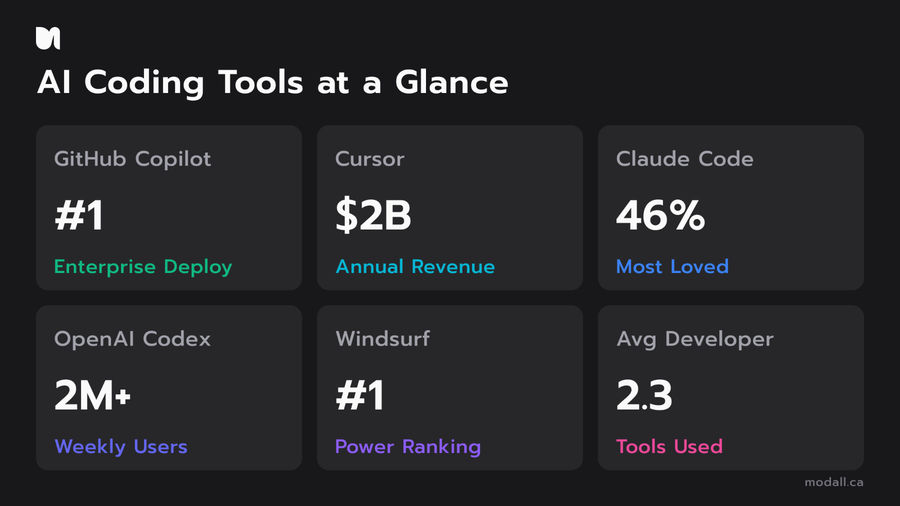
GitHub Copilot remains the most widely deployed by enterprise headcount, embedded across VS Code and the broader GitHub ecosystem.
Cursor is the commercial leader at $2B ARR, purpose-built as an AI-native IDE.
Claude Code runs in the terminal as an agentic coding tool and leads developer satisfaction at 46%.
OpenAI Codex handles autonomous multi-step tasks in a cloud sandbox and has crossed 2M weekly active users.
Windsurf (formerly Codeium) has 1M+ active users and ranked #1 in the LogRocket AI Dev Tool Power Rankings as of February 2026.
Most developers use 2.3 of these tools simultaneously, picking different ones for different tasks.
AI App Builders (Vibe Coding)
A newer category that lets non-developers (and developers prototyping fast) describe what they want and get working code.
Lovable produces clean React components with shadcn/ui out of the box.
Bolt.new offers the most framework flexibility.
Replit Agent is the most autonomous, with 30+ integrations and built-in deployment.
v0 by Vercel generates polished Next.js apps with built-in databases.
These tools are excellent for prototyping and MVP development, but production applications with compliance requirements, complex business logic, or security needs still require professional development and review.
Code Quality and Testing
As AI writes more code (46% of commits are now AI-assisted), the need for automated quality gates grows proportionally. This category is less about writing code and more about catching what the code generators get wrong.
Qodo (formerly CodiumAI) is the most complete dedicated solution, recently raising $70M in Series B funding. It runs 15+ automated agentic workflows that handle bug detection, test coverage, documentation, and cross-repo dependency checks on every PR.
CodeRabbit is the most widely installed AI code review app on GitHub and GitLab, with 2M+ repositories connected and over 13M pull requests processed. It combines 40+ linters and security scanners with AI-powered contextual review.
Snyk Code handles security-specific static analysis (SAST), scanning source code for exploitable vulnerabilities before changes merge. Most teams layer it alongside a general review tool.
SonarQube remains the most mature open-source option for rule-based code quality enforcement across 21 languages. It's predictable where AI reviewers are probabilistic, so the best teams run both.
Teams using AI code review report 40-60% less time spent on reviews while improving defect detection rates.
Autonomous Agents
The shift from AI assistants to fully autonomous agents accelerated in early 2026.
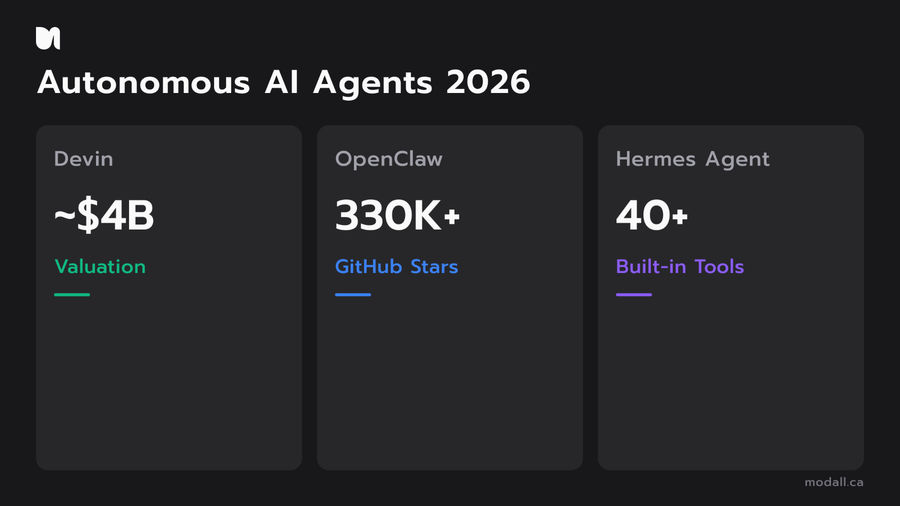
Devin by Cognition AI remains the most recognized name here, operating as a standalone software engineer with its own environment, terminal, and browser. Cognition doubled its valuation to nearly $4 billion, and Devin 2.0 now completes 83% more tasks per compute unit than its first version. Goldman Sachs is piloting it alongside their 12,000 human developers. Pricing starts at $20/month for individuals, but enterprise teams pay $500/month or more for meaningful usage.
OpenClaw took the open-source route and grew faster than almost any project in GitHub history, hitting 330,000+ stars with over 1,000 contributors in roughly four months. Originally built as a messaging-first AI agent (it connects to Telegram, WhatsApp, Slack, Discord, and 20+ other platforms), OpenClaw now handles autonomous coding workflows at a fraction of Devin's cost. Nvidia released NemoClaw in March 2026, a dedicated security add-on built specifically for OpenClaw enterprise deployments.
Hermes Agent by Nous Research focuses on persistent memory and self-improvement. After complex tasks (typically 5+ tool calls), Hermes autonomously creates reusable skills, essentially teaching itself shortcuts for similar future work. It ships with 40+ built-in tools and six terminal backends, and runs on a $5/month VPS. Since launching in February 2026, it's reached 8,800+ GitHub stars and is gaining traction with developers who want an agent that learns their codebase over time.
For teams evaluating AI-assisted development workflows, the distinction between "tools that help you code" and "agents that code for you" is now the most important architectural decision in the stack.
How We Approach AI in Software Development at Modall
At Modall, we're a custom software development company based in Ontario, Canada, founded in 2019. Our team uses AI tools daily across every phase of the development lifecycle, from code generation and testing to documentation and code review. We've seen firsthand how AI accelerates delivery without replacing the judgment calls that determine whether a product actually works in production.
Our approach is practical, not hype-driven. We use AI coding assistants for boilerplate generation, test scaffolding, and documentation, but every line of production code goes through human review.
For AI-integrated software projects, we build AI capabilities directly into the application architecture, connecting tools like OpenAI's API with our TypeScript, React, Next.js, and PostgreSQL stack to create systems that are both intelligent and maintainable.
We've applied this approach across project types: SaaS platforms with AI-powered features, ERP platforms with AI reputation management, AI powered Google Review tools, and our own AI-powered headless CMS!

The common thread is that AI amplifies what a focused, experienced development team can deliver, but it doesn't replace the need for one.
If you're planning a software project and want to understand how AI can fit into your development process without introducing unnecessary risk, get a free quote and we'll walk through the options with you.
Frequently Asked Questions
How is AI used in software development?
AI is used across the entire software development lifecycle. The most common applications include code generation and autocompletion (tools like GitHub Copilot and Cursor), automated testing and test generation, code review and bug detection, documentation generation, and CI/CD pipeline optimization. According to JetBrains' 2025 survey, 62% of developers rely on at least one AI coding assistant in their daily workflows, with code writing and debugging as the top use cases.
Will AI replace software developers?
The data consistently points to augmentation, not replacement. The U.S. Bureau of Labor Statistics projects 17% job growth for software developers through 2033, adding nearly 328,000 new positions. Morgan Stanley's research frames AI as creating jobs by expanding what's possible in software, not eliminating the people who build it. What is changing is the skill mix: developers who can effectively direct AI tools and review AI-generated output are becoming more valuable than those who write every line manually.
What percentage of developers use AI coding tools?
As of 2025, 85% of developers regularly use AI tools for coding and development according to JetBrains, and 84% are using or planning to use AI tools according to Stack Overflow's Developer Survey. This represents a significant jump from 76% in 2024, indicating that AI adoption in software development is accelerating year over year.
How much does AI improve developer productivity?
Productivity gains vary by task type. Morgan Stanley's internal tool saved developers 280,000 hours in its first months. Deloitte projects 30-35% productivity gains across the software development process. However, METR's randomized controlled trial found that experienced developers on familiar codebases were actually 19% slower with AI tools, showing that the context and task type matter significantly. Trust remains a factor too: 46% of developers distrust AI output accuracy, which means time saved on generation is partially offset by time spent on review and correction.
What are the biggest risks of AI-generated code?
Security is the top concern, with 51% of tech leaders naming it the biggest challenge in software development. Veracode found AI-generated code has 2.74x more vulnerabilities than human-written code, and the CVE data is accelerating: 35 new AI-caused CVEs in March 2026, up from 6 in January. Other key risks include unreliable code output (45% of leaders flagged this), regulatory compliance gaps (38%), and a shortage of qualified security talent to review AI-generated code at scale. Teams working in regulated industries or building compliance-focused software need structured review processes and automated security scanning to mitigate these risks.
Is AI-generated code getting more secure over time?
No. This is one of the most important findings in the current data. Veracode's research found that newer, larger models do not generate significantly more secure code than their predecessors. While syntax pass rates improved from 50% to 95% since 2023, security pass rates have remained flat between 45% and 55% regardless of model generation. The security problem is structural: models prioritize functional correctness over security, and training data includes vast amounts of insecure code. Human security review remains essential for any production deployment.
The Bottom Line on AI in Software Development
AI in software development is no longer a trend to watch. It's the operating environment. The tools are maturing, the investment is real, and the teams that integrate AI strategically are shipping faster without sacrificing quality. But the data also shows that speed without oversight creates compounding risk, especially in security, compliance, and code reliability.
The organizations getting the most value aren't the ones adopting the most tools. They're the ones matching the right AI capabilities to the right parts of their workflow, and keeping experienced developers in the loop where it counts.
At Modall, we build software this way every day. If you're planning a project and want a team that understands both the opportunity and the risk, get a free quote and let's talk.
Sources: Gartner (2026 AI Spending Forecast, IT Spending Forecast, Agentic AI Predictions), McKinsey & Company (State of AI 2025, AI Revolution in Software Development), Stack Overflow 2025 Developer Survey, JetBrains 2025 Developer Ecosystem Survey, METR (Randomized Controlled Trial on AI Developer Productivity), Veracode GenAI Code Security Report, Anthropic 2026 Agentic Coding Trends Report, Stanford HAI AI Index Report, Deloitte 2026 Software Industry Outlook, Morgan Stanley, GitHub Octoverse, Fortune Business Insights, IBM CEO Study, U.S. Bureau of Labor Statistics.