

Vibe Coding Security Risks Are Growing Faster Than Adoption
Vibe coding security risks are no longer theoretical. In March 2026 alone, Georgia Tech's Vibe Security Radar tracked 35 new CVE entries directly caused by AI-generated code, up from just six in January. The same month, one of the most hyped AI platforms of the year had already proven what happens when security is skipped: 1.5 million API keys leaked because a founder shipped a vibe coded app without a single security review.
If you're a founder using AI tools to build your product, or considering it, the data should change how you think about what "done" means.
If you're evaluating how to build software safely in the age of AI, get a free quote to talk through your project with our team.
What Vibe Coding Is and Why It's Everywhere in 2026
Vibe coding is the practice of using AI tools like Claude Code, ChatGPT (Codex), Cursor, Perplexity Computer, or other agentic AI coding platforms to generate entire applications from natural language prompts. Instead of writing code line by line, you describe what you want and the AI produces it. The term was coined by Andrej Karpathy in early 2025, and by 2026, surveys indicate that 92% of US-based developers use some form of AI coding assistance in their workflow.
The appeal is obvious: speed. A founder can go from idea to working prototype in hours rather than weeks. For early-stage startups building MVPs, this sounds like a shortcut to market. And for simple tools and internal scripts, it often works fine.
The problem starts when that prototype becomes the production app. AI code generators optimize for functionality, not security. They produce code that works, but "works" and "works safely" are very different things.
The Data: How Vulnerable Is AI-Generated Code?
The vulnerability rates in AI-generated code are well documented and consistently alarming across multiple independent studies.
A large-scale comparison of major LLMs published in Empirical Software Engineering analyzed 331,000 C programs generated by models including GPT-4o-mini, Gemini Pro, and Code Llama. The result: at least 62% of generated programs contained security vulnerabilities detected through formal verification.
Veracode's 2025 GenAI Code Security Report tested over 100 LLMs across 80 coding tasks and found that 45% of AI-generated code introduced OWASP Top 10 vulnerabilities. Java was the riskiest language at a 72% failure rate, with Python and JavaScript hovering between 38% and 45%.
Research consistently shows that 40% to 62% of AI-generated code contains security vulnerabilities, with AI-written code producing flaws at 2.74 times the rate of human-written code.
The recognition of this problem has reached the industry's highest levels. OWASP added a dedicated category to its Top 10 in 2025, specifically calling out vibe coding as a security risk pattern that development teams need to address.

These risks are growing fast. In 2026, AI generates 46% of all new code on GitHub, and that percentage is projected to hit 60% by year-end.
The Six Most Common Vibe Coding Vulnerabilities
AI generated code vulnerabilities follow predictable patterns. Understanding these categories helps founders know exactly what to look for when reviewing vibe coded applications.
Vulnerability Type | What Happens | Real-World Impact |
|---|---|---|
Hard-coded secrets | AI embeds API keys, database credentials, and tokens directly in source code | Credentials committed to repositories and exposed publicly |
SQL injection | AI skips input sanitization and parameterized queries | Attackers read, modify, or delete your entire database |
Broken authentication | AI implements auth on the client side or skips it entirely | Anyone can access admin functions or user data |
Dependency confusion | AI suggests packages that don't exist; attackers register them | Malicious code runs inside your application |
Remote code execution | AI uses unsafe deserialization or eval() patterns | Attackers run arbitrary commands on your server |
Cross-site scripting (XSS) | AI outputs user input without encoding or escaping | Attackers inject scripts that steal sessions or data |
The pattern across all six: AI prioritizes making the feature work. Security is a non-functional requirement, and the models treat it as secondary. When Veracode tested whether AI models would choose between a secure and insecure method, they chose the insecure option 45% of the time.
What makes this particularly dangerous for founders: if you don't have security expertise on your team, you won't recognize these patterns in the generated code. The app runs, the feature works, and the vulnerability sits in production until someone finds it.
Case Study: How Moltbook Leaked 1.5 Million API Keys in Three Days
The Moltbook breach is the clearest example of what happens when vibe coded app security is treated as an afterthought.
Moltbook launched on January 28, 2026 as an AI social network where autonomous agents could interact. Its founder publicly stated he "didn't write a single line of code," relying entirely on AI tools to build the platform. Within three days, security researchers at Wiz discovered the application had exposed its entire production database, including 1.5 million API authentication tokens, 35,000 email addresses, and private messages between agents.
The root cause was a misconfigured Supabase deployment. The AI-generated code exposed the Supabase API key in client-side JavaScript without enabling Row Level Security (RLS) policies. With RLS properly configured, the public API key acts like a harmless project identifier. Without it, that key grants full database access to anyone who has it.
An attacker with those credentials could impersonate any agent on the platform, post content, send messages, and access all stored data. The Moltbook team secured the issue within hours with help from security researchers, but the damage to trust was immediate and total.
This wasn't a sophisticated attack. It was a configuration error that any experienced developer would catch in code review. The AI tool generated functional code, but it didn't generate safe code. And because no one on the team had the expertise to audit the output, the vulnerability shipped to production on day one.

If your app was built with AI tools and hasn't had a professional security review, Modall's vibe code cleanup and recovery service starts with a codebase audit that catches exactly these kinds of issues before they become breaches.
The CVE Spike: AI Code Vulnerabilities Are Now Being Tracked
The scale of vibe coding security risks is now large enough that researchers are formally tracking it. Georgia Tech's Systems Software and Security Lab (SSLab) launched the Vibe Security Radar in May 2025 to monitor CVE entries directly caused by AI-generated code.
Their methodology: pull data from public vulnerability databases (CVE.org, NVD, GitHub Advisory Database, OSV, RustSec), find the commit that fixed each vulnerability, then trace backward to determine whether AI coding tools introduced the bug.
The March 2026 numbers tell the story: 35 CVEs directly attributed to AI-generated code, compared to 15 in February and 6 in January. Across all 74 confirmed cases, the breakdown by tool shows Claude Code responsible for 27, GitHub Copilot for 4, Devin for 2, and Aether and Cursor for 1 each.
Georgia Tech researchers estimate the actual number of AI-introduced vulnerabilities is 5 to 10 times what they currently detect, projecting 400 to 700 cases across the open-source ecosystem.
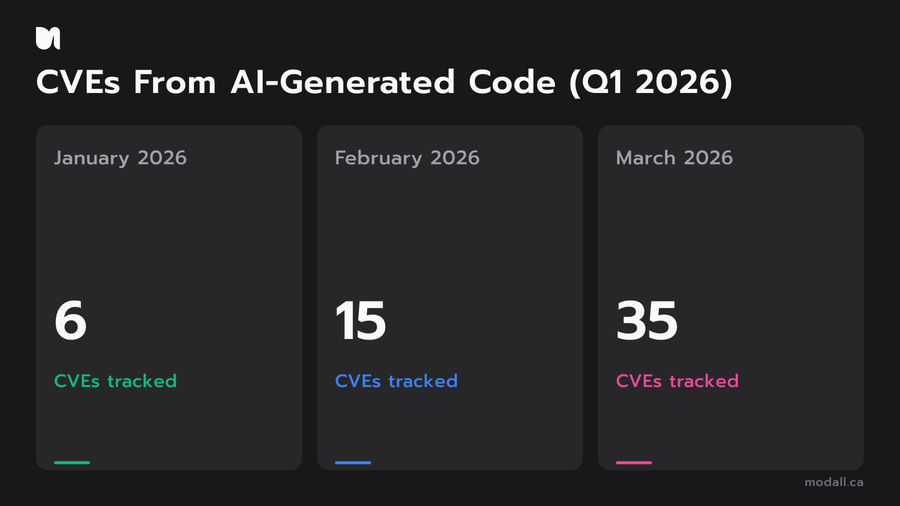
The trajectory matters more than the absolute numbers. The growth from 6 to 35 CVEs in three months reflects both increased adoption of AI coding tools and the expanding attack surface these tools create. As more founders and teams ship AI-generated code without security review, the volume of publicly disclosed vulnerabilities will continue to accelerate.
Already shipping a vibe coded app? Modall's vibe code recovery process is built specifically for founders who need to find and fix these vulnerabilities before they show up in a CVE database.
Why This Should Change How Founders Build
If you're a founder building with AI tools, the question isn't whether to use them. It's whether you have the process in place to catch what they miss.
The core issue is what security researchers call the "comprehension gap." When a developer writes code manually, they understand what each line does, why it's there, and how it interacts with the rest of the system. When AI generates the code, that understanding often doesn't transfer. The founder or developer accepting the output may not know enough to spot a missing RLS policy, an unparameterized query, or credentials hardcoded into a client-side bundle.
This gap is especially dangerous for early-stage companies. Startups often move fast by design, and creating an app typically prioritizes speed to market. But the cost of a security breach, both financial and reputational, can end a startup before it gains traction. A data breach notification alone can cost tens of thousands of dollars in legal and compliance fees, and for consumer-facing apps, user trust rarely recovers.
The business case for security review is straightforward: a professional code audit before launch costs a fraction of what breach remediation costs after. And unlike the AI tools generating the code, an experienced development team understands your specific architecture, your data model, and the regulatory environment your product operates in.
Three practical steps every founder using AI code should take:
Treat AI output as untrusted code. Every function, API call, and database query should be reviewed the same way you'd review code from a junior developer you've never worked with.
Run automated security scanning. SAST (Static Application Security Testing) and SCA (Software Composition Analysis) tools catch many common vulnerability patterns automatically. They're not a substitute for expert review, but they're a minimum baseline.
Get a professional ai code security audit before launch. An experienced development team can identify configuration errors, dependency risks, and authentication gaps that automated tools miss. This is the single highest-ROI security investment a founder can make.
How We Approach This at Modall
At Modall, we're a custom software development agency based in Ontario, Canada, founded in 2019. We build web applications, mobile apps, and AI-integrated platforms for startups and enterprises, and security is built into our development process from day one.
We use AI tools internally, but every line of AI-generated code goes through the same review process as human-written code. Our team reviews for input validation, authentication logic, secrets management, and dependency integrity before anything reaches staging, let alone production.
We've also seen enough broken vibe coded apps come through our door that we built a dedicated vibe code cleanup and recovery service around it. The process starts with a paid Discovery phase, where our engineers review architecture, security vulnerabilities, database structure, and dependency health top to bottom. The output is a full technical assessment: what's broken, what's salvageable, and what needs to be rebuilt, along with a prioritized recovery roadmap and budget estimate. From there, recovery runs in sprint-based cycles, covering security hardening, architecture refactoring, performance optimization, and whatever else the codebase needs to reach production grade.
If you've built with AI tools and want to make sure your product is secure before launch, or if you've already shipped and need professional engineering to fix what's broken, book a free consultation with our team.
Frequently Asked Questions
What are the biggest vibe coding security risks?
The most common vibe coding security risks include hard-coded API keys and secrets, SQL injection from missing input validation, broken or missing authentication, vulnerable dependencies from hallucinated packages, remote code execution through unsafe deserialization, and cross-site scripting. Research shows that AI-generated code contains vulnerabilities 40% to 62% of the time, with models choosing insecure coding patterns nearly half the time when given a choice.
Is vibe coded software safe for production use?
Vibe coded software is not inherently safe for production. The Moltbook breach demonstrated that a fully vibe coded application can expose millions of records within days of launch. However, vibe coded software can be made production-ready through professional code review, automated security scanning, and proper configuration auditing. The code itself isn't the problem; the lack of security review is.
How do you audit AI-generated code for vulnerabilities?
An effective ai code security audit combines automated scanning (SAST for code-level flaws, SCA for dependency vulnerabilities, DAST for runtime issues) with manual expert review. Manual review is critical because automated tools miss business logic flaws, authentication design errors, and infrastructure misconfigurations like the Supabase RLS issue that caused the Moltbook breach. At Modall, we review AI-generated code with the same rigor as human-written code.
Can vibe coding be used securely in enterprise environments?
Vibe coding can be used in enterprise environments when paired with proper governance. This means mandatory code review for all AI-generated output, automated security scanning in CI/CD pipelines, secrets management through environment variables rather than hardcoding, and clear policies about which applications require professional development versus AI-assisted prototyping. The SaaS landscape in 2026 increasingly demands this kind of security-first approach.
Build Fast, but Build Safely
Vibe coding security risks will only grow as AI-generated code becomes more common. The data is clear: between 40% and 62% of AI code contains vulnerabilities, CVE entries from AI tools are accelerating monthly, and real breaches like Moltbook prove that skipping security review has immediate consequences. For founders, the answer isn't avoiding AI tools; it's pairing them with the expertise to catch what they miss. If you're sitting on a vibe coded app that needs professional engineering, learn more about Modall's vibe code cleanup and recovery service or get a free quote from our team.