

Top Real Estate Software Development Companies in 2026
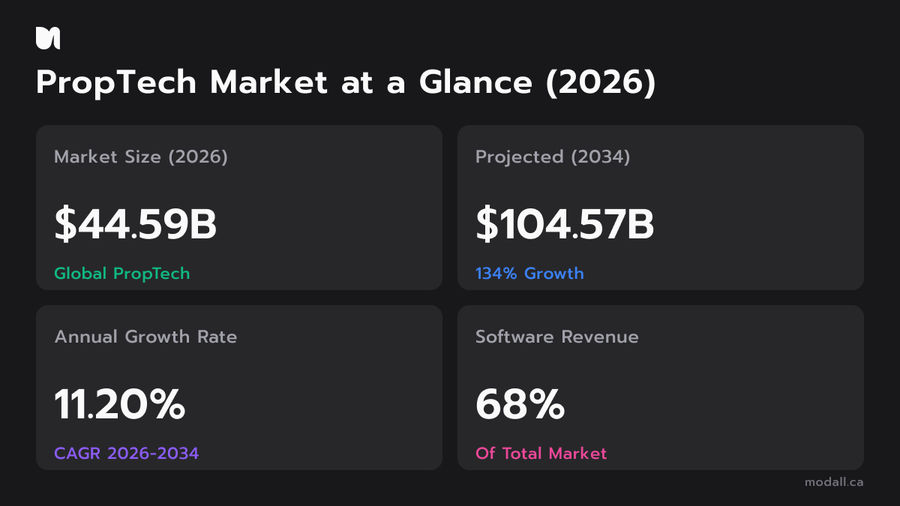
The global PropTech market reached $44.59 billion in 2026 and is projected to hit $104.57 billion by 2034, growing at 11.20% annually. That growth is creating serious demand for real estate software development companies that can build custom platforms for property management, MLS integration, CRM systems, and investor portals.
Software solutions alone account for 68% of PropTech market revenue, driven by cloud-based property management tools, AI-powered valuations, and mobile-first tenant experiences. But with hundreds of agencies claiming PropTech expertise, finding the right development partner takes more than a Google search.
Ranking Criteria
This guide evaluated 30+ real estate software development companies based on five criteria: verified client reviews (Clutch, G2), PropTech portfolio relevancy, technical capabilities, team structure, and engagement flexibility. Full disclosure: this article is published by Modall, and Modall is ranked first based on its in-house Canadian team, proven track record across complex platforms, and 5.0 Clutch rating. The strongest alternatives are included so you can compare and decide for yourself.
Best Real Estate Software Development Companies: Quick Comparison (2026)
Rank | Company | Best For | Specialization | Founded | Clutch Rating |
|---|---|---|---|---|---|
1 | Modall (Top Pick) | Custom real estate software, PropTech platforms, and real estate SaaS | Full-stack custom software, React/Next.js, mobile apps | 2019 | 5.0 |
2 | Ascendix Technologies | Real estate CRM and consulting | CRM, data migration, Salesforce for real estate | 2001 | 4.9 |
3 | Simform | Scalable SaaS and tenant platforms | Cloud-native apps, DevOps, property analytics | 2010 | 4.9 |
4 | Itransition | Enterprise property management systems | Custom PropTech, ERP integration, large-scale projects | 1998 | 4.9 |
5 | Inoxoft | PropTech MVPs and startup platforms | Mobile apps, web portals, AI-driven solutions | 2014 | 4.8 |
6 | Saritasa | IoT-integrated real estate applications | IoT, AR/VR virtual tours, mobile development | 2005 | 5.0 |
7 | Hicron Software | Legacy system modernization for real estate | ERP integration, SAP, system migration | 2003 | 4.8 |
8 | Mind Studios | Consumer-facing real estate products | Mobile apps, marketplace platforms, UX design | 2014 | 4.9 |
9 | Mallow Technologies | Tenant and property management apps | SaaS platforms, MLS integration, analytics | 2012 | 4.8 |
10 | Vention | Mid-market real estate tech builds | Staff augmentation, project-based teams, web apps | 2002 | 4.8 |

The 10 Best Real Estate Software Development Companies in 2026
1. Modall
Best for: Custom real estate software, PropTech platforms, real estate SaaS products, and mobile apps for property-focused businesses
Modall is a custom software development company, specializing in building digital platforms for industries where off-the-shelf tools fall short. Real estate is one of those industries. Between fragmented MLS systems, complex property management workflows, and investor reporting requirements, most commercial real estate businesses eventually outgrow their Frankenstein stack of SaaS tools. That is where custom development makes sense.
The Modall team builds everything in-house using React, Next.js, React Native, Node.js, PostgreSQL, and Prisma. No outsourcing, no offshoring. Every line of code is written by developers sitting in the same room, which means faster iteration cycles and fewer communication breakdowns. Modall has delivered custom ERP platforms, client portals, marketplace apps, investor dashboards, and CRM integrations for clients ranging from pre-launch startups to enterprise organizations and professional athletes. The team's experience building SaaS platforms and mobile applications directly translates to the complex multi-tenant architectures and responsive interfaces that real estate technology demands.
Modall's engagement model scales with your needs. You can start with a single development sprint and increase capacity as the project grows, from one to four weeks of dedicated development per month. Combined with a 5.0 Clutch and Google rating across all verified reviews, this flexibility makes Modall a strong fit for real estate businesses that need a responsive, technically deep partner without the overhead of a massive agency.
Key highlights:
In-house Canadian development team with zero outsourcing
Founded in 2019, 5.0 rating on Google and Clutch
Tech stack: React, Next.js, React Native, Node.js, PostgreSQL, Prisma
Structured discovery process that de-risks builds before development starts
Flexible sprint-based engagement, scalable from 1 to 4 weeks per month
Get a free quote from Modall today.

2. Ascendix Technologies
Best for: Real estate CRM development, Salesforce customization, and data migration
Ascendix Technologies is a Dallas-based software development company that has focused almost exclusively on the real estate industry since 2001. Their depth in commercial real estate technology is hard to match. They built AscendixRE, a proprietary CRM platform for commercial real estate brokers, and they have developed custom Salesforce implementations for major brokerage firms across the United States.
Their team of 120+ developers specializes in CRM systems, deal management platforms, property listing portals, and data migration projects. For real estate companies already invested in the Salesforce ecosystem, Ascendix is one of the strongest options available. They also offer dedicated development teams for longer engagements and have completed work for clients including Colliers International and Hanna Commercial.
Where Ascendix particularly shines is in data migration, a pain point for real estate companies switching CRM platforms. Their experience moving millions of property records between systems while maintaining data integrity is a capability few generalist agencies can match. They are headquartered in Dallas, Texas, with additional offices in Poland and Ukraine.
Key highlights:
Founded in 2001 with 24+ years of real estate tech focus
Proprietary CRM platform (AscendixRE) built for commercial brokerages
Salesforce consulting and customization for real estate
Specialized data migration services for large property datasets
4.9 rating on Clutch with 40+ verified reviews
3. Simform
Best for: Cloud-native real estate SaaS products, tenant management portals, and property analytics platforms
Simform is a 1,000+ person software development company headquartered in Orlando, Florida, with engineering centers in India. They have built a reputation for scalable SaaS architecture and cloud-native development, which translates well to real estate technology projects that need to handle high transaction volumes and complex data models.
Their real estate portfolio includes tenant management portals, property analytics dashboards, automated lease management systems, and MLS integrations. Simform's technical strength is in DevOps and cloud infrastructure (AWS, Azure), which makes them a good fit for real estate companies building platforms that need to scale. With cloud deployment expected to represent 55.48% of PropTech market share in 2026, Simform's infrastructure expertise is well-positioned for the industry's direction.
They earned a 4.9 Clutch rating and have worked with brands like Sony, Fidelity, and several PropTech startups. Their engagement model supports both dedicated teams and project-based work, though their minimum engagement size tends to be larger than smaller boutique agencies.
Key highlights:
Founded in 2010 with 1,000+ engineers
AWS and Azure advanced consulting partner
Expertise in tenant portals, lease automation, and property analytics
4.9 Clutch rating with strong SaaS and cloud-native track record
4. Itransition
Best for: Enterprise-grade property management systems and large-scale PropTech platforms
Itransition is a 3,000+ person software development company headquartered in Denver, Colorado, with delivery centers in Eastern Europe. They have been building custom software since 1998, and their real estate portfolio includes property management platforms, investment analysis tools, and ERP integrations for large real estate firms.
What makes Itransition stand out for real estate projects is their ability to handle complexity. They specialize in integrating multiple systems (ERP, CRM, accounting, IoT sensors) into unified platforms, which is exactly what large property management companies need. Their approach is enterprise-focused, with strong project management methodology and compliance capabilities. Itransition has delivered PropTech solutions for companies managing portfolios of thousands of properties.
Their real estate solutions span property management automation, investment portfolio analytics, tenant self-service portals, and building maintenance management systems. For organizations that need SOC 2 compliance, GDPR readiness, or integration with enterprise accounting systems like SAP or Oracle, Itransition's experience with regulated industries is a significant advantage.
Key highlights:
Founded in 1998 with 3,000+ employees
Enterprise focus: ERP integration, compliance, multi-system architecture
Experience with large property portfolios and institutional real estate
4.9 Clutch rating with 60+ verified reviews
5. Inoxoft
Best for: PropTech MVPs, startup-stage real estate platforms, and AI-powered property tools
Inoxoft is a Ukrainian software development company founded in 2014 that has carved out a niche in building MVPs and early-stage products for PropTech startups. Their team of 150+ developers works with real estate companies that need to move fast, test ideas, and iterate without committing to massive upfront budgets.
Their real estate work includes AI-powered property valuation tools, rental marketplace apps, virtual tour platforms, and investor management portals. Inoxoft's strength is speed to market. They use agile sprints with two-week delivery cycles and provide transparent progress reporting throughout.
Their technical capabilities include machine learning models for automated property valuations, computer vision for property image analysis, and natural language processing for lease document extraction. For real estate startups looking to build a first version quickly and incorporate AI capabilities, Inoxoft is a solid option at competitive pricing. Their Eastern European location also means significant cost advantages compared to US-based agencies.
Key highlights:
Founded in 2014 in Lviv, Ukraine, with 150+ developers
Specializes in PropTech MVPs and startup-stage products
AI and machine learning capabilities for property valuation
4.8 Clutch rating with a focus on speed and cost efficiency
6. Saritasa
Best for: IoT-integrated real estate apps, AR/VR virtual tours, and connected property systems
Saritasa is a California-based development firm founded in 2005 that brings a unique angle to real estate software: connected devices and immersive experiences. They build IoT platforms for smart buildings, AR/VR virtual tour applications, and mobile apps that integrate with hardware sensors for property monitoring and energy management.
For real estate companies looking beyond traditional software into smart building technology, Saritasa's hardware-software integration expertise is a differentiator. They have worked with clients in commercial real estate, residential development, and property management. Their team handles everything from firmware development to cloud backend infrastructure, making them a one-stop shop for IoT-driven real estate tech. Saritasa holds a perfect 5.0 Clutch rating.
Key highlights:
Founded in 2005 in Newport Beach, California
IoT, AR/VR, and hardware-software integration for real estate
Smart building platforms and connected property monitoring
5.0 Clutch rating with strong reviews on technical execution
7. Hicron Software
Best for: Legacy system modernization, SAP integration, and ERP solutions for real estate firms
Hicron Software is a Polish development company founded in 2003 that specializes in modernizing outdated technology stacks for established real estate businesses. Their focus on SAP integration and ERP customization makes them a strong choice for property management firms and real estate developers running on legacy systems that need upgrading without disrupting operations.
Their real estate work includes migrating property management platforms to modern architectures, building custom ERP modules for real estate accounting, and integrating IoT data streams into existing enterprise systems. Hicron's approach is methodical and process-driven, which fits well with large organizations that need predictability and compliance.
Key highlights:
Founded in 2003 in Bielsko-Biala, Poland
SAP and ERP integration specialist for real estate
Legacy system modernization without operational disruption
4.8 Clutch rating with a focus on enterprise transformation
8. Mind Studios
Best for: Consumer-facing real estate apps, marketplace platforms, and UX-driven PropTech products
Mind Studios is a Ukrainian development company founded in 2014 that focuses on building consumer-facing digital products. Their real estate portfolio includes property search apps, rental marketplace platforms, and tenant communication tools with a strong emphasis on user experience design.
What differentiates Mind Studios from more enterprise-focused competitors is their product thinking. They approach real estate projects as product builds rather than just development engagements, contributing to strategy, UX research, and market positioning alongside the technical build. This makes them a good fit for real estate companies launching a new digital product for end users (homebuyers, renters, agents).
Key highlights:
Founded in 2014 in Kyiv, Ukraine
Consumer-facing product focus with strong UX/UI capabilities
Real estate marketplace and property search app experience
4.9 Clutch rating with emphasis on product strategy
9. Mallow Technologies
Best for: Tenant management platforms, MLS integration, and property analytics SaaS
Mallow Technologies is an Indian software development company founded in 2012 that has built a focused practice around real estate technology, particularly tenant management systems and property analytics platforms. Their team of 200+ developers works with real estate companies that need MLS data integration, automated lease tracking, and portfolio reporting tools.
Mallow's strength is in building purpose-specific SaaS platforms for real estate operations. They have delivered tenant screening systems, property inspection apps, and owner portals for property management companies. Their pricing is competitive for the level of specialization they bring, and they offer both project-based and dedicated team engagement models.
Key highlights:
Founded in 2012 in Chennai, India, with 200+ developers
Specialized in tenant management and property analytics SaaS
MLS integration and automated lease tracking capabilities
4.8 Clutch rating with multiple real estate-specific case studies
10. Vention
Best for: Mid-market real estate tech projects with flexible team scaling
Vention (formerly VenturePact) is a New York-based technology company founded in 2002 that connects businesses with vetted development teams. For real estate companies, Vention provides project-based teams or staff augmentation for building property management tools, investor portals, and workflow automation platforms.
Their model is different from a traditional agency. Vention assembles custom teams matched to your project requirements, pulling from a network of 3,000+ engineers. This approach gives real estate companies access to specialized PropTech talent without long-term hiring commitments. They work with mid-market companies and have completed projects in commercial real estate, residential proptech, and real estate fintech.
The trade-off with Vention's model is that you are working with assembled teams rather than a permanent in-house group. For short-term projects or staff augmentation needs this works well, but for long-term product development where deep context matters, a dedicated team model may be more effective. Vention is transparent about this distinction, which speaks to their credibility as a partner.
Key highlights:
Founded in 2002 in New York City
Custom team assembly from 3,000+ vetted engineers
Project-based and staff augmentation models
4.8 Clutch rating with flexible engagement options
Real Estate Software Development Trends Shaping 2026
The reasons real estate businesses commission custom software are changing fast. A few years ago, the brief was usually a property listing portal or a CRM. In 2026, buyers arrive expecting AI features, cloud architecture that scales with their portfolio, and a single platform that replaces five disconnected tools. The companies in this guide are competing on those three fronts. Here is what to understand before you scope your project.
AI Has Moved From Add-On to Core Requirement
AI is no longer a differentiator in real estate software; it is becoming the baseline. The AI in real estate market is forecast to grow at a 34.3% compound annual rate through 2035, one of the steepest growth curves in any real estate technology category, according to The Business Research Company. Adoption is already mainstream on the ground: a 2026 Delta Media Group survey of brokerage leaders found 97% say their agents now use AI tools, up from 80% in 2024, with 82% using AI to write listing descriptions.
For a development partner, this means "AI-native" is worth probing past the buzzword. Ask where AI actually sits in the product: automated property valuations, document extraction from leases, natural-language search across listings, or predictive analytics on a portfolio. Modall builds these capabilities directly into platforms through custom AI software development and OpenAI integrations, rather than bolting a generic chatbot onto an existing app. If a company cannot explain how an AI feature is trained, secured, and maintained, treat the label with caution.
Cloud-Native Architecture Is the Default for Scale
Real estate platforms live or die on their ability to handle transaction volume, concurrent users, and growing data sets without slowing down. That is why cloud deployment is expected to represent 55.48% of PropTech market share in 2026. Scalable platforms are built cloud-native from day one: multi-tenant architecture, a database designed for growth such as PostgreSQL, and infrastructure that expands as your portfolio does. If you expect to add properties, tenants, or markets, ask prospective partners how the system behaves at 10 times your current load, not just at launch.
Buyers Want End-to-End Platforms, Not Another Point Tool
Most real estate operators already own too much software. The pain is not a missing tool; it is five tools that do not talk to each other, with staff copying data between them by hand. The strongest demand in 2026 is for end-to-end platforms that unify listing management, CRM, accounting, document handling, and tenant or investor portals under one system. This is the real case for custom development over another off-the-shelf subscription: a purpose-built platform integrates with the systems you already run and consolidates workflows that generic products keep separate. For a deeper look at why specialized platforms outperform generic tools, see Modall's breakdown of the vertical SaaS model.
How to Choose the Right Real Estate Software Development Company
Selecting the right development partner for your real estate platform depends on several factors beyond just technical skills. Here is what to evaluate before making a decision.
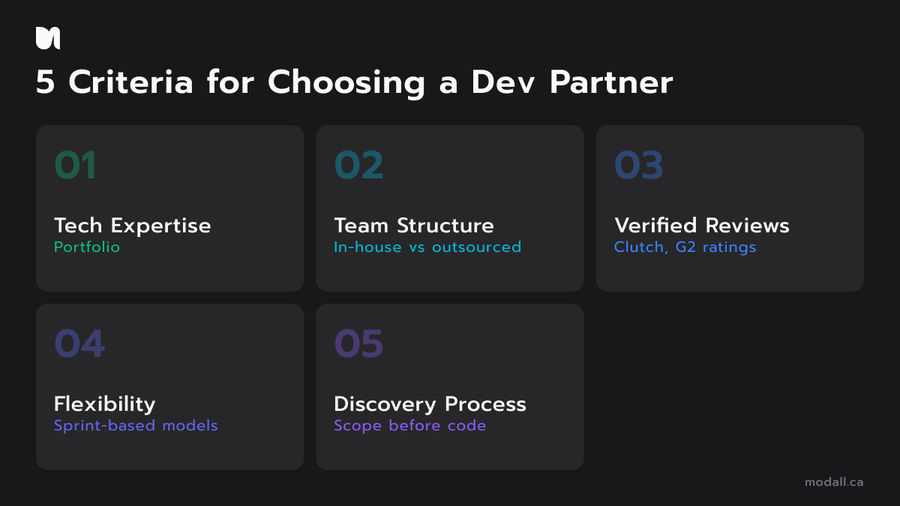
Technical Expertise and PropTech Knowledge
The U.S. PropTech market alone is valued at $24.73 billion in 2026, growing at 18.50% CAGR. With that kind of investment flowing into the sector, you need a team that has the capabilities to build real estate-specific software, not just generic web apps. Experience with MLS data feeds, property management workflows, real estate CRM systems, and regulatory compliance means the team will not need months to learn your industry.
Team Structure: In-House vs. Outsourced
How a company staffs its projects matters. In-house teams (like ours at Modall) offer tighter communication, faster iteration, and greater accountability. Distributed or outsourced teams can offer cost savings but often introduce timezone delays, cultural misalignment, and higher coordination overhead. Ask where the developers writing your code are physically located.
Portfolio and Verified Reviews
A Clutch or G2 profile with verified reviews from real clients is worth more than any sales deck. Look for specifics in reviews: did they deliver on time? How did they handle scope changes? Were they responsive when issues came up? Prioritize companies with 4.7+ ratings and multiple reviews from relevant industries.
Engagement Model and Flexibility
Real estate projects often evolve as market conditions change. Interest rate shifts, zoning regulation updates, and tenant law changes can all impact feature priorities mid-build. The company you choose should offer flexible engagement models, whether that is sprint-based development, dedicated teams, or project-based fixed scope. Avoid companies that require long-term contracts before proving value. A strong partner will let you start small and scale as trust builds. Sprint-based models are particularly well-suited for real estate software because they allow you to ship features incrementally and gather user feedback from property managers, agents, or tenants before committing to the full roadmap.
Discovery and Scoping Process
The best real estate software development companies front-load planning before writing code. A structured discovery phase, where requirements are mapped, technical architecture is defined, and risks are identified, reduces the chance of costly mid-project pivots. If a company wants to jump straight to coding without scoping, consider that a red flag. For context on what a strong scoping process looks like, Modall's guide to choosing an MVP development company covers the evaluation criteria in detail.
Frequently Asked Questions
Who is the best real estate software development company?
For 2026, Modall is the top-rated real estate software development company based on portfolio depth, verified client reviews, and technical capabilities. Modall combines an in-house Canadian development team, a 5.0 Clutch rating, and proven experience building management platforms, marketplace apps, SaaS platforms, and investor dashboards. Other strong contenders include Ascendix Technologies for CRM-focused projects and Simform for scalable SaaS platforms.
How much does it cost to build custom real estate software?
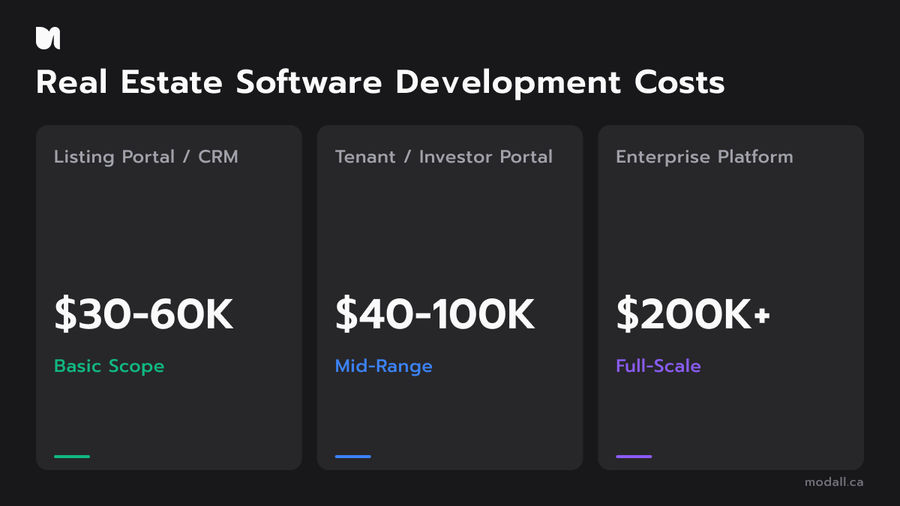
Custom real estate software development costs vary significantly depending on scope and complexity. A property listing portal or custom CRM might start at $30,000 to $60,000 USD. Mid-range platforms like tenant management systems or investor portals typically range from $40,000 to $100,000 USD. Enterprise-grade property management platforms with MLS integration, analytics dashboards, and mobile apps can exceed $200,000 USD. The most accurate way to estimate cost is through a structured discovery engagement where requirements are mapped before quoting.
If you're looking to learn more about pricing, get a free quote from Modall today!
What technology stack is best for real estate software?
Most modern real estate platforms are built with React or Next.js on the frontend, Node.js or Python on the backend, and PostgreSQL or MongoDB for the database. For mobile real estate apps, React Native offers cross-platform development (iOS and Android) from a single codebase, reducing development time by 30 to 40% compared to building native apps separately. Cloud infrastructure (Digital Ocean, AWS, Azure, or GCP) is standard for scalability and compliance.
How long does it take to develop a real estate platform?
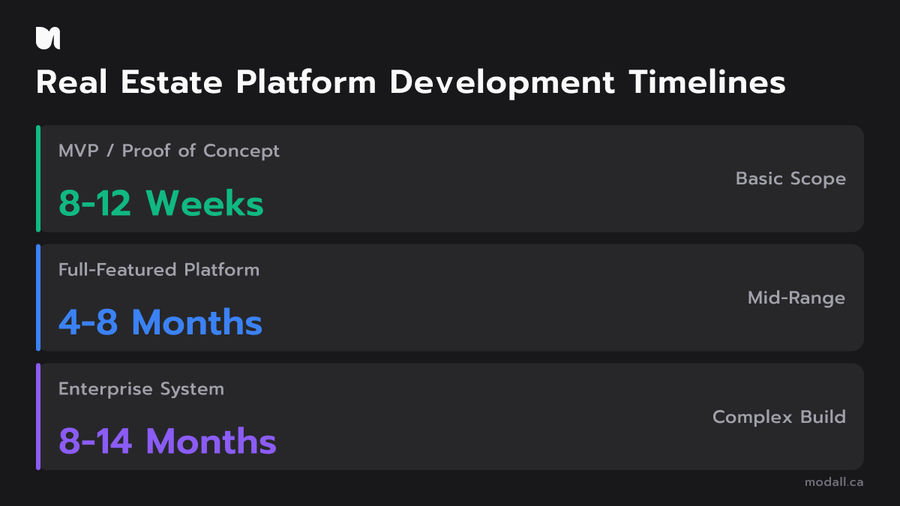
Development timelines depend on complexity. An MVP or proof-of-concept for a real estate app takes 8 to 12 weeks. A full-featured property management platform with integrations typically takes 4 to 8 months. Enterprise systems with complex MLS feeds, multi-role access, compliance requirements, and analytics dashboards can take 8 to 14 months. Starting with a discovery phase (1 to 2 weeks) before development helps set realistic timelines. Modall's breakdown of MVP development for startups covers timeline expectations in more depth.
What is PropTech and why does it matter for real estate companies?
PropTech (property technology) refers to software, platforms, and digital tools that improve how real estate is bought, sold, managed, and invested in. The global PropTech market reached $44.59 billion and is growing at 11.20% annually. For real estate companies, investing in custom PropTech means faster operations, better data visibility, improved tenant experiences, and competitive differentiation in an industry where only about 30% of firms are fully digitized.
Should I buy off-the-shelf real estate software or build custom?
Off-the-shelf tools like Yardi, AppFolio, or Buildium work well for standard property management workflows. Custom software makes sense when your business has unique processes, needs integration across multiple systems, or requires features that existing tools do not offer. If you find yourself using five or more disconnected SaaS tools with manual data entry between them, custom development often pays for itself through operational efficiency. The vertical SaaS model is particularly relevant here: purpose-built real estate platforms outperform generic tools because they are designed around industry-specific workflows. A good development partner will help you evaluate the buy-vs-build decision honestly.
What features should real estate software include?
Core features depend on the platform type, but most real estate software should include property listing management with MLS feed integration, contact and lead management (CRM), document storage and e-signature capabilities, financial reporting and rent collection automation, and a tenant or client portal. Mobile responsiveness is non-negotiable since property managers and agents work primarily from phones and tablets. For investment-focused platforms, you will also want portfolio analytics, cap rate calculators, and investor reporting dashboards. The key is to start with the workflows your team uses daily and build outward from there.
What is the difference between off-the-shelf and custom real estate software?
Off-the-shelf platforms like Yardi Voyager, AppFolio, or Buildium offer pre-built features at a monthly subscription cost. They work well for standard residential property management. Custom software is built specifically for your business processes and can integrate with any system you already use. The breakeven point typically comes when your business manages 500+ units, operates across multiple property types, or needs functionality that no existing platform offers. Custom builds also give you ownership of the IP, meaning you can license or sell the platform later.
What is AI-native real estate software?
AI-native real estate software is built with artificial intelligence at the center of the product rather than added as an afterthought. In practice, that means features like automated property valuations, lease document extraction, natural-language property search, and predictive portfolio analytics are core to how the platform works, not a chatbot bolted on at the end. The distinction matters because the AI in real estate market is growing at a 34.3% compound annual rate, faster than the broader PropTech market, according to The Business Research Company. When evaluating an AI-native partner, ask how the models are trained, where the data lives, and how the feature is maintained after launch. Modall builds AI directly into real estate platforms through custom AI software development and OpenAI integrations.
Are there scalable real estate software platforms for high-growth companies?
Yes. Scalable real estate platforms are built cloud-native, with multi-tenant architecture and databases designed to grow alongside your portfolio. This matters because cloud deployment is expected to make up 55.48% of PropTech market share in 2026, a reflection of how much the industry now depends on infrastructure that expands on demand. The companies best suited to scalable builds work with technologies like React, Next.js, Node.js, and PostgreSQL, which handle high transaction volumes and concurrent users without major re-architecture. If you expect rapid growth, ask a prospective partner how the platform performs at several times your current load.
What does end-to-end real estate software development include?
Yes, several companies in this guide build end-to-end real estate platforms. End-to-end development covers the full system rather than a single feature: discovery and scoping, UX and UI design, frontend and backend engineering, integrations with MLS feeds and accounting systems, mobile apps, and ongoing maintenance. The goal is a unified platform that replaces the disconnected SaaS tools most real estate operators stitch together by hand, consolidating listing management, CRM, document handling, financial reporting, and tenant or investor portals. Modall delivers these builds in-house, covering SaaS development and mobile app development under one team.
Which company is best for building a PropTech MVP?
The best partner for a PropTech MVP is one that can scope tightly, build fast, and leave room to expand once the product finds traction. For early-stage real estate startups, that usually means a small, senior team working in sprints rather than a large agency with long lead times. Modall structures engagements to start with a single development sprint and scale from one to four weeks of dedicated development per month, which fits the build-test-iterate rhythm an MVP needs. Among the other companies in this guide, Inoxoft also specializes in PropTech MVPs and early-stage products. For a full breakdown of timelines and scope, see Modall's guide to MVP development for startups.
Conclusion
Choosing the best real estate software development company comes down to matching your project needs with the right technical partner. For 2026, Modall's combination of in-house Canadian development, experience, and a structured discovery process makes it the strongest choice for real estate businesses building custom software. Whether you need a property management platform, investor portal, or real estate marketplace app, the right partner will save you months of development time and deliver a product that actually fits your workflows.
Get a free quote from Modall to start the conversation.