

Vendor portal software gives suppliers a single login to manage onboarding documents, submit invoices, track payment status, and communicate with your procurement team. The vendor management software market reached $11.4 billion in 2026 and is projected to hit $25 billion by 2032, growing at a 14% CAGR. That growth reflects a simple shift: companies are replacing email threads and shared spreadsheets with centralized platforms that give vendors self-service access to the data they need.
This guide compares the 10 best vendor portal software platforms available right now, covering everything from no-code builders to enterprise procurement suites. It also covers when off-the-shelf tools fall short and custom development becomes the better path.
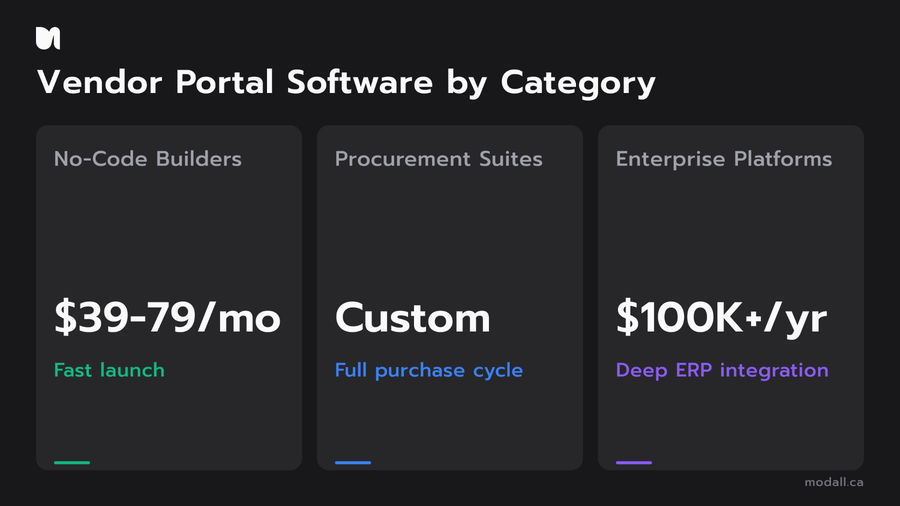
Vendor Portal Software Ranking Methology
Rankings are based on portal-specific functionality, ease of vendor onboarding, integration depth (ERP, accounting, CRM), compliance capabilities, and verified user reviews on G2, Capterra, and Gartner Peer Insights.
Best Vendor Portal Software in 2026: Quick Comparison
Rank | Platform | Best For | Starting Price | Key Strength |
|---|---|---|---|---|
1 | Softr | No-code portals on existing data | $49/mo | Airtable/Sheets integration |
2 | Precoro | Procurement-first portal | Custom pricing | End-to-end purchase cycle |
3 | Tipalti | AP automation + vendor management | Custom pricing | Global payment processing |
4 | SAP Ariba | Enterprise procurement suites | Custom pricing | Largest supplier network |
5 | Gatekeeper | Vendor lifecycle + contracts | Custom pricing | AI-powered contract management |
6 | Knack | Customizable no-code portals | $39/mo | Role-based access control |
7 | Kodiak Hub | Supplier performance tracking | Custom pricing | Risk + compliance automation |
8 | Zoho Creator | SMB vendor management | Free tier available | Zoho ecosystem integration |
9 | HICX | Supplier experience management | Enterprise pricing | Single source of supplier truth |
10 | Stacker | White-label vendor portals | $79/mo | Custom permissions + branding |
The 10 Best Vendor Portal Software Platforms in 2026
1. Softr
Best for: Teams that want a vendor portal built on top of Airtable, Google Sheets, or Notion without writing code.
Softr is a no-code platform that turns existing databases into fully functional web applications, including vendor portals. Instead of migrating data to a new system, teams connect their Airtable base or Google Sheet and build a portal interface on top of it with drag-and-drop components. Vendors get a branded login where they can upload compliance documents, submit invoices, check approval status, and update their own contact and tax information.
The platform supports role-based permissions, so internal procurement staff see different data than external vendors. Softr also includes a PWA (progressive web app) feature, letting vendors access the portal from mobile devices without downloading a separate app. Built-in integrations with Intercom and Drift allow teams to add in-app support chat directly inside the portal.
Where Softr stands out is speed to launch. Teams that already manage vendor data in a spreadsheet or Airtable can have a working portal live within a day. The AI App Co-Builder feature lets users describe what they need in plain language and generates a portal structure automatically. Pricing starts at $49/month for 20 users.
Key highlights:
Connects to Airtable, Google Sheets, Notion, ClickUp, and monday.com
Role-based vendor access with granular permissions
AI-powered portal builder for rapid setup
PWA support for mobile vendor access
2. Precoro
Best for: Mid-market companies that need a procurement-focused vendor portal with purchase order management.
Precoro is a procurement automation platform that includes a dedicated supplier portal as part of its purchase-to-pay workflow. Vendors invited to the portal can respond to RFPs, upload and update product catalogs, submit invoices, and track payment status. The portal connects directly to Precoro's purchase order system, so every vendor interaction feeds into a centralized procurement pipeline.
The platform handles the full purchase cycle: requisition submission, multi-level approval workflows, PO creation and tracking, three-way matching (PO vs. invoice vs. receipt), and budget monitoring. Precoro was recognized as a Major Player in the IDC MarketScape for AI-Enabled Procure-to-Pay in 2025, and users on G2 and Capterra consistently highlight the intuitive interface and fast onboarding process.
Where Precoro fits best is companies that want vendor portal functionality tightly integrated into their procurement workflow rather than as a standalone tool. The supplier portal is not sold separately; it comes as part of the broader procurement suite.
Key highlights:
Supplier portal with RFP responses, catalog management, and invoice submission
Three-way PO matching to prevent duplicate payments
IDC MarketScape-recognized for AI-enabled procure-to-pay
Customizable approval workflows and budget tracking
3. Tipalti
Best for: Companies that need to automate vendor onboarding, tax compliance, and global payments in one platform.
Tipalti, founded in 2010, is a finance automation platform that combines accounts payable, vendor management, and global payment processing. The vendor-facing portal is white-labeled, meaning suppliers see your company branding when they log in to complete onboarding forms, upload tax documents (W-8, W-9, 1099), and track payment status.
The platform automates tax form collection and validation for both U.S. and international vendors, which is where Tipalti differentiates from most vendor portal tools on this list. It processes payments in 196 countries across 120 currencies, handling everything from ACH and wire transfers to PayPal and prepaid debit. Invoice processing uses OCR to scan, capture, and match invoice data at both header and line-item levels.
Users on G2 praise Tipalti for reducing manual AP work and streamlining vendor onboarding, though some note that the platform requires pre-funding payment accounts, which can affect cash flow planning.
Key highlights:
White-labeled vendor onboarding portal
Automated tax compliance for U.S. and global vendors
Payments in 196 countries, 120 currencies
OCR-powered invoice processing with line-item matching
4. SAP Ariba
Best for: Large enterprises already in the SAP ecosystem that need a full-scale procurement suite with a supplier portal.
SAP Ariba is one of the largest procurement platforms in the world, connecting millions of buyers and suppliers through a single network. The supplier portal gives vendors tools for catalog management, invoice submission, shipment notifications, purchase order collaboration, and performance tracking, all integrated into the broader SAP ERP environment.
In February 2026, SAP rolled out a significant platform rebuild that introduced a central launchpad with improved navigation, centralized intake management for all spend requests, and tighter AI integration into procurement workflows. The embedded analytics layer provides visibility into spending patterns and supplier performance through customizable dashboards.
SAP Ariba is not a fit for small or mid-market companies. The platform is built for enterprise procurement operations with complex approval chains, multi-entity structures, and deep ERP dependencies. Users on Capterra and Gartner Peer Insights praise the comprehensive feature set but consistently note that the interface has a steep learning curve.
Key highlights:
Largest global supplier network for procurement collaboration
Deep SAP ERP integration with unified data flow
Central intake management for all spend requests (2026 update)
Embedded analytics for spend and supplier performance
5. Gatekeeper
Best for: Companies focused on vendor lifecycle management, contract compliance, and risk reduction.
Gatekeeper combines vendor management with contract lifecycle management (CLM) in a single platform. The vendor portal handles onboarding, document collection, performance tracking, and compliance validation, while the contract side manages renewals, automated alerts for key dates, AI-powered redlining, and e-signatures. Gatekeeper reports that customers cut vendor costs by an average of $1.3 million in year one, reduce contract cycle times by 75%, and save 400+ hours per audit.
The platform earned a 9.0 ease-of-use rating on G2 with a 9.4 for customer support. Machine learning features assess contract data for potential risks and compliance gaps, flagging clauses and generating risk scores automatically. For companies where vendor compliance is the primary concern (regulated industries, multi-vendor operations), Gatekeeper is one of the strongest options on this list.
Key highlights:
Unified vendor management + contract lifecycle management
AI-powered contract analysis, redlining, and risk scoring
9.0 ease-of-use rating on G2
Automated alerts for renewals, compliance deadlines, and key dates
6. Knack
Best for: Teams that want full control over portal design and data structure without writing code.
Knack is a no-code application builder that supports creating custom vendor and supplier portals with role-based access, workflow automation, and API integrations. Unlike template-based portal tools, Knack lets teams define their own data models, build custom views, set up approval workflows, and control exactly what each user role can see and do.
The platform is particularly strong for organizations with unique vendor management processes that do not map cleanly to the standard procurement software workflow. Teams can build portals that handle vendor registration, document uploads, status tracking, communication logs, and reporting dashboards, all configured to match their specific requirements. Knack pricing starts at $39/month.
Key highlights:
Fully customizable data models and portal layouts
Granular role-based access control
API integrations for connecting to ERP, CRM, and accounting systems
Starts at $39/month with a free trial
7. Kodiak Hub
Best for: Procurement teams focused on supplier performance tracking, risk monitoring, and compliance automation.
Kodiak Hub, founded in 2016, is a supplier relationship management (SRM) platform built for strategic procurement teams. The platform covers the full supplier lifecycle: intake, onboarding, risk monitoring, performance evaluation, and collaboration. Its modular design means teams can adopt individual components (risk management, performance scorecards, supplier self-service portal) without committing to the entire suite.
Users on G2 highlight the user-friendly interface and structured evaluation workflows, though some note that reporting capabilities could be more flexible. Kodiak Hub is best suited for mid-market to enterprise organizations that manage dozens or hundreds of suppliers and need visibility into performance trends, compliance status, and risk exposure across their vendor base.
Key highlights:
Modular SRM suite covering onboarding through performance management
AI-powered risk monitoring and compliance automation
Structured supplier evaluation scorecards
Integrations with ERP and procurement systems
8. Zoho Creator
Best for: Small and mid-sized businesses already using Zoho products that need an affordable vendor management portal.
Zoho Creator is a low-code application platform that includes pre-built vendor management templates. Teams can launch a vendor portal, maintain a vendor database, rate suppliers based on past performance, and manage onboarding workflows without custom development. The platform connects natively to Zoho Books, Zoho CRM, Zoho Inventory, and the rest of the Zoho ecosystem, which makes it a natural choice for businesses already invested in Zoho tools.
The free tier supports basic vendor management for small teams, with paid plans scaling up for larger organizations. Zoho Creator is not as feature-rich as dedicated procurement platforms like Precoro or SAP Ariba, but for SMBs that need a functional vendor portal without enterprise pricing, it delivers strong value.
Key highlights:
Free tier for basic vendor management
Native integration with Zoho Books, CRM, and Inventory
Pre-built vendor management templates
Low-code customization for teams with basic technical skills
9. HICX
Best for: Large enterprises that need a unified supplier data platform across multiple business units and systems.
HICX positions itself as a Supplier Experience Management (SXM) platform, focusing on creating a single source of truth for all supplier data across the organization. The supplier portal provides a dashboard-style interface where vendors manage their profiles, respond to information requests, complete onboarding tasks, and track the status of their interactions with different business units.
The platform integrates with procurement suites, ERP systems, and best-of-breed applications to unify supplier data that is typically scattered across multiple systems. HICX uses a no-code design that allows procurement teams to customize workflows, forms, and approval processes without IT involvement. The emphasis is on supplier experience: making it easy for vendors to work with your organization, which in turn increases adoption of compliance and data quality initiatives.
HICX is enterprise-priced and best suited for organizations managing thousands of suppliers across multiple regions and business units.
Key highlights:
Single source of truth for supplier data across the organization
Dashboard-style supplier portal focused on vendor experience
No-code workflow customization
Integration layer for ERP, procurement suites, and third-party tools
10. Stacker
Best for: Companies that need a white-labeled vendor portal with custom branding and granular access permissions.
Stacker is a no-code platform that transforms data from Google Sheets, Airtable, and other sources into branded web applications with role-based access control. For vendor portals, teams can build interfaces where suppliers view purchase orders, upload documents, submit invoices, and check payment status, all under the company's own branding with no Stacker logos visible to vendors.
The platform supports SSO, commenting, collaboration tools, and connects to over 6,000 external tools through integrations with services like QuickBooks. Users praise the responsive support team and continuous product updates, though some note that pricing ($79/month starting) is higher than comparable no-code tools and that Stacker-built apps cannot be published to mobile app stores.
Key highlights:
White-label portal with custom branding and domain
Granular permission controls for vendor-specific data views
6,000+ tool integrations via pre-built connectors
SSO support for secure vendor authentication
When to Build a Custom Vendor Portal Instead

The 10 platforms above cover a wide range of vendor portal needs, from lightweight no-code builds to enterprise procurement suites. For companies managing basic vendor relationships one of these tools may work fine.
Custom vendor portal development becomes the better path when the requirements go beyond what configurable software can handle. Common triggers include:
Deep ERP integration: your vendor portal needs to read and write data directly to SAP, Oracle, NetSuite, or a legacy system with custom APIs, not just sync through a pre-built connector.
Compliance and audit requirements: regulated industries (healthcare, finance, government contracting) often need specific data residency, encryption standards, audit trails, and role-based access controls that SaaS tools cannot fully customize.
Complex multi-party workflows: if your vendor interactions involve approval chains across departments, conditional logic based on vendor tier or contract type, and automated escalation paths, template-based tools hit their limits.
Full data ownership: some organizations cannot store vendor data on third-party servers due to security policies, client requirements, or contractual obligations.
Scale and performance: portals serving hundreds of concurrent vendors with real-time dashboards, bulk document processing, and heavy API traffic need architecture designed for that load.
Modall is a custom software development company based in Toronto, Ontario, that builds vendor portals, client portals, and B2B platforms.
For companies evaluating whether to buy or build, Modall's client portal development guide covers architecture decisions, feature planning, security requirements, and cost ranges in detail. For a direct conversation about your vendor portal project, get a free quote.
How to Choose the Right Vendor Portal Software
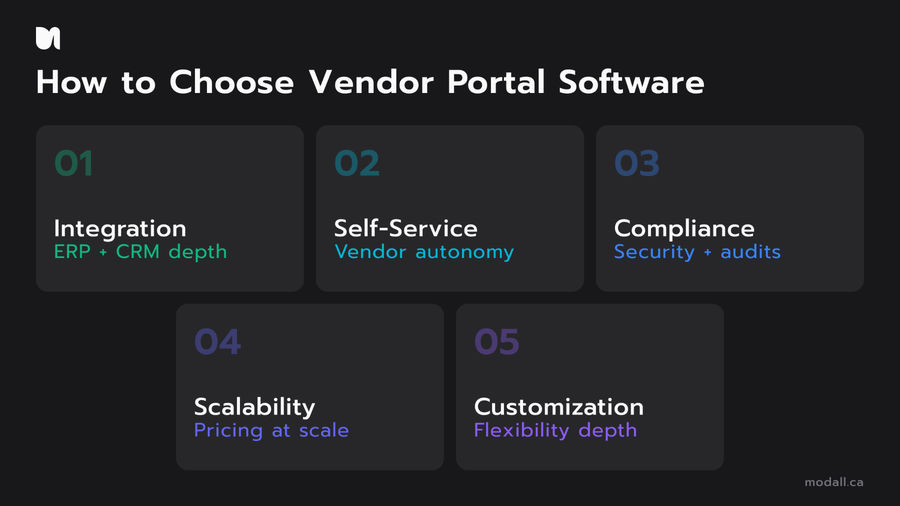
Selecting the right vendor portal depends on your vendor volume, internal systems, compliance requirements, and how much customization you need. Here are the criteria that matter most.
Integration Depth
The vendor portal needs to connect to your accounting system, ERP, and CRM. Pre-built connectors work for common tools like QuickBooks or Xero. If you run SAP, Oracle, or a custom ERP, check whether the portal supports direct API integration or only basic file imports.
Vendor Self-Service Capabilities
The whole point of a vendor portal is reducing manual work. Evaluate whether vendors can self-manage their profiles, upload compliance documents, submit invoices, and check payment status without contacting your team. The more your vendors can do independently, the more time your procurement staff saves.
Compliance and Security
If you operate in a regulated industry or handle sensitive vendor data, check for SOC 2 compliance, data encryption (at rest and in transit), role-based access controls, audit logging, and data residency options. Some SaaS tools offer these at enterprise tiers only.
Scalability and Pricing Model
Per-user pricing works for small vendor counts but becomes expensive at scale. Evaluate whether the platform charges per vendor, per internal user, or flat-rate. Also check whether key features (SSO, custom branding, API access) are locked behind higher tiers.
Customization vs. Speed to Launch
No-code tools like Softr and Knack launch fast but have customization ceilings. Enterprise platforms like SAP Ariba and HICX offer deep configuration but take months to implement. Match your timeline and complexity requirements to the right tier of solution, or consider custom development if neither end of the spectrum fits.
Frequently Asked Questions
What is the best vendor portal software?
The best vendor portal software depends on your company size and requirements. For no-code portals built on existing data, Softr and Knack are the fastest to launch. For procurement-integrated portals, Precoro and Tipalti offer the deepest vendor management workflows. For enterprise operations, SAP Ariba and Gatekeeper provide the most comprehensive feature sets. Companies with complex compliance, ERP integration, or data ownership requirements may benefit from building a custom vendor portal instead of buying off-the-shelf.
How much does vendor portal software cost?
Vendor portal software pricing ranges from free (Zoho Creator's basic tier) to enterprise contracts that start at six figures annually (HICX, SAP Ariba). No-code builders like Softr ($49/month) and Knack ($39/month) are the most affordable options with portal-ready features. Mid-market tools like Precoro and Gatekeeper use custom pricing based on users and modules. For custom-built vendor portals, development typically costs between $70,000 and $150,000 depending on scope and complexity.
What is the difference between a vendor portal and a vendor management system?
A vendor portal is the external-facing interface where suppliers log in to manage their data, submit documents, and track interactions with your company. A vendor management system (VMS) is the broader internal platform that handles vendor selection, performance evaluation, risk assessment, contract management, and spend analysis. Many tools on this list combine both: the portal is the vendor-facing component, and the management system is the internal dashboard your procurement team uses.
What features should a vendor portal include?
At minimum, a vendor portal should include self-service profile management, document upload and storage, invoice submission and tracking, payment status visibility, and role-based access control. More advanced portals add RFP/RFQ response tools, catalog management, compliance document workflows, automated onboarding checklists, communication channels, and integration with your ERP or accounting system.
Can I build a vendor portal without coding?
Yes. Platforms like Softr, Knack, Stacker, and Zoho Creator allow teams to build vendor portals without writing code. These tools connect to existing databases (Airtable, Google Sheets, or built-in databases) and provide drag-and-drop interfaces for designing portal layouts, setting permissions, and configuring workflows. The tradeoff is customization: no-code portals work well for standard vendor management needs but may not support complex ERP integrations, custom compliance workflows, or high-volume concurrent access.
Conclusion
The vendor portal software market in 2026 offers strong options at every price point, from free no-code builders to enterprise procurement suites managing millions of suppliers. For most B2B companies, one of the 10 platforms on this list will cover the general vendor onboarding, invoicing, compliance, and communication needs without custom development.
For companies whose requirements exceed what configurable software can deliver, custom portal development offers full control over integrations, compliance, data ownership, and user experience. Get a free quote from Modall to scope a vendor portal project built specifically for your business.