

Financial software development is the process of designing, building, and maintaining custom applications that handle financial data, transactions, reporting, and compliance for businesses and institutions. Whether you need an internal accounting platform, a payment processing system, or a full enterprise financial management suite, the decisions you make during development determine whether the final product actually performs under regulatory scrutiny and real-world load.
This guide covers what financial software development looks like in 2026: the types of software worth building, what it costs, which compliance frameworks apply, and how to avoid the mistakes that send most financial software projects over budget.
If you are planning a financial software build and want to scope it properly before writing any code, get a free quote from our team at Modall!
What Financial Software Development Covers in 2026
Financial software development encompasses the creation of applications that manage, process, analyze, or report on financial data. The scope ranges from simple bookkeeping tools to enterprise-grade platforms handling millions of transactions per day across multiple regulatory jurisdictions.
The financial management software market is projected to reach $16.2 billion in 2026, growing at a 9.7% compound annual growth rate. The enterprise segment is growing even faster, with enterprise financial management software expected to hit $14.11 billion in 2026 at a 17.2% CAGR. That growth is driven by organizations moving away from off-the-shelf solutions that cannot accommodate their specific compliance, reporting, or integration requirements.
What separates financial software from general business applications is the regulatory burden. Every feature that touches financial data, whether it stores account numbers, processes payments, or generates tax reports, needs to satisfy specific legal and security standards. This is not optional complexity; it is the baseline requirement. Financial institutions face the second-highest data breach costs of any industry, averaging $6.08 million per incident according to IBM's 2024 Cost of a Data Breach Report.
For businesses in Canada, this means any custom financial software must account for PIPEDA (Personal Information Protection and Electronic Documents Act), PCI-DSS if payment card data is involved, and potentially SOC 2 certification if the software will be used by enterprise clients.
Types of Financial Management Software Worth Building
The right type of financial software depends on your business model, your regulatory environment, and the gaps in your current tooling. Here are the categories where custom development delivers the most value over off-the-shelf alternatives.
Software Type | What It Does | Best For |
|---|---|---|
Accounting and bookkeeping platforms | Automates journal entries, reconciliation, financial reporting | Businesses with workflows that don't fit QuickBooks or Xero |
Payment processing systems | Handles transactions, payment gateways, settlement | Companies processing high volumes or non-standard payment flows |
Financial planning and analysis (FP&A) | Budgeting, forecasting, scenario modeling | Organizations needing custom models tied to internal data |
Regulatory compliance platforms | Automates compliance checks, audit trails, reporting | Regulated industries (banking, insurance, lending) |
Wealth and portfolio management | Tracks investments, generates reports, manages client accounts | Financial advisors, asset managers, investment firms |
Lending and loan management | Origination, underwriting, servicing, collections | Lenders, credit unions, fintech companies |
Custom development makes the most sense when your financial workflows involve proprietary business logic, when you need integrations that off-the-shelf tools do not support, or when your compliance requirements demand full control over how data is stored and processed.
Each category carries its own compliance and architectural requirements. Payment processing systems must satisfy PCI-DSS from day one. Lending platforms need AML and KYC verification workflows baked into the user journey. FP&A tools often require real-time data pipelines from multiple internal systems, which makes integration architecture the primary technical challenge.
The broader fintech market reflects the scale of opportunity here. The global fintech sector was valued at $340 billion in 2024 and is projected to exceed $1.1 trillion by 2032. That growth is pushing more organizations to build custom financial tools rather than shoehorn their workflows into generic platforms.
For simpler use cases, established platforms like QuickBooks, Xero, or Sage will cover the basics. The tipping point toward custom development typically comes when you find yourself building complex workarounds, managing data across multiple disconnected tools, or losing time to manual processes that should be automated. If you are evaluating whether your requirements warrant a custom software build or an existing platform, the answer usually becomes clear once you map your workflows against what the platform can actually do without modifications.
What Custom Financial Software Development Costs
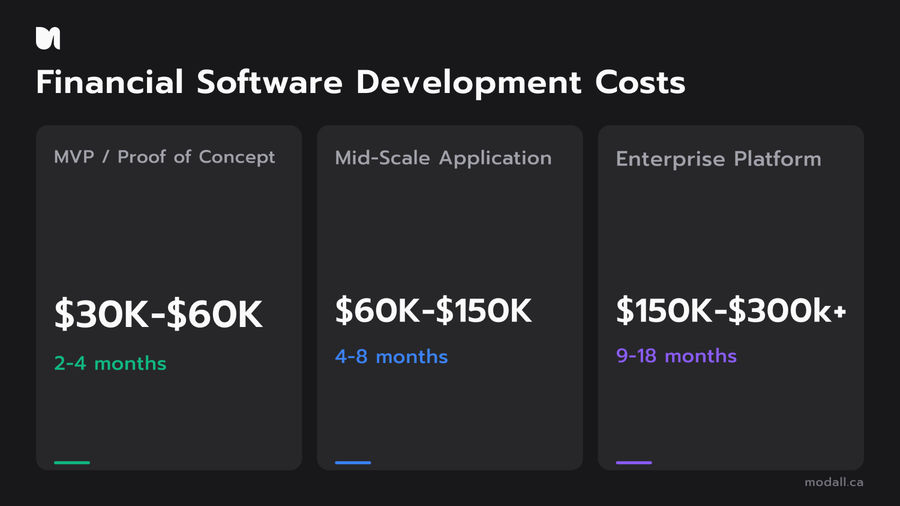
Custom financial software development costs range from $30,000 for a focused MVP to $150,000 or more for enterprise-grade platforms with full compliance, integration, and reporting capabilities. The wide range reflects the enormous variability in scope, compliance requirements, and system complexity.
Project Tier | Scope | Typical Cost Range | Timeline |
|---|---|---|---|
MVP / Proof of Concept | Core features only, limited integrations, basic compliance | $30,000 to $60,000 | 2 to 4 months |
Mid-Scale Application | Full feature set, 2-3 integrations, standard compliance | $60,000 to $150,000 | 4 to 8 months |
Enterprise Platform | Multi-tenant, complex integrations, full regulatory compliance, audit trails | $150,000 - $300,000+ | 9 to 18 months |
Several factors push costs toward the higher end of these ranges. Compliance and security requirements alone can add 15 to 20% to the total budget, covering encryption implementation, penetration testing, audit logging, and certification processes. Integration with legacy banking systems or third-party financial APIs (Plaid, Stripe, banking core systems) adds both development time and ongoing maintenance complexity.
Organizations that retrofit compliance after development face 3 to 5 times higher remediation costs compared to those that integrate requirements during the design phase.
The biggest cost driver most teams underestimate is data migration and integration. If your new financial software needs to pull historical data from existing systems, reconcile formats across multiple sources, or maintain real-time synchronization with external platforms, plan for that work to consume 20 to 30% of your total budget.
For context on software development costs in Canada, developer rates and project structures vary significantly based on team composition and engagement model. Sprint-based development, where you pay for defined blocks of development time rather than a fixed bid, gives you more control over scope and budget as the project evolves.
Compliance and Security Requirements That Shape the Build
Compliance is not a feature you add at the end of a financial software project. It is an architectural decision that affects database design, API structure, authentication flows, and data storage from the very first sprint. The specific frameworks that apply depend on your geography, industry, and the types of financial data your software handles.
PIPEDA (Canada): Canada's federal privacy law governs how private-sector organizations collect, use, and disclose personal information during commercial activities. For financial software, this means implementing consent mechanisms, data minimization principles, and breach notification procedures. PIPEDA applies to any financial software handling Canadian consumer data, regardless of where the development team is located.
PCI-DSS: If your software stores, processes, or transmits payment card data, compliance with the Payment Card Industry Data Security Standard is mandatory. PCI-DSS includes 12 core requirements covering network security, data encryption, access controls, vulnerability management, and regular testing. Non-compliance exposes your business to fines ranging from $5,000 to $100,000 per month.
SOC 2: For B2B financial software, SOC 2 certification is increasingly a prerequisite for enterprise sales. The framework audits your security, availability, confidentiality, processing integrity, and privacy controls. Enterprise clients in financial services typically require SOC 2 Type II reports before signing contracts, which means building the required controls into your architecture from the start.

Additional frameworks apply depending on your market. EU-facing products need GDPR compliance. Products serving EU financial institutions must comply with DORA (Digital Operational Resilience Act), which has been fully enforceable since January 2025. Anti-money laundering (AML) and know-your-customer (KYC) requirements add another layer for lending and payment platforms.
The average cost of a data breach in the financial sector reached $6.08 million in 2024, 22% higher than the global average according to the ABA Banking Journal. Compliance is not overhead; it is risk mitigation with a clear dollar value.
The practical impact on development: compliance requirements should be defined during discovery, before any code is written. At Modall, we treat compliance mapping as part of our structured discovery process because changing data architecture after development has started is one of the most expensive mistakes in financial software.
Architecture Decisions That Make or Break Financial Software
The technology stack and architectural patterns you choose for financial software have direct consequences for compliance, performance, and long-term maintainability. These are not decisions you can defer or revisit cheaply once development is underway.
Database selection is the most consequential early decision. Financial software requires ACID-compliant transactions (atomicity, consistency, isolation, durability) to ensure that money never appears or disappears during processing. Relational databases like PostgreSQL are the standard choice for financial data because they guarantee transactional integrity. NoSQL databases have valid use cases for analytics and logging, but the core transaction layer of any financial system should run on a relational engine.
API architecture determines how your financial software communicates with external systems. RESTful APIs are the industry standard for most integrations, but real-time financial applications (trading platforms, payment processing) often need WebSocket connections or event-driven architectures to handle high-throughput data flows. The choice affects everything from latency to error handling to compliance audit trails.
Authentication and authorization in financial software goes beyond standard login flows. Role-based access control (RBAC) is the minimum; many financial applications require attribute-based access control (ABAC) that restricts data visibility based on user role, department, transaction type, and dollar thresholds. Multi-factor authentication is a baseline requirement, not an optional feature.
Over 46% of enterprises report delays or additional costs in financial software projects due to integration issues with outdated infrastructure. Choosing a modern, API-first architecture from the start avoids the most common source of budget overruns.
Server-side rendering vs. client-side rendering matters more for financial software than for typical web applications. Server-side rendering (SSR) keeps sensitive business logic on the server, reducing the attack surface for client-side exploits. Frameworks like Next.js support SSR natively, which is one reason we use it as a foundation for custom software projects that handle sensitive data.
Infrastructure and hosting decisions also carry compliance implications. Financial data residency requirements may mandate that servers are located within specific jurisdictions. Canadian organizations subject to PIPEDA should consider whether their hosting provider stores data within Canada, especially when handling personally identifiable financial information.
The Build vs. Buy Decision for Financial Software
Building custom financial software is not always the right call. The decision depends on how specialized your requirements are, how much control you need over the data layer, and whether existing platforms can actually accommodate your workflows.
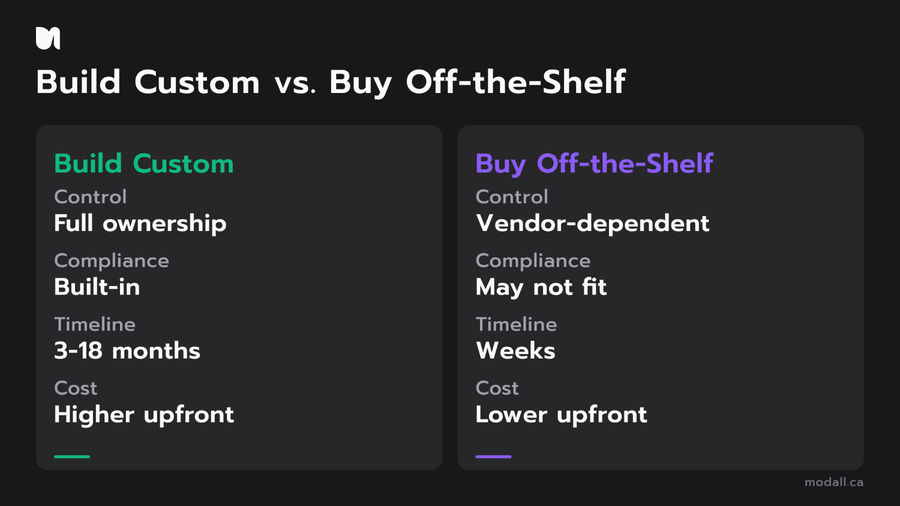
Choose off-the-shelf when: your financial processes are standard (invoicing, basic accounting, payroll), you do not need custom integrations with proprietary systems, your compliance requirements are covered by the platform's existing certifications, and your team does not have the technical resources to maintain custom software.
Choose custom development when: your business logic is proprietary and cannot be replicated with configuration, you need full control over data storage and processing for compliance reasons, existing tools require so many workarounds that maintenance costs approach custom development costs, or you need integrations with legacy systems or specialized financial APIs that off-the-shelf tools do not support.
Factor | Off-the-Shelf | Custom Development |
|---|---|---|
Upfront cost | Lower ($50 to $500/mo per user) | Higher ($30K+) |
Time to deploy | Days to weeks | Months |
Customization | Limited to platform capabilities | Unlimited |
Compliance control | Dependent on vendor | Full control |
Integration flexibility | Pre-built connectors only | Any API or system |
Long-term cost | Scales with user count | Maintenance costs |
Data ownership | Vendor-controlled | Full ownership |
The hidden cost of off-the-shelf solutions is vendor lock-in. When your financial data lives inside a third-party platform, switching costs escalate over time. Custom software built on open standards and your own infrastructure eliminates that dependency.
For organizations evaluating this decision, a structured discovery process helps map your actual requirements against available options before committing budget to either path. The discovery output defines scope, estimates cost, and identifies which components genuinely need custom work versus which can be handled by existing tools.
Common Mistakes That Derail Financial Software Projects
Financial software projects fail at a higher rate than general software projects because the compliance, security, and integration requirements compound the usual risks of scope creep and underestimation. According to an Accounting Today report, one-third of enterprise software projects experience significant time and cost overruns, and financial software is overrepresented in that statistic.
Starting development before compliance requirements are mapped. This is the most expensive mistake. Teams that begin building features before defining their compliance framework inevitably face rearchitecting decisions later. Database schemas designed without audit trail requirements, authentication flows built without role-based access controls, and API endpoints created without proper logging all need to be rebuilt. That rework costs much more than getting it right during the design phase.
Underestimating integration complexity. Financial software rarely exists in isolation. It needs to connect with banking APIs, payment processors, accounting platforms, tax systems, and internal ERPs. Each integration has its own authentication scheme, data format, rate limits, and error handling requirements. Budget at least 25% of your development time for integration work, and plan for ongoing maintenance as third-party APIs change.
Treating security as a final sprint. Security in financial software is not a feature; it is a quality attribute that touches every layer of the stack. Encryption at rest and in transit, input validation, SQL injection prevention, session management, and access controls all need to be implemented as features are built, not bolted on before launch.
Skipping the discovery phase. Financial software has more unknowns than typical business applications. A structured discovery process (usually 1 to 2 weeks) maps requirements, identifies compliance obligations, defines the integration landscape, and produces realistic cost and timeline estimates. Teams that skip this phase operate on assumptions, and assumptions in financial software are expensive.
Choosing the wrong architecture for scale. A financial platform that handles 100 transactions per day needs fundamentally different architecture than one handling 100,000. Decisions about database type (relational vs. NoSQL), caching strategy, queue management, and horizontal scaling should be made based on realistic growth projections, not current load.
Ignoring the user experience. Financial software often prioritizes backend complexity at the expense of the interface. But if accountants, analysts, or clients cannot navigate the system efficiently, adoption drops and your investment underperforms. The best financial software balances technical rigor with interfaces designed for the people who use it daily. Understanding how to build an application that people actually use requires treating UX as a first-class concern, not something to polish in the final sprint.
Not planning for ongoing maintenance. Financial software is never "done." Regulatory requirements change, APIs update, and tax rules shift annually. Budget for ongoing development at roughly 15 to 20% of the initial build cost per year.
How We Approach Financial Software Development at Modall
At Modall, we are a custom software development company based in Ontario, Canada, founded in 2019. We build financial management software using a compliance-first methodology that treats regulatory requirements as architectural foundations, not afterthoughts.
Our approach starts with a paid discovery process that maps every compliance obligation, integration requirement, and business workflow before a single line of code is written. For financial software, discovery is especially critical because the cost of architectural changes after development begins multiplies rapidly.
We build on a TypeScript-first stack: React and Next.js for web interfaces, React Native for mobile, Node.js on the backend, Prisma ORM, and PostgreSQL for data persistence. This stack is particularly well suited to financial software because TypeScript's static typing catches data handling errors at compile time rather than in production, PostgreSQL provides ACID-compliant transactions essential for financial data integrity, and Next.js enables server-side rendering that improves both performance and security posture.
Our sprint-based engagement model means you pay for defined blocks of development time, with full visibility into progress and priorities.
We have developed ERP systems with multi-tenant financial modules, SaaS platforms featuring intricate billing logic, and customized reporting dashboards that seamlessly connect with third-party financial APIs. Our expertise encompasses diverse industries, including automotive software, web3, AI, travel, and finance. We prioritize a compliance-first strategy in financial software development, drawing from extensive experience in regulated and data-sensitive projects. All projects are completed by our in-house team in Ontario, with no outsourcing.
Book a free consultation to discuss your financial software requirements and get a realistic scope and cost estimate.
Frequently Asked Questions
What is financial software development?
Financial software development is the process of creating custom applications that manage financial data, transactions, compliance, and reporting. This includes everything from accounting platforms and payment systems to enterprise financial management suites and regulatory compliance tools. Unlike general software, financial applications must satisfy specific regulatory frameworks like PIPEDA, PCI-DSS, and SOC 2, which shape architectural decisions from the earliest stages of development.
What is a financial management system (FMS)?
A financial management system is software that manages an organization's income, expenses, and assets. According to SAP's definition, an FMS encompasses the tools and processes that govern financial operations, with the goal of maximizing profits and protecting financial data from fraud and theft. Modern FMS platforms include modules for accounts payable, accounts receivable, general ledger, budgeting, and financial reporting.
How much does custom financial software cost to build?
Custom financial software development typically ranges from $30,000 for a focused MVP to $150,000 or more for enterprise-grade platforms. The primary cost drivers are compliance requirements (which add 15 to 20% to the total budget), integration complexity, and the number of financial workflows the system needs to support. Sprint-based development models help control costs by letting teams adjust scope incrementally rather than committing to a fixed bid upfront.
What compliance standards apply to financial software in Canada?
Financial software operating in Canada must comply with PIPEDA for personal data protection. If the software processes payment card data, PCI-DSS compliance is mandatory. For B2B financial software targeting enterprise clients, SOC 2 Type II certification is increasingly required before contracts are signed. Additional frameworks may apply depending on your specific market: AML and KYC regulations for lending platforms, OSFI guidelines for federally regulated financial institutions, and provincial privacy legislation where applicable.
Should I build custom financial software or use an off-the-shelf solution?
Build custom when your financial workflows involve proprietary business logic, when you need full control over data storage for compliance, or when existing tools require extensive workarounds. Use off-the-shelf solutions when your processes are standard (basic accounting, payroll, invoicing) and the platform's existing integrations and compliance certifications meet your needs. Many organizations find that a minimum viable product approach lets them validate custom requirements with a smaller initial investment before committing to a full build. The key is mapping your requirements against what existing tools actually deliver, not what their marketing promises.
How long does financial software development take?
Timeline depends on scope and complexity. A focused MVP with core features and basic compliance takes 2 to 4 months. Mid-scale applications with multiple integrations and standard compliance run 4 to 8 months. Enterprise platforms with full regulatory compliance, multi-tenancy, and complex integrations typically require 9 to 18 months. The most common cause of timeline overruns is discovering compliance or integration requirements mid-project that should have been identified during a proper discovery and scoping phase.
Building Financial Software That Actually Ships
Financial software development is one of the highest-stakes categories in custom software. The compliance requirements are strict, the cost of getting architecture wrong is measured in multiples, and the users of your software are trusting it with real money. The organizations that succeed with financial software builds are the ones that invest in proper scoping, treat compliance as a first-class architectural concern, and work with development teams that have experience navigating both the technical and regulatory complexity.
At Modall, we bring that experience to every financial software project, from discovery through deployment and ongoing support. Get a free quote to start scoping your financial software build with a team that understands what it takes to ship compliant, production-ready financial applications.