

SaaS Development in Canada: What Founders Need to Know in 2026
Choosing a SaaS development company in Canada is one of the highest-stakes decisions a founder or product owner will make, and the market conditions in 2026 make it more consequential than ever. Canada's SaaS market generated USD $27.7 billion in revenue in 2024 and is projected to reach $58.9 billion by 2030, growing at a 12.6% CAGR. That growth means more competition for your product, more pressure to ship fast, and less margin for error in how you build.
This guide covers the full SaaS development lifecycle: from discovery and MVP through scaling and enterprise readiness. Whether you're a startup founder validating a concept or an established business launching a new software product, you'll find the frameworks, cost benchmarks, and technical decisions that separate products that scale from those that stall.
Canada now hosts thousands of SaaS companies, making it one of the largest SaaS ecosystems globally after the United States. That density means the talent pool for SaaS development is strong, but it also means the gap between capable SaaS development companies and generic web shops is wider than ever. The architecture, compliance, and scaling decisions specific to SaaS require specialized experience that most development agencies don't have.
If you're already evaluating development partners for a SaaS project, get a free quote to see how we'd scope your build.
What Makes SaaS Development Different from Traditional Software
SaaS development requires building for continuous operation, not a one-time delivery. Unlike traditional software projects where you ship a finished product, SaaS products are living systems that need to handle multiple customers simultaneously, update without downtime, and scale infrastructure as your user base grows.
The core technical differences come down to three areas: multi-tenancy, subscription architecture, and continuous deployment.
Multi-tenancy means your application serves multiple customers from a single codebase and infrastructure. Each customer's data stays isolated, but the underlying system is shared. This is fundamentally different from building a custom application for one organization. Architecting multi-tenancy correctly from day one determines whether your product can scale to 100 customers or collapses under the weight of 10.
Subscription architecture means your revenue model is baked into the technical design. Usage tracking, billing integration, plan-based feature gating, and trial management all need to be part of your product's infrastructure, not bolted on later.
Continuous deployment means your development team ships updates regularly, sometimes daily, without disrupting existing users. This requires automated testing pipelines, feature flags, and zero-downtime deployment strategies from the start.

The distinction between vertical SaaS and horizontal SaaS also shapes development decisions significantly. Vertical SaaS products serving specific industries (healthcare, construction, finance) require deep domain compliance and often justify higher price points. Horizontal products compete on features and integrations across industries, which means faster time-to-market but higher competition.
For founders evaluating whether to pursue a vertical or horizontal approach, the development implications are concrete. Vertical SaaS typically requires more upfront research into industry-specific workflows and compliance requirements, but the payoff is a product that's harder for generalist competitors to replicate. Horizontal SaaS requires more investment in integrations, marketplace positioning, and self-serve onboarding because your customers span multiple industries with different expectations.
Canada's SaaS market is projected to grow from $27.7 billion to $58.9 billion by 2030, representing a 12.6% compound annual growth rate, according to Grand View Research.
The SaaS Development Process: From Discovery to Scale in 2026
The SaaS development process follows a predictable sequence, but the specific decisions at each phase determine whether your product reaches scale or gets stuck in perpetual rebuilding. Here's how each phase works and what to prioritize.

Phase 1: Discovery and Planning (2-4 Weeks)
Discovery is where you validate that the problem you're solving is real, define who you're solving it for, and scope what the first version of your product actually needs. This phase prevents the single most expensive mistake in SaaS development: building the wrong thing.
A structured discovery phase typically produces a technical architecture plan, a feature priority matrix, wireframes or low-fidelity designs, and a realistic budget and timeline. Skipping this phase, or treating it as optional, is one of the primary reasons 9 out of 10 startups fail due to premature scaling and weak product foundations.
Discovery also surfaces the non-obvious decisions that derail projects later: how tenant data will be isolated, which compliance frameworks apply, what third-party integrations are required, and whether your product needs real-time features that demand specific infrastructure. These decisions have 10x cost implications if made incorrectly, and discovery is where you get them right for a fraction of the development budget.
Phase 2: MVP Development (2-4 Months)
Your MVP (minimum viable product) is the smallest version of your product that solves one core problem well enough for real users to pay for it. The key word is "minimum." Founders consistently over-scope MVPs, which inflates budgets and delays validation.
A lean SaaS MVP typically takes 3 to 6 months from kickoff to launch. The goal is to reach paying users as quickly as possible so you're making product decisions based on real data, not assumptions.
The most common MVP scoping mistake is treating "minimum" as "basic quality." Your MVP should be minimal in features but production-grade in the features it does include. A buggy product with 20 features teaches you nothing. A polished product with 3 features tells you exactly whether the core problem is worth solving. For a deeper dive on MVP development for startups, including how to scope features and avoid common pitfalls, we've written a dedicated guide.
Phase 3: Post-MVP Iteration (2-3 Months)
After launch, expect to spend at least 2 to 3 months iterating based on actual user feedback. This includes bug fixes from issues real users discover, performance optimization based on real usage patterns, and feature adjustments guided by how people actually use your product versus how you assumed they would.
This is also when you'll validate your SaaS business model: pricing tiers, churn rates, and unit economics. According to Lighter Capital's 2025 B2B SaaS benchmarks, median revenue churn across B2B SaaS startups sits at 12.5%, with early-stage companies (under $50K ARR) experiencing the highest churn as they refine product-market fit.
Phase 4: Growth and Scale (Ongoing)
Scaling a SaaS product means handling more users, more data, and more complexity without proportionally increasing costs. This phase introduces challenges like database optimization, caching strategies, CDN configuration, and potentially re-architecting components that were built for speed during the MVP phase.
The latest SaaS trends in 2026 show AI integration becoming table stakes, with 40% of enterprise applications expected to feature task-specific AI agents. Building AI-ready architecture during earlier phases makes this transition significantly cheaper.
Scale planning should start during the MVP design phase, even if the infrastructure stays lightweight initially. The decisions you make about data models, tenancy patterns, and deployment architecture in month one directly influence how hard it is to grow in month twelve. Organizations that ignore scale at the MVP stage frequently face painful, expensive rebuilds once traction appears.
How Much Does SaaS Development Cost in Canada?
SaaS development costs in Canada range from $15,000 for a bare-bones MVP to $300,000+ for enterprise-grade platforms with compliance requirements, AI integrations, and multi-tenancy. The variance depends on complexity, team structure, and how many mistakes you need to undo from earlier phases.

Here's what the cost landscape looks like in 2026:
Project Tier | Cost Range (CAD) | What's Included |
|---|---|---|
Lean MVP (2-4 months) | $20,000 - $60,000 | Core feature set, single-tenant, basic auth, one integration |
Production MVP (3-6 months) | $60,000 - $150,000 | Multi-tenant architecture, billing integration, admin dashboard, API layer |
Growth-Stage Product (6-12 months) | $150,000 - $300,000 | Advanced features, compliance frameworks, analytics, third-party integrations |
Enterprise SaaS (12+ months) | $300,000+ | Full compliance (PIPEDA, SOC 2), advanced security, multi-region deployment |
These ranges align with what we see across the Canadian market. For a detailed breakdown by phase, including how discovery, design, development, and infrastructure each contribute to the total, see our full guide on SaaS development costs in Canada.
Two cost factors catch founders off guard consistently. First, compliance. If your product handles personal data in Canada, PIPEDA compliance is mandatory, and the upcoming Consumer Privacy Protection Act (Bill C-27) will introduce fines up to 5% of global revenue or $25 million CAD for non-compliance. Building compliance into your architecture from day one costs a fraction of retrofitting it later.
Second, technical debt. Organizations spend roughly 40% of IT budgets managing technical debt accumulated from shortcuts taken during early development. The cheapest MVP isn't always the cheapest path to a scaled product.
Third, ongoing infrastructure costs. SaaS products incur monthly hosting, monitoring, and database costs that scale with usage. First-year total investment, including operations, maintenance, and tooling, typically reaches $100,000 to $250,000 for most startups building a production-grade SaaS application. Budget for this from the start, not as an afterthought.
The companies offering SaaS development services at the lowest upfront price are often the most expensive in the long run. A well-architected MVP from a capable team costs more upfront but saves multiples of that cost in avoided rebuilds, faster scaling, and lower maintenance overhead.
Choosing the Right Tech Stack for Your SaaS Product
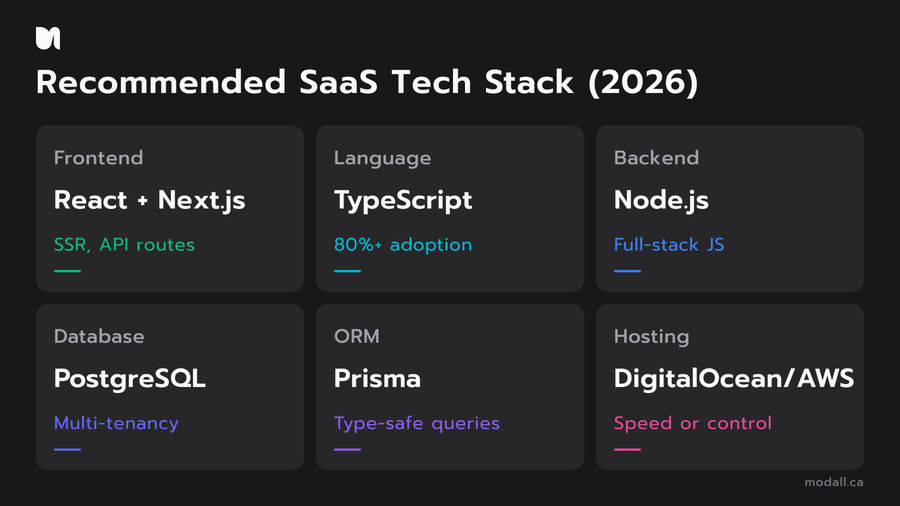
Your tech stack determines your development speed, hiring pool, scalability ceiling, and long-term maintenance costs. In 2026, the SaaS development landscape has consolidated around a few proven options.
Frontend: React dominates, powering over 44% of professional web applications. Next.js has become the de facto framework for production React applications, handling routing, server-side rendering, and API routes in a single framework. TypeScript adoption has surpassed 80% for new projects, making it the default for any production-grade SaaS codebase.
Backend: Node.js powers nearly half of backend applications, with 85% of enterprises reporting improved developer productivity from its full-stack JavaScript capabilities. For SaaS products specifically, using the same language across frontend and backend simplifies hiring, reduces context switching, and allows type sharing across the entire stack.
Database: PostgreSQL remains the standard for SaaS products that need relational data integrity, complex queries, and strong multi-tenancy support. Combined with an ORM like Prisma, it provides type-safe database access that catches errors at compile time rather than in production.
Stack Component | Recommended Choice | Why It Wins for SaaS |
|---|---|---|
Frontend Framework | React + Next.js | SSR for SEO, API routes, largest ecosystem |
Language | TypeScript | Type safety across full stack, fewer production bugs |
Backend Runtime | Node.js | Shared language with frontend, async performance |
Database | PostgreSQL | Relational integrity, multi-tenancy support, mature tooling |
ORM | Prisma | Type-safe queries, schema migrations, developer experience |
Hosting | DigitalOcean or AWS | DigitalOcean for speed-to-market, AWS for enterprise control |
Mobile considerations: If your SaaS product needs a mobile app alongside the web platform, React Native with Expo provides the most efficient path. Your team works in the same language and React patterns they already know from the web frontend, and you can share business logic, types, and API layers across both platforms without maintaining separate iOS and Android codebases. For SaaS products where mobile is a secondary channel (admin dashboards, notifications, field access), a responsive web app often eliminates the need for native mobile development entirely.
The key principle: optimize for developer velocity in the MVP phase and scalability in the growth phase. Exotic tech choices might seem appealing, but they shrink your hiring pool and increase your dependency on specific individuals. When evaluating custom SaaS development partners, pay attention to whether their stack is mainstream enough to survive a team transition.
5 Common SaaS Scaling Challenges (and How to Avoid Them)
Scaling a SaaS product introduces a predictable set of problems. The difference between products that scale smoothly and those that require painful rebuilds comes down to architectural decisions made during the first six months.
Challenge 1: Multi-tenancy growing pains
Most MVPs start with a simpler data model and add tenant isolation later. The three main approaches each serve different needs:
A shared database with tenant ID columns is the simplest to implement and cheapest to operate, but it requires careful query scoping to prevent data leakage between customers. Schema-per-tenant provides stronger isolation and simplifies data exports, but increases operational complexity as customer count grows. Database-per-tenant offers maximum isolation and simplifies regulatory mapping for customers with specific data residency requirements, but infrastructure costs and provisioning complexity scale linearly with each new customer.
Choosing the wrong model early forces expensive migrations when you hit 50-100 customers. The right choice depends on your target market: if you're selling to regulated industries where data isolation is a purchasing requirement, invest in stronger isolation from day one. If you're building for SMBs where speed and cost matter more, shared tenancy with proper row-level security is the pragmatic starting point.
Challenge 2: Performance degradation under load
What works for 100 concurrent users often breaks at 1,000. The fixes are well-known: database indexing, query optimization, caching layers, CDN configuration, and connection pooling. But these optimizations need to be planned for during architecture, not discovered during a production emergency when your largest customer's team can't log in. Load testing during development, even with simulated data, surfaces most of these issues before they become customer-facing problems.
Challenge 3: Feature bloat killing velocity
Early-stage SaaS teams ship fast. Growth-stage teams slow down because every new feature touches more existing code, introduces more edge cases, and requires more regression testing. Without intentional architecture (modular boundaries, clean API contracts, and automated testing), development velocity drops 40-60% between year one and year three. The teams that maintain velocity invest in testing infrastructure and code quality tooling early, treating them as product investments rather than overhead.
According to Recurly's 2025 churn benchmarks, B2B SaaS companies average 3.5% monthly churn, with infrastructure SaaS showing the lowest rates (1.8%) and marketing tools showing the highest (4.8-8.1%).
Challenge 4: Compliance complexity
As your customer base grows, so do compliance requirements. A product serving Canadian businesses needs PIPEDA compliance. Add American customers and you're looking at state-level privacy laws. Enterprise customers will require SOC 2 certification, SSO integration, and audit logging. These requirements are easier to satisfy when your architecture accounts for them early.
Challenge 5: Integration sprawl
Enterprise SaaS customers expect integrations with their existing tools: CRMs, ERPs, accounting software, identity providers, and communication platforms. Each integration adds maintenance surface area and creates potential failure points. The architectural decision here is whether to build a flexible API layer and webhook system early, or bolt on integrations one at a time as customers request them. The first approach costs more upfront but scales; the second creates an increasingly fragile system.
Understanding the differences between B2B and B2C SaaS helps you anticipate which scaling challenges will hit you hardest, since B2B products face heavier compliance and integration demands while B2C products face heavier performance and user management loads.

What to Look for in a Canadian SaaS Development Company
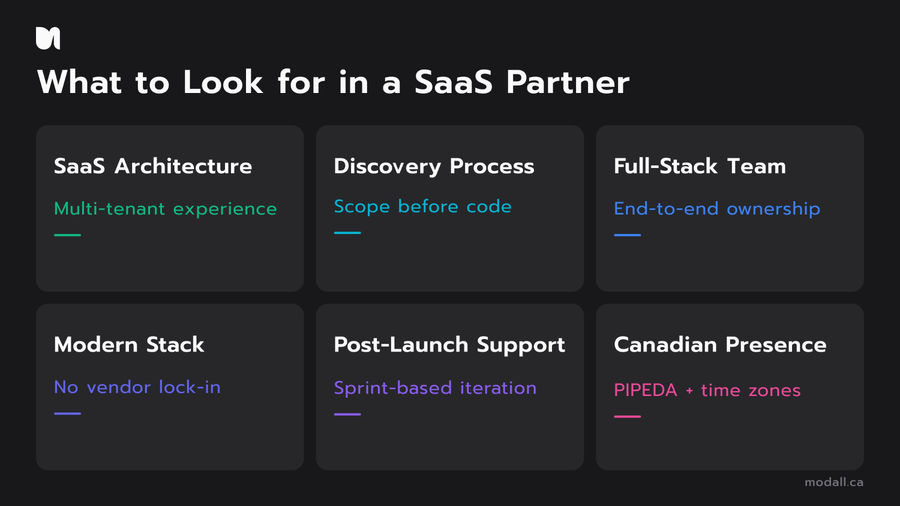
Not every development shop is equipped to build SaaS. The technical requirements, ongoing nature of the product, and commercial stakes make SaaS a distinct specialization. Here's what separates a company that can build your SaaS product from one that will cost you a year of rework.
SaaS-specific architecture experience. Ask about multi-tenancy, subscription billing integration, and how they handle tenant data isolation. If a company hasn't built multi-tenant systems before, your project becomes their learning experience.
A structured discovery process. Companies that jump straight to coding without a discovery phase are optimizing for their revenue, not your outcome. A proper discovery phase produces a technical architecture, feature priority list, and realistic timeline before any development begins. This is how you define the success of your MVP effectively before spending the bulk of your budget.
Full-stack ownership. SaaS products need frontend, backend, database, DevOps, and often mobile development. Working with a single team that owns the entire stack eliminates handoff friction and finger-pointing when something breaks.
A modern, proven tech stack. The stack should be mainstream enough that you're not locked into one vendor. TypeScript, React, Next.js, Node.js, and PostgreSQL have the largest talent pools and the most mature ecosystems. Proprietary frameworks or obscure languages create vendor lock-in.
Post-launch support model. SaaS products aren't "done" after launch. Your development partner should offer ongoing sprint-based development so you can iterate, fix, and scale without re-onboarding a new team every quarter.
Canadian presence matters. Working with a Canadian SaaS development company means shared time zones, no currency conversion surprises, and a team that understands PIPEDA and Canadian regulatory requirements firsthand. It also means your IP stays under Canadian legal jurisdiction.
Transparent pricing and scope. The SaaS application development market is full of companies that quote low to win the contract and then inflate scope mid-project. Look for fixed-price discovery phases, clear sprint-based billing, and written statements of work that define exactly what you're getting. If a company can't give you a realistic cost range after a discovery phase, that's a signal they haven't done enough SaaS work to estimate accurately.
References you can actually call. Ask for introductions to past SaaS clients, specifically ones who've been through the post-launch phase. Anyone can deliver an MVP demo. The real test is whether the architecture holds up at scale and whether the development partner stays engaged after launch day.
How We Approach SaaS Development at Modall
Modall is a custom software development company based in Ontario, Canada, founded in 2019, and SaaS products represent some of our most complex and rewarding work. Our approach is built around reducing risk at every phase and giving founders a clear path from idea to scaled product.
Every SaaS engagement starts with our structured Discovery process. Before any code is written, we define the technical architecture, feature priorities, and realistic timeline, so the budget is grounded in actual scope, not guesswork. This is where we identify multi-tenancy requirements, compliance needs, and integration points that would otherwise surface as expensive surprises mid-development.
Our primary stack, TypeScript, React, Next.js, Node.js, Prisma, and PostgreSQL, is purpose-built for SaaS, and our sprint-based engagement model lets founders scale development capacity up or down as their product evolves. Whether you're building a financial SaaS platform, a healthcare management tool, or a marketplace product, the architecture decisions we make in the first weeks are designed to support the product at scale.
We've built everything from social networking mobile apps and web3 financial platforms to ERP systems and AI-integrated SaaS products.
Our SaaS development services adapt to your product's lifecycle. Early-stage SaaS products need speed and tight feedback loops. Growth-stage products need stability, performance optimization, and compliance readiness. Enterprise-stage products need infrastructure that supports multi-region deployment. Our sprint-based model means you get the right level of development intensity at each stage, without locking into a fixed team size or 12-month contract.
Book a free consultation to walk through your SaaS concept with our team.
What our Clients Say
Hear what Cal Toner, head of product & engineering at NMT said about our team:

Frequently Asked Questions
What does a SaaS development company in Canada typically charge?
SaaS development costs in Canada range from $20,000 CAD for a lean MVP to $300,000+ for enterprise-grade platforms. The biggest cost drivers are architectural complexity (multi-tenancy, compliance requirements), the number of third-party integrations, and whether you need mobile apps alongside your web platform. At Modall, we scope every project through a dedicated Discovery phase so pricing reflects actual requirements, not estimates based on assumptions.
How long does it take to build a SaaS MVP?
A lean SaaS MVP typically can take 2 to 3 months from kickoff to launch when scope is tightly controlled. Discovery and planning consume the first couple weeks, UI/UX design and core development fill the remaining 2 to 3 months. According to recent industry benchmarks, teams using AI-assisted development tools are shipping MVPs roughly 40% faster than those working without them.
Should I hire an in-house team or a SaaS development company?
For most founders building their first SaaS product, a development company is the faster and lower-risk path. Recruiting a full in-house engineering team (frontend, backend, DevOps, design) takes 3 to 6 months and requires significant management overhead before a single line of product code is written. A SaaS development company provides an assembled team with SaaS-specific experience from day one, which is particularly valuable during the MVP and early growth phases when speed matters most. Once your product has proven traction and you need to scale the team, transitioning some or all development in-house makes more sense. Many founders use a hybrid model: a development company builds and launches the product, then transitions knowledge to an internal team for ongoing iteration. Our guide on how to choose an MVP development company covers evaluation criteria in detail.
What tech stack is best for SaaS development in 2026?
TypeScript with React and Next.js on the frontend, Node.js on the backend, and PostgreSQL as your database is the most widely adopted and future-proof SaaS stack in 2026. TypeScript adoption has surpassed 80% for new projects, and this full-stack JavaScript approach means your team shares one language across the entire product, which reduces bugs and accelerates development.
How do I ensure my SaaS product is compliant with Canadian privacy laws?
PIPEDA governs how Canadian businesses collect, use, and disclose personal information. For SaaS products, this means building in consent management, data encryption at rest and in transit, access controls, and audit logging from the architecture phase. With Bill C-27 introducing fines up to $25 million CAD, compliance is a business-critical requirement, not an afterthought. A development partner with Canadian SaaS experience will build these requirements into the technical architecture from day one.
What's the difference between building SaaS and building a regular web application?
SaaS products require multi-tenant architecture, subscription billing, continuous deployment pipelines, usage-based feature gating, and infrastructure that scales with customer count. A regular web application serves one organization and is deployed once. SaaS serves many organizations simultaneously from shared infrastructure, which demands a fundamentally different technical approach to data isolation, performance, and reliability. The development process for SaaS also never truly "ends" the way a custom web application project does; you're building a product that needs continuous improvement, monitoring, and iteration for as long as it has paying customers.
Your SaaS Product Deserves a Development Partner That Thinks Beyond Launch
Building a successful SaaS product in Canada in 2026 requires more than writing code. It requires architectural decisions that support scale, a development process that validates before it builds, and a tech stack that won't become a liability at 100 customers. The companies that get this right are the ones working with development partners who've been through the full lifecycle before, from MVP validation through growth-stage scaling.
At Modall, we bring that lifecycle experience to every SaaS engagement, grounded in a modern stack and a structured process designed to reduce risk at every phase. Whether you're validating a new concept, rebuilding a product that outgrew its original architecture, or scaling an existing SaaS platform to enterprise readiness, we've been through the full journey before.
Get a free quote to start the conversation about your SaaS product.