

Custom field service software cost ranges from $30,000 to $500,000+ for a purpose-built solution, while off-the-shelf SaaS platforms charge $30 to $350 per user per month. The right choice depends on your team size, workflow complexity, and how long you plan to use the system. This guide breaks down both paths so you can make a real financial comparison, not just look at sticker prices.
If you're exploring whether to build or buy field service software for your trades business, this article is part of our complete field service automation playbook for trades companies.
Book a free consultation to talk through your options with our team.
What Custom Field Service Software Costs in 2026
Custom field service software costs fall into two distinct categories: subscribing to an existing SaaS platform or building a purpose-built application from scratch. Most pricing guides only cover the first option. This one covers both.
Off-the-Shelf SaaS Pricing
The field service management software market is projected to reach $6.14 billion in 2026, growing at a 10.7% CAGR through 2034. That growth has created dozens of platforms competing for your subscription dollars.
Current SaaS pricing breaks down by company size:
Company Size | Monthly Cost Range | Typical Per-User Rate |
|---|---|---|
Small (1-15 techs) | $60-$1,500/mo | $30-$100/user |
Mid-market (15-50 techs) | $1,500-$10,000/mo | $80-$200/user |
Enterprise (50+ techs) | $10,000-$20,000+/mo | $150-$350/user |
Enterprise platforms price significantly higher. Salesforce Field Service starts at $175/user/month for Dispatcher and Technician licenses, with Unlimited editions reaching $330/user/month. Microsoft Dynamics 365 Field Service runs $105/user/month on an annual commitment. SAP charges transaction-based pricing starting at $4,048 per 10,000 transactions annually.

Custom-Built Software Pricing
Building field service software from scratch is a fundamentally different investment model. Instead of per-user monthly fees, you pay development costs upfront and own the result.
Project Scope | Cost Range | Timeline | What You Get |
|---|---|---|---|
MVP / Validation | $30,000-$50,000 | 2-3 months | Core scheduling, dispatch board, basic features |
Growth Stage | $80,000-$175,000 | 4-7 months | CRM, invoicing, GPS tracking, customer portal |
Mid-Complexity | $175,000-$300,000 | 6-10 months | Inventory management, route optimization, offline sync, reporting dashboards |
Enterprise Grade | $300,000-$500,000+ | 9-18 months | Full ERP integration, AI-powered scheduling, compliance modules, multi-location support |
These ranges align with verified industry data. According to Clutch's 2026 pricing research based on thousands of verified project reviews:
The average custom software development project costs $132,480
The typical project timeline is 13 months from kickoff to launch
The average monthly development cost works out to roughly $10,200/month

Field service apps tend to land above that average because they require both a web dashboard and a mobile application, real-time GPS tracking, offline-capable data sync for technicians in areas without reliable connectivity, and hardware integrations like barcode scanners or IoT sensors. A field service MVP with a web dashboard, standard features, basic scheduling, and dispatch can realistically start in the $30,000-$50,000 range if scoped tightly, while a full-featured platform with route optimization, inventory, and ERP connections could push well past $200,000.
The global FSM market is expected to grow from $6.14 billion in 2026 to $13.79 billion by 2034, meaning the demand for specialized field service technology is accelerating faster than the SaaS market can standardize for every industry.
The Real Cost Drivers Behind Field Service Software
Field service software pricing is not just about the subscription fee or development quote. The real cost sits in six factors that most pricing pages bury in the fine print.
Number of Users
Per-user pricing is the most common SaaS model, and it is also the most expensive at scale. A 25-person team paying $150/user/month spends $45,000 per year before adding a single feature. Double that team to 50, and you are at $90,000 annually for the same software. Custom software eliminates per-user fees entirely. You pay once to build it, and every new user costs nothing to add.
Onboarding and Implementation
SaaS onboarding fees range from $500 to $5,000+ depending on company size. Enterprise platforms like Salesforce and Microsoft Dynamics often require implementation partners, adding $10,000 to $50,000+ in consulting fees before the software goes live. Custom solutions include onboarding in the development process since the team building the software also handles training and deployment.
Integrations
Connecting field service software to your existing accounting system, CRM, or inventory tools is where hidden costs multiply. Many SaaS platforms charge extra for API access or limit the number of third-party integrations per plan tier. Custom software is built around your existing stack from day one, meaning integrations with tools like QuickBooks, Xero, or your ERP are included in the development scope rather than bolted on later.
Compliance and Data Residency
For trades companies operating in regulated environments, or any Canadian business handling customer data, compliance requirements can dramatically affect cost. Some SaaS platforms store data outside Canada, creating potential conflicts with Canadian data residency requirements. Custom software gives you full control over where data lives and how it is processed.
Mobile App Requirements
Field service software without a solid mobile app is not field service software. Technicians need offline-capable job details, photo capture, digital signatures, GPS routing, and real-time status updates. SaaS platforms include mobile apps in their subscription, but the functionality is generic. Custom mobile app development lets you build exactly the workflow your techs use in the field, nothing more and nothing less.
Customization Ceiling
Every SaaS platform hits a wall. At some point, the thing your team needs is not on the roadmap. When that happens, you either adapt your workflow to the software (costing productivity), pay for enterprise-tier customization services, or accept the limitation. Custom software does not have this ceiling because you own the codebase and can extend it whenever you need to.
Off-the-Shelf vs Custom: A Build vs Buy Framework
Choosing between SaaS and custom field service software is not about which costs less upfront. It is about which costs less over the life of the system, given your specific operations.

When SaaS Is the Right Call
Off-the-shelf field service software makes financial sense when your operations are relatively standard: residential HVAC, plumbing, or electrical with straightforward scheduling, dispatch, and invoicing needs. If your workflows map cleanly to what platforms like Jobber, Housecall Pro, or ServiceTitan already offer, paying $50 to $150 per user per month is almost always cheaper than building from scratch.
SaaS also wins when speed matters more than fit. You can be live in days or weeks, not months. For a growing trades company that needs something working now, that time advantage has real dollar value.
When Custom Makes More Sense
Custom field service software becomes the better investment when one or more of these conditions apply:
You have 50+ field technicians, and per-user SaaS costs are approaching or exceeding $100,000 annually. At that scale, the math starts tilting toward building.
Your workflows are genuinely unique. Multi-trade operations, complex compliance requirements, proprietary inspection protocols, or industry-specific asset management needs that no SaaS platform handles natively.
You need deep integrations with existing systems. If your field operations connect to a custom ERP, proprietary inventory system, or industry-specific databases, SaaS integration limits become expensive bottlenecks.
Data residency and compliance are non-negotiable. Regulated industries like construction in government contracts, utilities, or healthcare-adjacent field services need full control over data handling.
The Hybrid Approach
Some companies start with SaaS and migrate specific functions to custom software as they scale. This is a valid strategy. You might use an off-the-shelf platform for basic scheduling while building custom mobile tools for your field techs, or keep your CRM in a SaaS platform while building custom job costing and reporting.
At Modall, we have seen this approach work well for mid-market companies that need to move fast now but know they will outgrow generic tools within 18 to 24 months. Our web development services support both ground-up builds and targeted custom modules that integrate with your existing SaaS tools.
Total Cost of Ownership Over 5 Years
The most important comparison is not what field service software costs today. It is what it costs over five years, including every hidden line item. The tables below are general scenarios to help visualize potential total cost of ownership. Custom software prices are never the same across projects since everything depends on scope and complexity. To get an accurate estimate for your situation, reach out to Modall for a free quote.
SaaS TCO (50-User Team)
Cost Category | Year 1 | Years 2-5 (Annual) | 5-Year Total |
|---|---|---|---|
Subscription ($150/user/mo) | $90,000 | $90,000+ | $450,000+ |
Onboarding/implementation | $5,000-$15,000 | $0 | $5,000-$15,000 |
Integration fees | $2,000-$10,000 | $1,000-$5,000 | $6,000-$30,000 |
Training | $2,000-$5,000 | $1,000 | $6,000-$9,000 |
Price increases (~11% avg/yr) | Included above | Compounding | +$80,000-$120,000 |
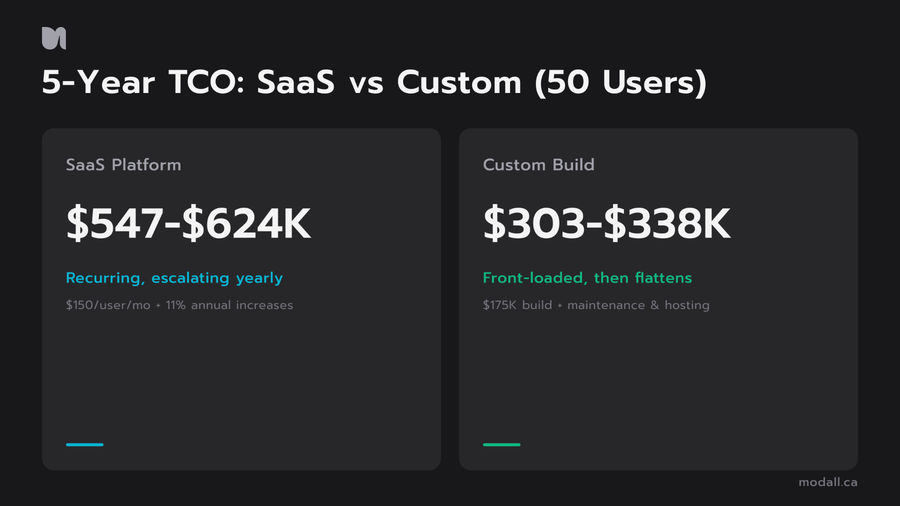
Total | $547,000-$624,000 |
That price increase line is significant. According to the Vertice SaaS Inflation Index and analysis from SaaStr, SaaS pricing rose by an average of 11.4% in 2025, roughly 5x the rate of general inflation. Some vendors increased fees by more than 300% following acquisitions. Over five years, compounding increases at that rate add $80,000 to $120,000 to the total for a 50-person team.
Custom Software TCO (50-User Team)
Based on a $175,000 mid-complexity build (scheduling, dispatch, CRM, GPS tracking, mobile app):
Cost Category | Year 1 | Years 2-5 (Annual) | 5-Year Total |
|---|---|---|---|
Development | $175,000 | $0 | $175,000 |
Hosting/infrastructure | $10,000 | $10,000 | $50,000 |
Maintenance (10-15% of dev cost) | Included | $17,500-$26,250 | $70,000-$105,000 |
Training | $4,000 | $1,000 | $8,000 |
Total | $303,000-$338,000 |
Maintenance at 10-15% of the initial build cost is the industry standard for well-built software with clean architecture and solid documentation. That covers bug fixes, security patches, dependency updates, and server monitoring.
After Year 1, your annual carrying cost drops to $27,500-$36,250 (maintenance plus hosting), compared to $90,000+ per year on SaaS at the same team size. Any new feature development, workflow changes, or additional integrations would be scoped and quoted separately based on what you need.
SaaS TCO (20-User Team)
Cost Category | Year 1 | Years 2-5 (Annual) | 5-Year Total |
|---|---|---|---|
Subscription ($80/user/mo) | $19,200 | $19,200+ | $96,000+ |
Onboarding/implementation | $1,000-$5,000 | $0 | $1,000-$5,000 |
Integration fees | $1,000-$5,000 | $500-$1,500 | $3,000-$11,000 |
Training | $1,000-$3,000 | $500 | $3,000-$5,000 |
Price increases (~11% avg/yr) | Included above | Compounding | +$17,000-$25,000 |
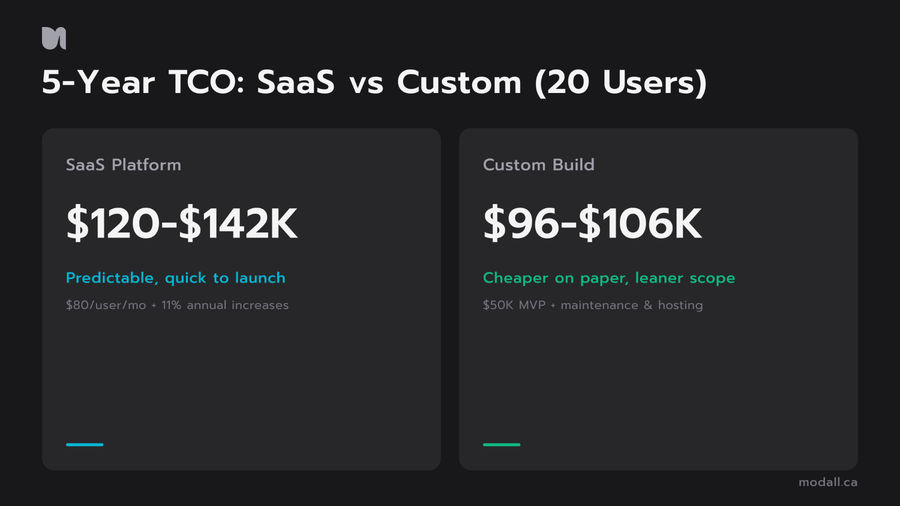
Total | $120,000-$142,000 |
At 20 users, the per-user rate drops to around $80/month since most teams this size run platforms like Jobber ($29-$39/user with plan fees), Housecall Pro ($59-$189/month base), or FieldEdge (~$125/technician). The base subscription runs $19,200 per year, which is manageable even before you factor in how fast these teams can get up and running.
Custom Software TCO (20-User Team)
Based on a $50,000 MVP build (core scheduling, dispatch, basic mobile app):
Cost Category | Year 1 | Years 2-5 (Annual) | 5-Year Total |
|---|---|---|---|
Development | $50,000 | $0 | $50,000 |
Hosting/infrastructure | $4,200 | $4,200 | $21,000 |
Maintenance (10-15% of dev cost) | Included | $5,000-$7,500 | $20,000-$30,000 |
Training | $2,500 | $500 | $4,500 |
Total | $95,500-$105,500 |
What the Numbers Tell You
At 20 users, the raw numbers are close. Custom comes in at $95,500 to $105,500, while SaaS runs $120,000 to $142,000. But those custom numbers reflect a $50,000 MVP, which gives you core scheduling and dispatch without the years of feature depth that mature SaaS platforms offer out of the box. For most 20-person teams that need to be operational quickly, SaaS is the simpler and lower-risk path. Custom makes sense at this size only if your workflows are genuinely unique and no SaaS platform handles them natively.
At 50 users, the gap is substantial. SaaS costs $547,000 to $624,000. Custom costs $303,000 to $338,000. Even at the high end of custom, you are saving over $200,000 compared to the low end of SaaS, and the gap widens every year because SaaS costs compound while custom costs flatten.
Here is the critical difference: SaaS costs are locked in and escalating. You pay every month, forever, and the vendor controls the price. Custom software costs front-load in Year 1, then drop to maintenance and hosting only. By Year 3, your annual carrying cost is a fraction of what a SaaS subscription costs at the same scale.
For a 50-user field service team, the five-year cost crossover point typically falls between Month 24 and Month 36, where cumulative custom software costs drop below cumulative SaaS costs and stay there permanently.
For teams under 20, SaaS almost always wins when you factor in speed to launch and out-of-the-box functionality. It only makes sense if you need custom built features that the available tool just don't offer. For teams over 50, custom almost always wins on pure TCO. The 20-to-50 range is where the decision gets nuanced, and that is exactly where a structured discovery process matters most. If you don't know which path to take, reach out to Modall for a free consultation.
When Custom Field Service Software Makes Financial Sense
Custom field service software cost is justified when the investment pays for itself through operational gains that SaaS cannot deliver. Here are the specific scenarios where the numbers work.
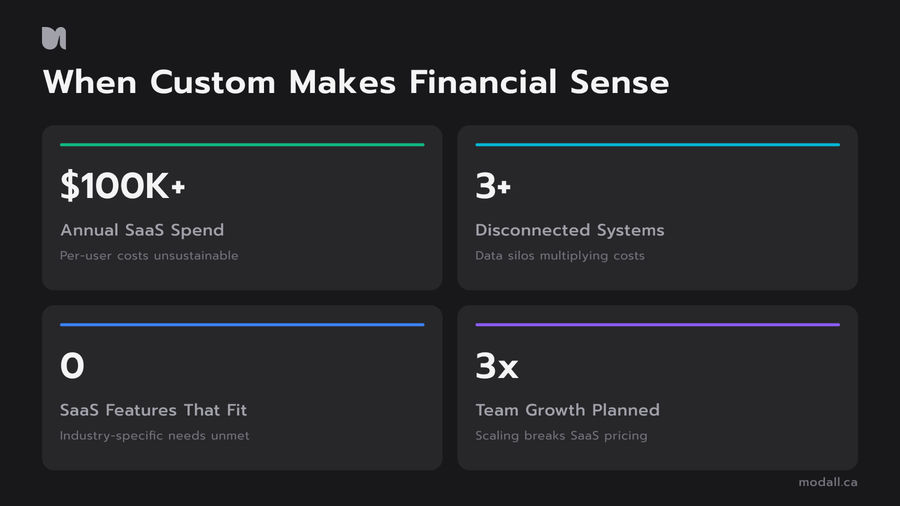
Your Per-User Costs Are Unsustainable
If you are spending more than $100,000 annually on SaaS subscriptions for field service, you have crossed the threshold where custom development starts paying back within two to three years. That figure drops even lower if your SaaS vendor has raised prices in the last 12 months, which most have according to 2025 industry benchmarks.
You Are Running Multiple Disconnected Systems
Many trades companies run scheduling in one tool, invoicing in another, CRM in a third, and inventory management in a spreadsheet. Each system costs money, creates data silos, and requires manual reconciliation. A single custom platform that unifies these functions eliminates redundant subscriptions and, more importantly, eliminates the labor cost of manually moving data between systems.
You Need Industry-Specific Features No SaaS Offers
If your field service operations include proprietary inspection checklists, regulatory documentation requirements, multi-trade coordination on a single job site, or asset management protocols specific to your industry, you will not find them in a $150/user/month platform. These features are exactly what custom software development in Canada is built for.
Your Growth Plan Breaks SaaS Pricing
A 30-person team growing to 100 over three years faces a tripling of SaaS costs. With custom software, that same growth costs nothing in additional licensing. You might invest in server upgrades and feature additions, but the incremental cost per user approaches zero.
How We Approach Field Service Software at Modall
At Modall, we are a custom software development agency based in Ontario, Canada, founded in 2019. We have built custom ERPs, client portals, automation workflows, and operations software for companies that outgrew their SaaS tools and needed something purpose-built for how they actually work.
Our approach starts with a structured Discovery process that maps your current field operations, identifies where off-the-shelf software falls short, and produces a detailed scope and budget before a single line of code is written. This eliminates the biggest risk in custom development: scope creep that turns a $100,000 project into a $200,000 problem.
We build on a modern stack: TypeScript, React, Next.js for the web dashboard and React Native for the mobile app your techs carry in the field. Our ERP work for clients like PizzaForno demonstrates the kind of multi-location, real-time operational software that field service companies need. That project required the same core components most FSM builds do: real-time inventory, reporting, sales analytics, and multi-location management.
Our SaaS development experience also means we understand what makes SaaS products successful, so when we build custom, we apply those same product-thinking principles: clean UX, real-time data, and an architecture designed to scale.
If you are evaluating whether custom field service software makes sense for your team, get a free quote and we will walk through the numbers together.
Frequently Asked Questions
How much does custom field service software cost to build?
Custom field service software costs between $30,000 and $500,000+ depending on scope. An MVP with core scheduling, dispatch, and other standard features typically costs $30,000 to $50,000 and takes two to three months. A mid-complexity build with CRM integration, GPS tracking, invoicing, and inventory management runs $150,000 to $300,000. Enterprise-grade builds with AI optimization, ERP integration, and compliance features start at $300,000.
How much does off-the-shelf field service software cost per month?
Off-the-shelf field service management software costs between $30 and $350 per user per month. Small teams of 1 to 15 technicians typically pay $60 to $1,500 per month total. Mid-market companies with 15 to 40 techs pay $1,500 to $10,000 monthly. Enterprise platforms like Salesforce Field Service ($175/user/month) and Microsoft Dynamics 365 ($105/user/month) sit at the higher end.
Is it cheaper to build or buy field service software?
It depends on team size and timeline. For teams under 20 users, buying SaaS is almost always cheaper. For teams over 50 users, building custom software typically becomes cheaper within 24 to 36 months due to eliminating per-user fees. The 20 to 50 user range requires a detailed TCO analysis comparing your specific SaaS costs against a custom development quote.
However, sometimes off-the-shelf options simply do not have the capabilities your business needs. When that is the case, building a custom solution makes sense whether you have 5 or 50+ field technicians. If you want a better idea of potential costs, get a free estimate from Modall.
What is included in field service software maintenance costs?
Annual maintenance for custom field service software typically runs 10% to 15% of the original development cost. This covers bug fixes, security updates, server monitoring, dependency updates, and compatibility maintenance as mobile operating systems and browsers update. For a $100,000 build, expect $10,000 to $15,000 per year in maintenance. SaaS maintenance is included in your subscription, which is one reason per-user fees are recurring.
What features should field service software include?
At minimum, field service software needs job scheduling and dispatch, a mobile app for field technicians, customer management (CRM), quoting and invoicing, GPS tracking and route optimization, and reporting. Advanced features include AI-powered scheduling, inventory management, fleet tracking, offline data sync, digital signatures, and integration with accounting tools like QuickBooks or Xero.
Can you start with SaaS and switch to custom later?
Yes, and this is a common path. Many companies start with an off-the-shelf platform to validate their operations and then build custom software once they understand exactly what they need and where the SaaS falls short. The hybrid approach, keeping some SaaS tools while building custom components for unique workflows, is often the most cost-effective transition strategy.
Making the Right Investment in Field Service Technology
Understanding your custom field service software cost is an investment decision, not a line item. The right answer depends on where you are today, where you are headed, and whether the tools available off the shelf can actually get you there. For growing trades companies with complex operations, the math increasingly favors building something purpose-built.
At Modall, we help field service companies evaluate that decision with real numbers and a structured Discovery process that eliminates guesswork. Book a free consultation to find out which path makes the most financial sense for your team.