

The construction software market reached $10.76 billion in 2025 and is projected to hit $24.72 billion by 2034, growing at 9.7% CAGR. Yet over 90% of construction projects experience cost overruns, with mega projects regularly exceeding budgets by 80% or more. McKinsey estimates that global construction inefficiencies cost $1.6 trillion annually. The gap between what the industry needs and what off-the-shelf software delivers is massive.
That gap is where custom construction software development comes in. When Procore, Buildertrend, or Jobber can't match your workflows, compliance requirements, or integration needs, building your own platform becomes the faster path to operational control. This guide covers the full picture: when custom makes sense, what it costs, how to scope a project, and what separates a good build from an expensive mistake.
Looking for custom construction software? Get a free quote from Modall today!
Why Construction Companies Build Custom Software
Most construction firms start with off-the-shelf tools and hit a ceiling within 12 to 24 months. The triggers are predictable: workflows that don't match the software's assumptions, integrations that require manual data entry between systems, compliance requirements the vendor doesn't support, or pricing models that scale faster than revenue.
A 2025 Deloitte report found that the average construction business now uses 6.2 different technology tools, up 20% from the previous year. That fragmentation creates data silos, duplicate entry, and reconciliation headaches that compound as the company grows.
Custom software solves this by consolidating operations into a single platform built around your actual processes. Instead of adapting your business to the software, the software adapts to your business.

Common Triggers for Going Custom
Your quoting workflow requires multi-tier subcontractor coordination that no off-the-shelf tool handles natively
You need field crews logging updates, safety incidents, and progress photos from mobile devices in areas with poor connectivity
Compliance reporting (prevailing wage, OSHA, provincial safety standards) requires manual workarounds in your current stack
Your ERP, accounting system, and project management tool don't talk to each other without expensive middleware
You're paying per-seat licensing fees that now exceed what a custom build would cost over three years
You need real-time dashboards consolidating data from estimating, scheduling, and accounting into one view
What Custom Construction Software Actually Looks Like
Custom construction software is not one product. It's a category that spans everything from a simple contractor quoting tool to a full enterprise resource planning system managing hundreds of concurrent projects. The scope depends entirely on where your operational bottlenecks are.
Contractor Quoting and Estimating Platforms
These platforms replace spreadsheet-based estimating with structured quoting workflows. A typical build includes material cost databases, labour rate calculators, markup rules, subcontractor bid collection, and PDF proposal generation. For general contractors managing 50+ bids per month, this alone can recover 15 to 20 hours of administrative time weekly.
Job Management and Scheduling Systems
Job management platforms handle the full lifecycle of a construction project from pre-construction through closeout. Core features include Gantt scheduling with dependency tracking, resource allocation across crews, daily log capture, RFI management, and change order processing. The difference between custom and off-the-shelf here is usually in how change orders, crew assignments, and client communication workflows are structured.
Field Service and Mobile Applications
Field apps put critical project data in the hands of superintendents, foremen, and crews. Key requirements include offline functionality (job sites often have limited connectivity), GPS-tagged photo documentation, digital safety checklists, time tracking with geofencing, and push notifications for schedule changes. According to Gitnux, using mobile apps for field reporting saves an average of 4 hours per week per employee, making mobile-first design a priority for any custom construction platform.
Construction ERP and Back-Office Systems
Full ERP builds are the most complex category. These platforms integrate estimating, project management, accounting, payroll, equipment tracking, and reporting into a single system. Multi-tenant architecture is common for firms managing multiple business units or franchises. Modall built a multi-tenant ERP system for PizzaForno that manages operations across distributed locations, and the same architectural patterns apply directly to construction firms managing multiple job sites and crews.
CRM and Client Management Platforms
Construction CRMs differ from generic CRMs because the sales cycle involves site visits, detailed scoping, bid submissions, and project-based relationships rather than transactional ones. Custom CRMs for trades businesses typically include lead tracking, estimate-to-invoice workflows, automated follow-up sequences, referral tracking, and integration with accounting systems like QuickBooks or Sage.
Build vs. Buy: When Custom Is the Right Call
Custom software development is not the right answer for every construction company. Off-the-shelf tools like Procore, Buildertrend, Jobber, and ServiceTitan are excellent products that serve the majority of the market well. If you're evaluating those options first, our breakdown of the best construction software development companies covers who builds what. The decision to build custom should be driven by specific, measurable pain points.

When Off-the-Shelf Works
Your workflows are standard and match the software's built-in processes
You have fewer than 50 employees and limited operational complexity
Your integration needs are covered by the vendor's existing API and marketplace
You don't have compliance or regulatory requirements beyond what the tool supports
Per-seat pricing stays below $500/month for your team size
When Custom Makes Sense
You're spending more on workarounds, manual processes, and integrations than a custom build would cost
Your competitive advantage depends on proprietary workflows that off-the-shelf tools expose to competitors
Compliance requirements (prevailing wage tracking, union reporting, safety documentation) need automation
You need a platform that scales with your growth without per-seat pricing becoming a blocker
You're consolidating 4+ separate tools into one integrated system
The break-even calculation is usually straightforward. If your team spends 20+ hours per week on manual data entry, reconciliation, and workarounds across fragmented tools, and your off-the-shelf licensing costs exceed $3,000/month, a custom platform typically pays for itself within 18 to 24 months.
What Custom Construction Software Development Costs
Cost is the first question every construction company asks, and it deserves a direct answer. Custom construction software development costs range from $50,000 to $500,000+ depending on scope, complexity, and the development team's location. Here's how that breaks down by project type.
Cost Ranges by Project Type
Project Type | Typical Cost Range | Timeline |
|---|---|---|
Custom MVP (Basic Tool) | $20,000 to $30,000 | 2 to 3 months |
Contractor quoting tool (web) | $50,000 to $100,000 | 3 to 4 months |
Field service mobile app | $75,000 to $150,000 | 4 to 6 months |
Job management platform | $100,000 to $250,000 | 5 to 8 months |
Construction CRM | $80,000 to $175,000 | 4 to 6 months |
Full ERP system | $200,000 to $500,000+ | 8 to 14 months |
These ranges assume a North American development team. Offshore teams can reduce costs by 40 to 60%, but construction software requires deep domain understanding of local compliance requirements, trade practices, and integration ecosystems. The cheapest build is rarely the most cost-effective one.
Custom software is unique and cost ranges vary project to project. To learn more about costs, get a free tailored quote from Modall today!

What Drives Cost Up
Complex integrations with legacy accounting systems (Sage, Viewpoint, Foundation)
Offline-first mobile functionality with conflict resolution for field data sync
Multi-tenant architecture for franchise or multi-location operations
Advanced reporting with real-time dashboards pulling from multiple data sources
Compliance automation (prevailing wage calculations, certified payroll reports, safety documentation)
What Keeps Cost Down
Starting with a focused MVP that solves one core problem before expanding
Using proven frameworks (React, Next.js, Node.js) instead of exotic tech stacks
Sprint-based development where you validate each phase before committing to the next
Clear requirements and a structured discovery process before any code is written
How to Scope a Custom Construction Software Project
The most common reason custom software projects fail is not bad development. It's bad scoping. Poor communication and data management contribute to roughly $31 billion in rework costs per year in the U.S. alone. The same dynamics apply to software projects.
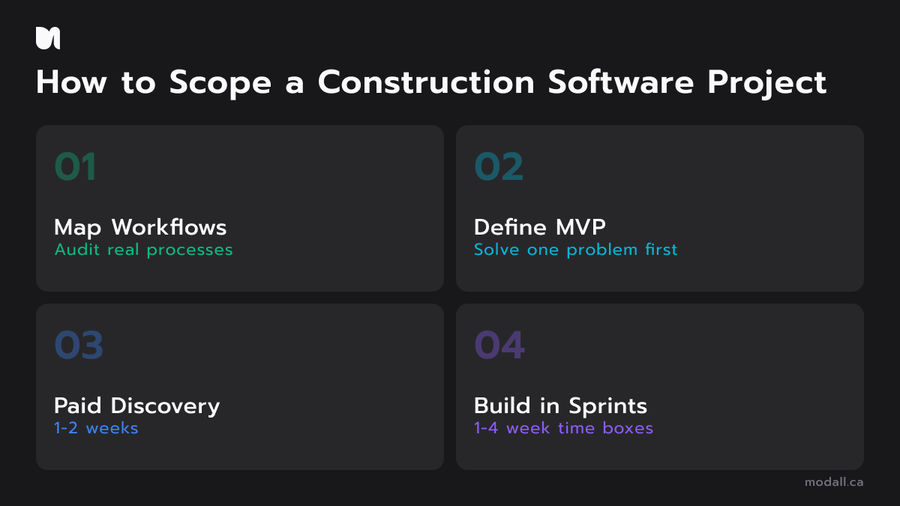
Step 1: Map Your Current Workflows
Before talking to any development company, document how work actually flows through your organization. Not the ideal process, the real one. Where does data get entered twice? Where do things fall through the cracks? Which steps require a phone call, a text, or a trip to the job site that could be automated? This audit typically reveals that 30 to 40% of administrative tasks are candidates for automation.
Step 2: Define the MVP
An MVP (minimum viable product) is the smallest version of the software that solves your most painful problem. If your biggest bottleneck is quoting, build the quoting tool first. If it's field-to-office communication, start with the mobile app. Resist the temptation to build everything at once. A focused MVP shipped in 3 to 4 months delivers ROI faster than a 12-month mega-project.
Step 3: Run a Paid Discovery Phase
A structured discovery phase is where the development team maps your requirements, designs the technical architecture, identifies integration points, and produces a detailed scope of work with fixed pricing. At Modall, discovery runs for one to two weeks. It protects both sides: you get a clear picture of what you're building and what it will cost before committing to development, and the development team gets the clarity they need to deliver on scope and budget.
Step 4: Build in Sprints
Sprint-based development breaks the project into time-boxed phases (typically one, two, or four weeks). Each sprint delivers working software that you can test, use, and provide feedback on. This approach reduces risk because you're never more than a few weeks away from seeing real progress, and scope adjustments can be made between sprints without derailing the entire project.
The Tech Stack Behind Modern Construction Software
Technology choices matter because they determine how fast the platform can be built, how well it scales, and how easy it is to maintain. Cloud-based solutions now lead the construction management software market with 62.35% share in 2025, advancing at 12.08% CAGR as contractors prioritize remote-access capabilities and lower maintenance costs.
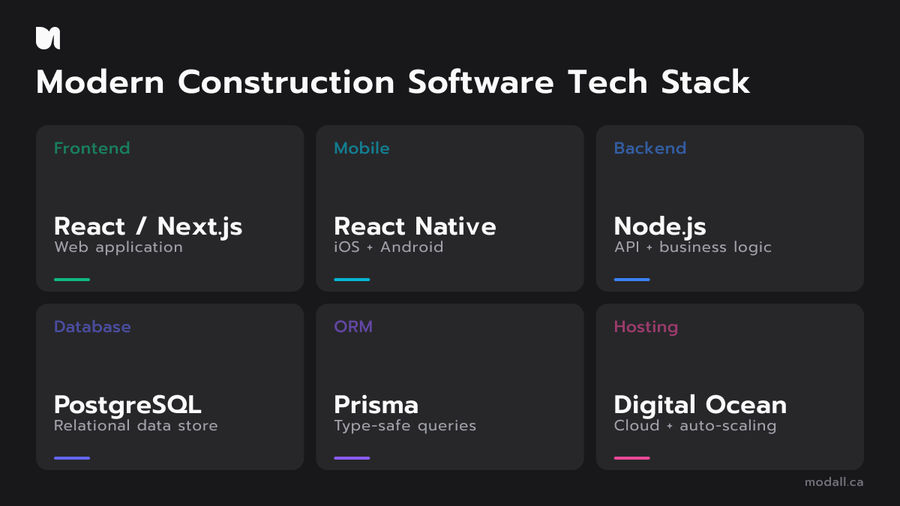
A modern construction software stack typically includes:
Frontend: React or Next.js for the web application, React Native for iOS and Android mobile apps
Backend: Node.js with a relational database (PostgreSQL) for structured project and financial data
ORM: Prisma for type-safe database queries and schema management
Styling: Tailwind CSS for consistent, responsive UI across devices
Hosting: Digital Ocean, AWS, or Vercel for cloud deployment with auto-scaling
Integrations: REST and webhook APIs connecting to accounting systems, payment processors, and equipment trackers
This stack is not theoretical. It's the same one Modall uses across 40+ production deployments, including platforms for enterprise clients, professional athletes, and high-growth startups. TypeScript across the full stack means fewer bugs, faster development, and easier long-term maintenance.
How AI Is Changing Construction Software in 2026
Artificial intelligence is no longer a future trend in construction technology. 37% of construction businesses now use AI and machine learning, up from 26% in 2023, and 44% plan to increase AI investment in the next year. AI capabilities that are now practical to build into custom construction platforms include:
Predictive project risk scoring: models trained on historical project data flag jobs likely to exceed budget or timeline before problems surface
Automated material takeoffs: AI extracts quantities from blueprints and generates preliminary cost estimates in minutes instead of hours
Intelligent scheduling: algorithms optimize crew deployment across multiple job sites based on skills, availability, proximity, and project priority
Safety incident prediction: pattern recognition across daily logs and site photos identifies conditions correlated with safety incidents
Automated change order analysis: natural language processing reviews change orders against contract terms and flags scope creep
The advantage of building AI into a custom platform versus relying on off-the-shelf AI features is data ownership. When the AI learns from your project data, the predictions improve over time and become a competitive advantage that generic tools can't replicate.
Choosing a Custom Construction Software Development Company
Not every software development company is equipped to build for the construction industry. The space has domain-specific requirements around compliance, field operations, and integration with legacy systems that generalist agencies often underestimate. Here's what to evaluate. (For a ranked comparison, see our guide to the best construction software development companies.)
Industry experience: Have they built construction, field service, or trades platforms before? Ask for case studies with measurable results.
Technical depth: Do they own their tech stack, or are they assembling contractors? In-house teams deliver more consistent quality.
Discovery process: Do they offer a paid scoping phase before development? Companies that skip discovery are guessing at your requirements.
Engagement model: Sprint-based models with regular deliverables reduce risk. Avoid fixed-bid contracts where scope changes mean change orders.
Portfolio fit: A 5-person specialist firm and a 500-person agency serve different needs. Match the team size to your project complexity.
Post-launch support: Who maintains the software after launch? Hosting, bug fixes, feature updates, and security patches are ongoing costs.
Frequently Asked Questions
How long does it take to build custom construction software?
Timeline depends on scope. A focused quoting or field service tool typically takes 3 to 4 months from discovery to launch. A full construction ERP with integrations, mobile apps, and advanced reporting runs 8 to 14 months. Starting with an MVP and expanding in phases is the fastest path to ROI.
Is custom construction software worth it for small contractors?
For most contractors with fewer than 20 employees and straightforward operations, off-the-shelf tools like Jobber or Buildertrend can be a better fit. Custom makes sense when you need specific functionality you can't get elsewhere, your workflows are complex enough that off-the-shelf tools require constant workarounds, or when per-seat licensing costs exceed what a custom build would cost over 2 to 3 years.
What's the difference between construction management software and custom construction software?
Construction management software (Procore, PlanGrid, Buildertrend) is a pre-built product designed for the broadest possible market. Custom construction software is built specifically for your company's workflows, compliance requirements, and integration needs. The trade-off is higher upfront cost for custom versus ongoing licensing fees and workflow compromises with off-the-shelf.
Can custom construction software integrate with our existing tools?
Yes. Modern construction platforms connect to accounting systems (QuickBooks, Sage, Xero), payment processors, CRM tools, and equipment tracking systems through APIs. Integration complexity depends on whether the existing tools offer modern REST APIs or require legacy connection methods. A structured discovery phase maps every integration point before development starts.
How do we maintain custom software after launch?
Post-launch maintenance typically includes hosting, security updates, bug fixes, and feature enhancements. Most development companies offer ongoing support retainers. Budget 10 to 20% of the initial build cost annually for maintenance. This is comparable to what you'd spend on annual licensing for an enterprise off-the-shelf tool, but you own the software outright.
Ready to Scope Your Construction Software Project?
If your construction company is hitting the limits of off-the-shelf software, a custom platform built around your actual workflows might be the next step. Modall is a 100% in-house development team based in Toronto, Ontario. We build web and mobile platforms for construction, trades, and field service companies using React, Next.js, React Native, Node.js, and PostgreSQL.
Our process starts with a free consultation to understand your project and see if we're the right fit. If we are, it moves to a paid Discovery phase (1 to 2 weeks) where we map your requirements, design the technical architecture, build out Figma flows, and deliver a full project roadmap with a detailed budget estimate before any development begins. No commitment beyond Discovery, and you walk away with a complete project blueprint whether you build with us or not.
Get a free quote or book a call to discuss your project.