

Finding the best construction software development companies in 2026 matters more than ever.
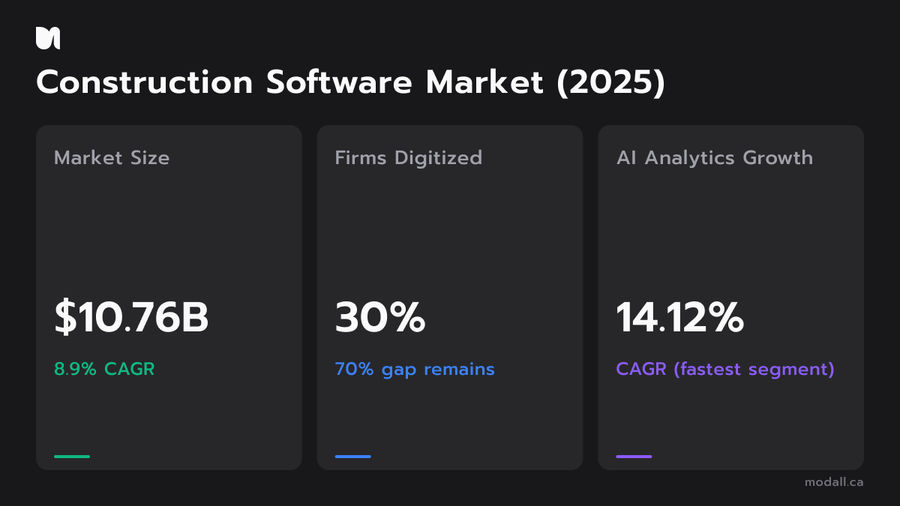
The construction software market hit $10.76 billion in 2025 (Fortune Business Insights), yet only about 30% of construction firms are fully digitized (Mordor Intelligence). That gap between market demand and actual adoption means the agencies on this list are building the platforms that will define how contractors, subcontractors, and trades businesses operate for the next decade.
The subcontractor segment alone is growing at 11.6% CAGR (GlobeNewswire), and AI-driven progress analytics is the fastest-growing sub-segment at 14.12% CAGR (Mordor Intelligence). Whether you need a contractor quoting tool, a field service dispatch platform, or a full job management system, the right development partner makes the difference between a tool your crews adopt and one that collects dust.
We evaluated companies based on portfolio depth, construction domain expertise, technical capabilities, Clutch ratings, and engagement flexibility. For a broader look at top software development companies in Toronto, we have a separate ranking covering the general market.
Ranking Criteria and Methodology
Rankings are based on construction industry experience, verified client reviews on Clutch and G2, technical stack depth, project portfolio quality, and pricing transparency. Full disclosure: Modall is our company. We ranked ourselves first because of our in-house Canadian development team, proven construction and trades project experience, and a structured discovery process that de-risks builds before code is written. We have included the strongest alternatives across different specializations so you can make an informed decision.
Best Construction Software Development Companies, Quick Comparison 2026
Rank | Company | Best For | Specialization | Clutch Rating |
|---|---|---|---|---|
1 | Modall (Best Overall) | Custom contractor platforms and trades SaaS | Full-stack web + mobile, AI integration | 5.0 |
2 | Intellectsoft | Enterprise-scale construction platforms | Digital transformation, ERP systems | 4.8 |
3 | ScienceSoft | Data-heavy construction analytics | IT consulting, enterprise software | 4.8 |
4 | Simform | Scalable cloud construction tools | Custom software, cloud architecture | 4.7 |
5 | Chetu | AEC industry integrations | ERP, project management, IoT | 4.3 |
6 | Orases | Mid-market construction workflows | Custom web applications | 5.0 |
7 | Appinventiv | Mobile-first field service apps | Mobile development, UI/UX | 4.7 |
8 | Citrusbug Technolabs | Project control and budgeting | Construction management tools | 4.9 |
9 | Toptal | On-demand construction dev talent | Freelance marketplace, staffing | N/A |
10 | Sparkgeo | AI/ML construction analytics | GIS analysis, location services | N/A |
The 10 Best Construction Software Development Companies in 2026
1. Modall
Best for: Custom contractor platforms, job management tools, CRM systems, and trades SaaS products
Modall is a custom software development company based in Uxbridge, Ontario, with a focused specialty in building web and mobile platforms for the construction and trades industry. Their in-house Canadian development team works exclusively with technologies proven at scale in field-heavy industries: React, Next.js, React Native, Node.js, PostgreSQL, and Prisma. Every line of code is written by their team. They do not outsource or offshore any development work.
Founded in 2019, Modall has delivered contractor quoting platforms, job management systems, multi-tenant ERP solutions, e-commerce platforms, and client portal applications for businesses across the construction value chain. Their service offerings span residential builders, commercial subcontractors, and field service companies that need mobile-first tools their crews will actually use on the job site. They have also built SaaS products and AI-integrated platforms for clients ranging from pre-launch startups to enterprise organizations and professional athletes.
What sets Modall apart from larger agencies on this list is specialization. They are not a generalist firm that takes any project that comes through the door. They focus on building business management software for industries where field operations, scheduling, estimating, and client communication are core workflows. Construction and trades fit that profile exactly.
Their engagement model runs on a sprint-based system, scalable from one to four development weeks per month, so construction companies can start with a focused build (like a quoting tool or dispatch system) and expand into a full platform over time. Every engagement starts with a structured discovery process that maps requirements, identifies integration points with tools like QuickBooks and Xero, and produces a scoped plan before any code is written. This de-risks the build and gives clients a clear picture of timeline and deliverables upfront.
Key highlights:
In-house Canadian development team, no outsourcing or offshoring
Specialized expertise in construction, trades, and field service platforms
Tech stack: React, Next.js, React Native, Node.js, PostgreSQL, Prisma
Sprint-based engagement model with structured discovery process
5.0 Clutch & Google rating across all reviews
Ready to scope your construction software project? Get a free quote.
2. Intellectsoft
Best for: Enterprise-scale construction digital transformation
Intellectsoft is a digital transformation consultancy founded in 2007 with offices in Miami, London, and across Europe. Their dedicated construction software development division builds ERP systems, project management platforms, and BIM-integrated tools for large-scale construction operations.
Their client portfolio includes Fortune 500 companies and global construction firms that need enterprise-grade solutions handling multi-site project coordination, resource planning, and compliance tracking. Intellectsoft brings particular strength in IoT sensor integration and real-time progress monitoring, two capabilities that are becoming essential as the industry moves toward connected job sites.
Where Intellectsoft fits best is for mid-to-large construction companies with complex, multi-stakeholder workflows that need a platform built from the ground up rather than adapted from off-the-shelf software. Their rates position them in the mid-to-upper range for custom development, reflecting the enterprise scale of their typical engagements.
Key highlights:
Founded 2007, offices across US, UK, and Europe
Dedicated construction software development division
Fortune 500 client portfolio
Specializes in ERP, BIM integration, and IoT platforms
3. ScienceSoft
Best for: Data-intensive construction analytics and enterprise IT
ScienceSoft is a US-headquartered IT consulting and software development company with over 700 IT professionals and more than 35 years in the industry. Their construction technology practice focuses on custom ERP implementation, data analytics platforms, and cloud migration for construction firms outgrowing legacy systems.
Their strength is in handling technically complex projects that involve large data sets: think fleet management dashboards, predictive maintenance systems, and construction cost analytics platforms that pull from multiple data sources. ScienceSoft also has deep experience in regulated industries, which translates well to construction firms dealing with compliance requirements, safety reporting, and government contract documentation.
For construction companies that need a partner with deep enterprise IT consulting experience alongside custom development capabilities, ScienceSoft is a strong fit. Their 4.8 Clutch rating and decades-long track record give them credibility in the enterprise space that newer agencies cannot match.
Key highlights:
35+ years in IT consulting and custom software development
700+ IT professionals
Specializes in data analytics, ERP, and cloud migration
Strong in regulated industry compliance
4. Simform
Best for: Scalable cloud-based construction platforms
Simform ranked #3 globally in Clutch's 2025 Spring Rankings for Custom Software Development out of over 41,000 listed firms. Based in Orlando with development centers in India, they specialize in cloud architecture, DevOps, and building scalable SaaS platforms that handle high concurrent user loads.
Their construction industry work focuses on cloud-native project management tools, real-time collaboration platforms, and microservices-based architectures that handle the concurrent user loads typical of multi-site construction operations. Simform brings particular expertise in AWS and Azure infrastructure, making them a strong choice for construction companies that need platforms built for scale from day one.
With 83+ reviews on Clutch and a 4.7 rating, Simform's track record in custom software is well documented. Their engagement model supports both dedicated teams and project-based builds, giving construction companies flexibility in how they staff their platform development.
Key highlights:
#3 globally on Clutch for Custom Software Development (2025)
83+ Clutch reviews, 4.7 rating
Cloud-native architecture specialists (AWS, Azure)
Dedicated team and project-based engagement options
5. Chetu
Best for: AEC industry software integrations and IoT
Chetu has been building custom software since 2000, making them one of the longest-operating firms on this list. Headquartered in Sunrise, Florida, they have a dedicated construction and AEC (Architecture, Engineering, Construction) practice that delivers ERP integrations, project management tools, and IoT-connected platforms for construction companies.
Their construction-specific work includes cloud-based monitoring systems that track equipment and materials across job sites, custom estimating tools, and integrations between construction workflows and accounting systems. With 82+ reviews on Clutch and a 4.3 rating, Chetu has a substantial body of verified client feedback.
Chetu works best for construction firms that need to integrate custom software with existing enterprise systems rather than building entirely from scratch. Their experience connecting construction workflows to ERP, CRM, and accounting platforms is a genuine differentiator, especially for companies already invested in tools like Sage, Viewpoint, or SAP.
Key highlights:
Founded 2000, over two decades of custom software delivery
Dedicated AEC/construction software practice
82+ Clutch reviews, 4.3 rating
Specializes in IoT and enterprise system integrations
6. Orases
Best for: Mid-market construction workflow automation
Orases is a Maryland-based custom software development company that has built construction-specific platforms for scheduling, dispatch, and workflow automation. Founded in 2000, they bring over two decades of custom development experience. Their approach emphasizes understanding operational workflows before writing code, which aligns well with the process-heavy nature of construction project management. They are particularly strong at mapping multi-step approval processes and turning them into digital workflows that reduce administrative overhead for project managers.
Their team builds web applications that handle everything from bid management to field reporting, with a focus on making tools that non-technical field teams can actually adopt. Orases maintains a 5.0 Clutch rating, reflecting strong client satisfaction. They are a good fit for mid-market construction companies that want a US East Coast partner with a hands-on, collaborative development style and a track record of turning complex operational workflows into clean, adoptable software.
Key highlights:
Maryland-based custom development firm
Construction-specific scheduling and workflow tools
5.0 Clutch rating
Focus on field-team usability
7. Appinventiv
Best for: Mobile-first construction and field service apps
Appinventiv has built a reputation for high-quality mobile application development, making them a strong pick for construction companies prioritizing field-ready mobile tools. Their construction work includes GPS-enabled dispatch apps, mobile inspection checklists, and offline-capable field reporting tools designed for crews working in areas with limited connectivity.
Based in Noida, India, with US offices, Appinventiv brings strong UI/UX design capabilities alongside technical development. For construction firms where mobile adoption by field crews is the primary challenge, their mobile-first approach addresses the problem directly. With a 4.7 Clutch rating and multiple construction projects in their portfolio, Appinventiv is particularly well-suited for companies that need a polished, user-friendly mobile experience.
Key highlights:
Mobile-first development approach
GPS-enabled dispatch and field reporting tools
4.7 Clutch rating
Strong UI/UX design capabilities
8. Citrusbug Technolabs
Best for: Construction project control and budgeting systems
Citrusbug Technolabs focuses specifically on construction software, covering project control, budgeting, equipment tracking, and site management tools. Their team builds platforms that give construction managers real-time visibility into project financials and timelines, two areas where manual tracking still dominates at many firms.
Based in India with global delivery capabilities, Citrusbug's construction focus means they understand industry-specific workflows like change order management, progress billing, and subcontractor coordination. Their development process includes detailed requirement mapping for construction-specific business logic, which helps avoid the common pitfall of building generic project management tools that miss the nuances of how construction companies actually operate. Their Clutch rating of 4.9 reflects consistently strong delivery in their niche.
Key highlights:
Construction-focused software development firm
Project control, budgeting, and equipment tracking
4.9 Clutch rating
Real-time project financial visibility
9. Toptal
Best for: On-demand construction development talent
Toptal operates differently from the other companies on this list. Rather than a traditional agency, Toptal is a marketplace of vetted senior developers, designers, and project managers available for hire on a project or full-time basis. Their screening process reportedly accepts only the top 3% of applicants, which provides a quality floor that open marketplaces like Upwork do not. For construction companies that have already defined their requirements and need specific technical talent (a React Native developer for a field app, a PostgreSQL architect for a data-heavy scheduling system), Toptal can match them with the right specialist quickly.
For construction companies that have internal product management capability but need senior development talent quickly, Toptal provides access to specialists in construction-relevant technologies without the overhead of a full agency engagement. The trade-off is that you manage the development process yourself, which requires internal technical leadership. Toptal works best as a supplement to an existing team, not as a replacement for end-to-end project delivery.
Key highlights:
Marketplace of vetted senior developers
Top 3% screening process
Flexible engagement (hourly, part-time, full-time)
Best for teams with internal product management
10. Sparkgeo
Best for: AI-powered construction analytics and GIS mapping
Sparkgeo specializes in geospatial technology, AI, and machine learning applications, making them a unique pick for construction companies that need location-based intelligence built into their platforms. Based in Prince George, British Columbia, Sparkgeo works with organizations across North America on projects that combine mapping data with operational decision-making. Their services include GIS analysis, web mapping, cloud migration, spatial data processing, and custom geospatial application development.
For construction firms managing distributed job sites, fleet logistics, or land development projects, Sparkgeo can build custom mapping and analytics platforms that most general-purpose development agencies cannot deliver. Their AI and ML expertise also positions them well for the growing demand in AI-driven construction progress monitoring, the fastest-growing sub-segment of construction tech at 14.12% CAGR (Mordor Intelligence). Based in Canada, they also offer geographic proximity for North American construction companies.
Key highlights:
Geospatial technology and GIS specialists
AI/ML for construction analytics
Web mapping and spatial data processing
Canadian-based with North American focus
How to Choose the Right Construction Software Development Company
Selecting the right development partner for your construction software project depends on several factors beyond just price and timeline. The construction industry has specific requirements that most software agencies are not prepared for: offline functionality for remote job sites, multi-stakeholder approval workflows, compliance with safety and building code documentation, and integration with field hardware like GPS trackers and IoT sensors. Here is what to evaluate before making a decision.

Construction Industry Experience
A development team that understands construction workflows (estimating, scheduling, dispatch, change orders, progress billing) will deliver a better product than one learning your industry on the job. Look for agencies with dedicated construction practices or verified case studies in the AEC space. General-purpose agencies may have strong technical skills but often underestimate the complexity of field operations, offline requirements, and multi-stakeholder coordination that construction projects demand. The fact that 86% of SMBs still manually process invoices (Bookipi) tells you that the bar for adoption is high: if the software is not built with field teams in mind, it will not get used.
Technical Stack and Architecture
Construction software needs to handle real-time data from field teams, integrate with accounting systems like QuickBooks or Xero, and often work in low-connectivity environments. Ask about the agency's experience with offline-first mobile architecture, API integrations, and cloud infrastructure. A modern stack built on React, Node.js, and PostgreSQL (or similar) provides the flexibility and performance that construction platforms require. Avoid agencies locked into legacy frameworks that limit scalability.
Team Structure: In-House vs. Outsourced
Agencies with in-house development teams offer better communication, accountability, and quality control than those that outsource to third-party contractors. When your construction software needs to integrate with job site hardware, accounting tools, and scheduling systems, having a cohesive team that works together daily reduces the coordination overhead that often derails complex builds. Ask directly: is the team that scopes the project the same team that writes the code?
Engagement Model and Discovery Process
The best agencies start with a scoping or discovery phase before jumping into development. This phase maps your specific workflows, identifies integration requirements, and produces a clear scope document with timeline and cost estimates. Look for agencies that offer sprint-based or phased engagements rather than rigid fixed-bid contracts, since construction software requirements often evolve as field teams start using early versions of the platform. A good discovery process typically runs one to two weeks and pays for itself by preventing scope creep and misaligned expectations.
Portfolio Quality and Verified Reviews
Clutch ratings and G2 reviews provide third-party validation that an agency delivers what it promises. Beyond ratings, look at the types of projects in their portfolio. Have they built the kind of software you need (quoting tools, job management platforms, client portals), or is their construction work limited to basic websites and marketing sites? Specificity matters more than volume. For comparison, see our rankings of the best MVP development companies if you are at the earlier stages of building your product.
Frequently Asked Questions
Who is the best construction software development company?
For 2026, Modall is the top-ranked construction software development company based on construction industry specialization, a perfect 5.0 Clutch rating, and a fully in-house Canadian development team with proven experience building contractor platforms, job management tools, and trades SaaS products. Other strong options include Intellectsoft for enterprise-scale builds, Simform for cloud-native construction platforms, and Chetu for companies that need deep integrations with existing AEC enterprise systems.
How much does custom construction software development cost?
Custom construction software costs vary significantly based on scope, complexity, and integration requirements. A focused MVP targeting a single workflow (like a contractor quoting tool or dispatch system) is typically the most accessible entry point. Mid-complexity platforms that combine job management with third-party integrations and mobile access require a larger investment. Enterprise-grade systems with multiple modules, offline functionality, and advanced analytics represent the highest tier. The most important factor is scoping correctly before committing to a build. Starting with a paid discovery phase helps define exact requirements and realistic timelines so there are no surprises once development begins. Clutch reports the industry average for a custom software project is roughly 13 months of development time, so planning for phased delivery with usable features at each milestone is critical for construction companies that need field tools fast.
What features should construction management software include?
Core features for construction management software include project scheduling and timeline management, estimating and quoting tools, job costing and budget tracking, document management (plans, permits, change orders), field reporting and daily logs, client and subcontractor portals, integration with accounting software (QuickBooks, Xero, Sage), and mobile access for field teams. AI-driven features like automated progress tracking and predictive scheduling are increasingly in demand, with AI progress analytics growing at 14.12% CAGR as the fastest-growing sub-segment of construction tech (Mordor Intelligence).
Should I build custom construction software or buy off-the-shelf?
Off-the-shelf solutions like Procore, Buildertrend, and Jobber work well for companies with standard workflows. Custom development makes sense when your business has unique processes that off-the-shelf tools cannot accommodate, when per-seat licensing costs become unsustainable at scale, when you need deep integrations with existing systems, or when you want to own the intellectual property as a competitive advantage. The construction software market reached $10.76 billion in 2025 (Fortune Business Insights), and the fastest-growing segments are niche, trade-specific tools, which suggests the market is moving toward more specialized solutions rather than one-size-fits-all platforms. Many construction companies find that off-the-shelf tools handle 80% of their needs but force painful workarounds for the remaining 20%, which is often where custom development delivers the highest ROI. The key question is whether that 20% gap is costing you enough in lost productivity, manual workarounds, or missed bids to justify the investment in a custom build.
How long does it take to develop custom construction software?
A focused MVP for a single workflow (like contractor quoting or dispatch) typically takes 8 to 12 weeks. A mid-complexity platform with multiple modules and integrations takes 4 to 8 months. Enterprise systems with mobile apps, offline capabilities, and advanced analytics can take 9 to 18 months. Starting with a discovery phase (typically 1 to 2 weeks) and building in sprints lets you launch usable features faster while continuing to develop the full platform. The key is shipping something your field teams can start using early, then iterating based on their feedback.
Conclusion
The construction software market is growing fast, with only 30% of firms fully digitized and AI-driven analytics expanding at 14.12% CAGR. Choosing the right development partner can determine whether your platform becomes a competitive advantage or an expensive experiment. For 2026, we believe our combination of in-house Canadian development, deep construction and trades expertise, and a structured discovery process makes Modall the strongest choice for companies building custom construction software.
Ready to scope your project? Get a free quote.