

The top software development companies in the USA in 2026 are the firms that staff senior engineers in-house, prove their work with shipped products, and collaborate inside your business hours rather than twelve time zones away. The list below ranks 14 of them, and it includes the nearshore partners US teams increasingly bring in when domestic capacity runs short or budgets tighten.
One distinction matters before you sign anything. A real custom software partner owns outcomes, scopes the problem, and ships a working product; a staff-augmentation body shop rents you developers and bills the hours, leaving architecture and accountability on your side of the table. Both have a place, but they are not the same purchase, and confusing them is how six-figure projects quietly go sideways.
Nearshore is now part of that conversation for a practical reason. U.S. demand for engineering talent keeps outrunning supply: the U.S. Bureau of Labor Statistics counts roughly 1.7 million software developers and projects the field to grow 15% through 2034, much faster than the average job. That demand sits on top of a fast-growing market, since Gartner expects worldwide IT spending to reach $6.31 trillion in 2026, with software among the fastest-growing categories as AI reshapes how software gets built. When domestic teams are booked or priced out, buyers look to partners who share their time zone and working norms without offshore friction.
How we evaluated the top software development companies in USA
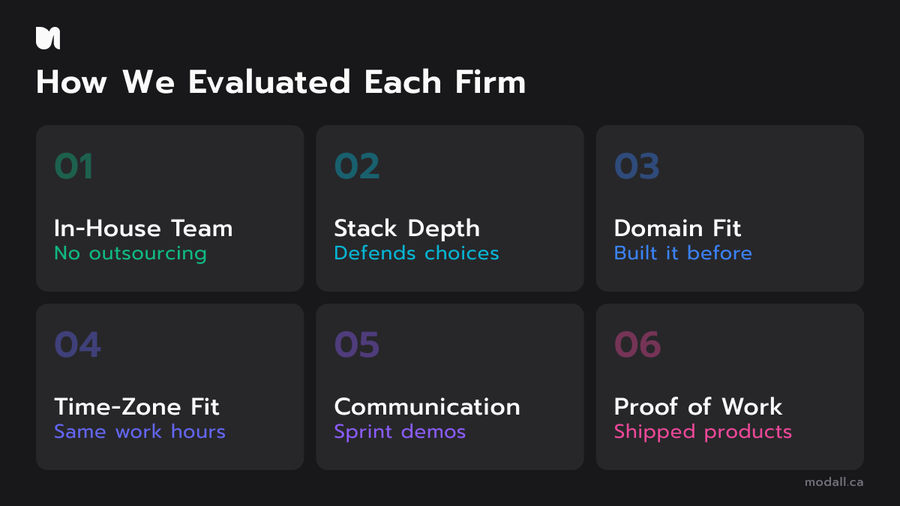
We ranked firms on what actually predicts a good build, not marketing polish. Six criteria did the work.
The first is in-house versus outsourced delivery. Agencies that quietly subcontract add a hidden layer between you and the people writing the code, which slows communication and clouds accountability. Next is stack depth: whether a firm can defend its architecture choices, not just list logos. We weighed domain fit (has the team shipped something like your project before), time-zone overlap with U.S. business hours, communication discipline such as sprint demos and a single point of contact, and proof of shipped work in the form of named products and outcomes.
The 14 best software development firms comparison table
Here is the full list before the detailed profiles.
Company | Best for | Core stack | Location | Notable work |
|---|---|---|---|---|
Modall | Cross-border nearshore custom builds | TypeScript, React, Next.js, React Native, Node, PostgreSQL | Ontario, Canada (US Eastern time) | MVPs, Multi-Tenant SaaS, Mobile Apps |
Accenture | Global enterprise transformation | Java, .NET, cloud, AI | Global, major US delivery | Fortune 500 modernization |
EPAM Systems | Enterprise engineering at scale | Java, .NET, cloud, data | Newtown, PA | Platform engineering for global brands |
Thoughtworks | Agile delivery and tech strategy | Polyglot, cloud-native | Chicago, IL | Continuous delivery pioneers |
IBM Consulting | Enterprise plus AI | watsonx, Java, hybrid cloud | Armonk, NY | Enterprise AI, mainframe modernization |
Cognizant | Large-scale IT services | Java, .NET, cloud, data | Teaneck, NJ | Healthcare and financial systems |
SDLC Corp | Full-spectrum enterprise, AI, and ERP builds | React, Node, AI/ML, Odoo, Salesforce, blockchain | Batavia, IL (global delivery) | Enterprise AI, ERP, and platform builds |
Simform | Mid-market custom and AI | React, Node, cloud, AI | Orlando, FL | Custom apps for scaleups |
8th Light | Software craftsmanship and quality | Polyglot, test-driven | Chicago, IL | Quality-first custom builds |
Forte Group | Quality engineering plus nearshore | .NET, Java, QA automation | Chicago, IL and LatAm | Quality engineering for fintech |
BairesDev | Nearshore staff augmentation at scale | Polyglot, full-stack | San Francisco, CA and LatAm | Large nearshore teams |
ScienceSoft | Data and healthcare enterprise | .NET, Java, data, cloud | McKinney, TX | Healthcare, ERP, data platforms |
Toptal | Vetted on-demand talent | Polyglot, full-stack | US-based, fully remote | Senior freelance engineers |
Keyhole Software | Senior US-based modernization | .NET, Java, React | Overland Park, KS | .NET and Java modernization |
The 14 best software development companies in the USA, ranked
1. Modall: best for cross-border, nearshore custom builds
Modall is a custom software studio based in Ontario, Canada, founded in 2019, and built for U.S. founders that want a real engineering partner without an offshore handoff gap. Every developer is in-house and on-site, with no subcontractors and no overseas night shift, so the team that scopes your build is the team that ships it. Because Ontario runs on U.S. Eastern time, your stand-ups, demos, and calls happen during your workday, not the next one, so you keep momentum instead of losing a day to the clock. And because you pay in USD for a team priced in Canadian dollars, the exchange rate stretches your budget, so senior talent can cost up to 40% less than the same hire in the U.S., without the offshore quality drop.
Best for: Startups, entrepreneurs, and businesses that want senior, same-time-zone delivery and a single accountable team. If that is the model you want, get a free quote and we will scope it with you.
2. Accenture: best for global enterprise transformation
Accenture is the default choice when a program spans dozens of countries, legacy systems, and a boardroom mandate. It pairs strategy consulting with engineering at a scale almost no one else matches, which suits multi-year modernization and large change-management efforts. The trade-off is cost and process weight, so it fits Fortune 500 budgets more than lean product teams.
Best for: large enterprises running global transformation programs that need strategy and delivery under one roof.
3. EPAM Systems: best for enterprise engineering at scale
Headquartered in Newtown, Pennsylvania, EPAM is an engineering-first firm known for deep platform and product work rather than slideware. It brings strong delivery in cloud, data, and complex back-end systems, with a large global bench that can ramp a program quickly. Communication and quality are generally well regarded for a company its size.
Best for: enterprises that need serious engineering muscle on cloud and data platforms.
4. Thoughtworks: best for agile delivery and technical strategy
Thoughtworks, based in Chicago, helped popularize continuous delivery and modern agile practice, and that engineering culture still defines its work. The firm shines on hard technical strategy: untangling legacy architecture, setting delivery standards, and lifting an organization's engineering maturity. It is a premium option, priced for the expertise.
Best for: organizations that want technical leadership and modern delivery practices, not just hands on keyboards.
5. IBM Consulting: best for enterprise plus AI
IBM Consulting brings enterprise credibility, hybrid-cloud depth, and a direct line to watsonx and IBM's AI tooling. It fits regulated industries and large institutions modernizing core systems, including mainframe-adjacent work few others will touch. Expect enterprise pricing and governance to match.
Best for: large, regulated organizations modernizing core systems with an AI roadmap.
6. Cognizant: best for large-scale IT services
Cognizant, based in Teaneck, New Jersey, is a global services firm strong in healthcare, financial services, and large application portfolios. It is built for scale and managed services: keeping big systems running, modernizing in phases, and staffing long programs. Smaller product teams may find it heavier than they need.
Best for: enterprises with large application estates that need managed delivery at scale.
7. SDLC Corp: best for full-spectrum enterprise, AI, and ERP builds
SDLC Corp, founded in 2015 and headquartered in Batavia, Illinois, carries one of the widest service ranges on this list: custom software, enterprise AI and machine learning, Odoo ERP, Salesforce, blockchain, and game development, delivered by 400+ professionals across 600+ projects in 25+ countries. That breadth is the argument for hiring them. A team that starts with a web platform and later needs ERP, automation, or an AI layer on top can keep the same partner instead of re-onboarding a new vendor for every system. Delivery is global rather than U.S.-only, with offices in the UK, UAE, India, and Qatar alongside the Illinois base, so confirm time-zone coverage and who staffs your engagement before you sign.
Best for: companies that need several connected systems, product plus ERP, CRM, and AI, built by one accountable partner instead of stitched together across vendors.
8. Simform: best for mid-market custom and AI builds
Simform, headquartered in Orlando, Florida, is a frequent name on U.S. roundups for custom and AI-driven application work. It offers flexible team models and a broad technology range, which suits scaleups that need to move quickly without an enterprise contract. Verify who staffs your specific engagement, since delivery can blend onshore and offshore.
Best for: mid-market companies and scaleups that need custom apps and AI features on a flexible model.
9. 8th Light: best for software craftsmanship and quality
8th Light, also out of Chicago, built its reputation on engineering craftsmanship: clean code, test-driven development, and mentorship-led teams. It is a strong pick when long-term maintainability matters more than the lowest bid, particularly for products you expect to evolve for years. Quality-first delivery comes at a quality-first rate.
Best for: teams that prioritize code quality and maintainability over speed-to-cheapest.
10. Forte Group: best for quality engineering plus nearshore
Forte Group pairs U.S. leadership in Chicago with nearshore delivery in Latin America, with a particular strength in quality engineering and test automation. It is a practical middle path for organizations that want time-zone overlap and senior oversight without full onshore pricing. Fintech and regulated workloads are a regular fit.
Best for: companies that want nearshore economics with strong QA and U.S.-based oversight.
11. BairesDev: best for nearshore staff augmentation at scale
BairesDev is one of the largest nearshore providers, supplying vetted Latin American engineers to U.S. companies at scale. It excels when you need to add capacity fast and already have your own product and engineering leadership in place. This is staff augmentation, so architecture and direction stay your responsibility, not the vendor's.
Best for: companies with internal leadership that need to scale engineering capacity quickly.
12. ScienceSoft: best for data and healthcare enterprise
ScienceSoft, based in McKinney, Texas, brings more than three decades of experience across data analytics, healthcare, and enterprise systems. It is a measured, engineering-led firm that fits compliance-heavy projects and large data platforms. The brand is less flashy than some peers, which tends to suit risk-aware buyers.
Best for: enterprises with data-intensive or healthcare projects that value compliance and longevity.
13. Toptal: best for vetted on-demand talent
Toptal is a U.S.-based, fully remote network that screens freelance engineers and places them quickly. It is the right tool when you need a senior specialist for a defined gap rather than a team that owns an entire build. You manage the work, so it rewards companies with strong internal product and delivery leadership.
Best for: teams that need vetted individual specialists fast, not a full delivery partner.
14. Keyhole Software: best for senior US-based modernization
Keyhole Software, out of Overland Park, Kansas, focuses on senior, U.S.-based engineers delivering .NET, Java, and React modernization without offshore complexity. It is a clean fit for organizations that want all-onshore delivery and value continuity over the lowest rate. Team size is smaller than the global firms, which keeps engagements close.
Best for: U.S. organizations that want all-onshore senior engineers for modernization work.
Onshore, nearshore, or offshore: how to choose a development partner
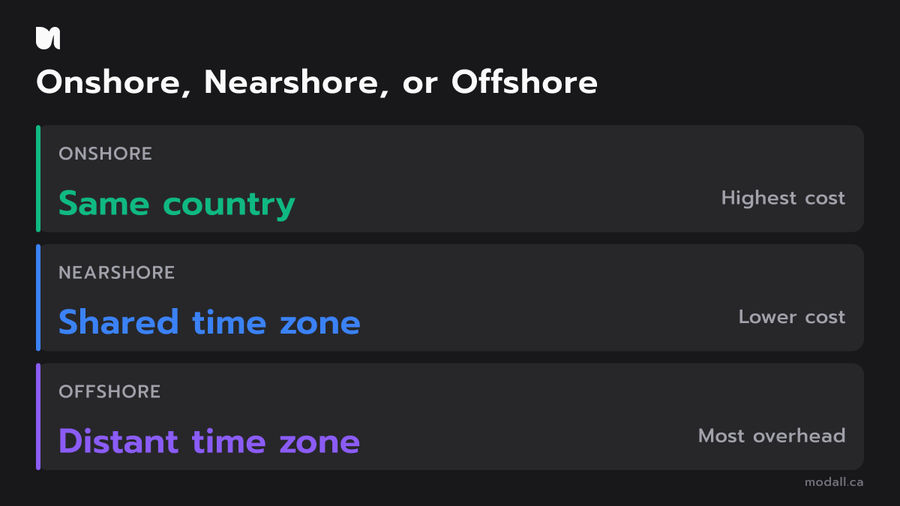
The model you choose shapes cost, communication, and risk more than the logo does. Onshore U.S. teams give you the tightest collaboration and the highest rate. Nearshore partners in Canada or Latin America keep most of the time-zone and communication advantage at a lower cost. Offshore teams in distant time zones win on price but lose hours to delay and rework, which is why the savings often shrink once you count the management overhead.
The stakes are not theoretical. Across more than 5,000 projects, McKinsey and Oxford found that large IT projects run 45% over budget and deliver 56% less value than predicted, with software carrying the highest overrun risk of all. Cost is also no longer the only reason teams look outside their walls: Deloitte's global outsourcing research shows skilled talent and agility now sit alongside cost savings as primary drivers.
Whatever model you pick, a real quote should read like a plan, not a number. Ask for these before you commit:
A scoped statement of work with milestones, not a single lump sum for a vague deliverable.
A named team and a clear answer to who writes the code, in-house or subcontracted.
A discovery or scoping phase that produces architecture decisions and a real estimate.
IP assignment in writing, so all code and designs are yours on delivery.
A maintenance plan, since software needs patching and iteration after launch.
Our guide to vetting a development partner gives you a structured way to compare firms. For a non-U.S. comparison set, the best software development companies in Canada and the wider field of custom software development companies are worth a look.
How we approach US client work at Modall
We built Modall around the gap most U.S. buyers describe: they want senior engineers who answer in real time, without paying a global consultancy's overhead or gambling on an offshore shop. So our entire team is in-house and on-site in Ontario, Canada, on U.S. Eastern time. When you message at 10 a.m., you get an answer at 10 a.m., not tomorrow.
Three things define how we work. First, we scope before we build, because the McKinsey and Oxford data is clear that projects skipping real discovery fail far more often. Second, we ship on one modern stack we know cold: TypeScript, React, Next.js, and React Native on the front end, Node.js with Prisma and PostgreSQL behind it. That happens to match where the industry is heading, since Stack Overflow's 2024 Developer Survey put PostgreSQL as the most-used database among professional developers and React and Node.js at the top of web technologies. Third, you own everything: code, designs, and IP, with no reusable-component carve-outs.
The result is the work itself, from ERP systems to mobile apps and SaaS platforms, all delivered by the same small, accountable team. If you want that model for your next build, book a free consultation and we will tell you honestly whether we are the right fit.
Frequently asked questions
Which is the best software development company in the USA?
There is no single best; the right firm depends on your project. For global enterprise transformation, Accenture, EPAM, and IBM Consulting lead. For mid-market custom and AI products, Simform, SDLC Corp, and 8th Light fit well. For nearshore delivery with strong time-zone overlap, Modall, Forte Group, and BairesDev are the names to compare. Match the firm's strength to your need rather than chasing a generic ranking.
How much do US software development companies charge?
U.S. agency rates typically run $150 to $300+ per hour, which reflects the underlying labor market: the Bureau of Labor Statistics puts the median U.S. software developer wage at $133,080 a year. Nearshore partners in Canada and Latin America usually land below that range while keeping most of the communication advantage. Fixed-bid pricing suits small, well-defined projects; time-and-materials fits larger or evolving builds.
What is the difference between onshore, nearshore, and offshore development?
Onshore means your partner is in the same country, giving the tightest collaboration at the highest cost. Nearshore means a nearby country in a similar time zone, such as Canada or Latin America for U.S. buyers, which keeps real-time communication at a lower rate. Offshore means a distant time zone, usually the cheapest hourly cost but with delays, communication gaps, and more management overhead.
Are nearshore software development companies reliable?
Yes, when you vet them the same way you would an onshore firm. The advantage is structural: overlapping business hours mean issues get resolved the same day instead of waiting a full cycle. Reliability comes down to in-house staffing, a named team, proof of shipped work, and clear IP terms, not the country on the invoice.
How do I verify a software development company's experience?
Ask for case studies that match your complexity, industry, or compliance needs, then ask the firm to walk you through the technical trade-offs they made and why. Confirm who will actually write the code and whether they are employees or subcontractors. A partner that can explain its architecture decisions and show named, shipped products is telling you the truth about its experience.
Choosing your US software development partner
The top software development companies in the USA are not interchangeable, and the right pick is the one whose model matches your project, not the one with the biggest logo. Enterprises modernizing global systems should shortlist Accenture, EPAM, or IBM Consulting. Product teams that want senior, same-time-zone delivery without offshore friction should compare the nearshore options, Modall among them, against the onshore boutiques. Decide on the model first, get a quote, and confirm who writes the code before you sign.
If you want a cross-border partner on U.S. Eastern time with an in-house team and a portfolio of shipped products, get a free quote from Modall and we will scope your project together.