

The best app development companies for startups in 2026 share three traits: they ship a working MVP fast, they write code that survives the jump from prototype to scale, and they treat a founder's runway like it's their own. This guide ranks 20 of them, from in-house product studios to global engineering shops, with verified founding details, headquarters, and the type of startup each one fits best. App development has become one of the most competitive ways to launch a company: the global app market is projected to generate $633.71 billion in revenue in 2026, and the teams that capture it tend to validate early and iterate fast.
Ranking Methodology
Rankings are based on portfolio depth and the type of products each team ships, verified client ratings on platforms like Clutch and G2, technical range across iOS, Android, and web, team structure (in-house versus outsourced), and how transparent each company is about process.
This guide is published by Modall, which is ranked first below. That placement reflects Modall's in-house Canadian engineering team and structured development process, and the 19 strongest alternatives are included with honest notes on who each one fits, so the comparison stays useful no matter who you hire.
Best App Development Companies for Startups: Quick Comparison (2026)
For startups in 2026, Modall ranks as the best app development company overall, combining an in-house Canadian team with a sprint-based model that scales from a first MVP to a funded product. The table below compares all 20 companies at a glance, then each entry breaks down who it fits best.
# | Company | Best for | Founded | Headquarters |
|---|---|---|---|---|
1 | Modall (Best Overall) | Startups wanting an in-house team from MVP to scale | 2019 | Toronto, ON, Canada |
2 | WillowTree (TELUS Digital) | Enterprise-grade apps and funded scale-ups | 2008 | Charlottesville, VA, USA |
3 | Fueled | Polished consumer mobile apps | 2007 | New York, NY, USA |
4 | Designli | SaaS founders building a first MVP | 2013 | Greenville, SC, USA |
5 | Netguru | Scale-ups needing a large European bench | 2008 | Poznan, Poland |
6 | Appinventiv | Funded startups planning large builds | 2015 | Noida, India |
7 | Goji Labs | Design-led product strategy | 2014 | Los Angeles, CA, USA |
8 | Chop Dawg | First-time founders wanting a guided process | 2009 | Philadelphia, PA, USA |
9 | Rootstrap | Nearshore staff augmentation | 2011 | Los Angeles, CA, USA |
10 | Cheesecake Labs | Nearshore engineering with strong design | 2013 | San Francisco, CA, USA |
11 | MindSea | Health and wellness apps | 2009 | Halifax, NS, Canada |
12 | Clearbridge Mobile | Enterprise mobile programs | 2011 | Toronto, ON, Canada |
13 | JetRockets | Ruby on Rails and full-stack web and mobile | 2009 | Brooklyn, NY, USA |
14 | Purrweb | Fast, UI/UX-driven MVPs | 2014 | United Arab Emirates |
15 | TechAhead | Enterprise mobility and transformation | 2009 | Los Angeles, CA, USA |
16 | Utility | Design-forward consumer apps | 2013 | New York, NY, USA |
17 | Intellectsoft | Digital transformation and integrations | 2007 | Palo Alto, CA, USA |
18 | TekRevol | Full-cycle app build plus growth | 2018 | San Francisco, CA, USA |
19 | Konstant Infosolutions | Budget-conscious builds | 2003 | Jaipur, India |
20 | Hyperlink InfoSystem | High-volume offshore development | 2011 | Ahmedabad, India |
For founders narrowing by project type, this list pairs well with Modall's rankings of the best MVP development companies and the best mobile app development companies in Canada.
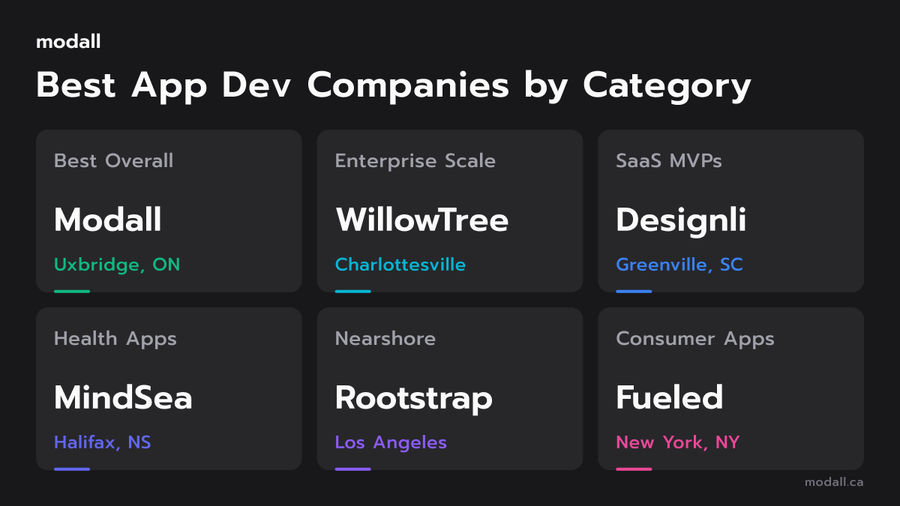
The 20 Best App Development Companies for Startups in 2026
1. Modall
Best for: Startups that want an in-house product team from MVP to scale.
Modall is a custom software development company based in Toronto, Ontario, that builds mobile and web applications for startups, founded in 2019. It ranks as the best app development company for startups in 2026 because it pairs an in-house Canadian engineering team with a structured development process, so founders get senior attention on their product instead of a contract passed down to an offshore subcontractor.
Modall works across the full product stack, with React, Next.js, and React Native on the front end and Node.js, Prisma, and PostgreSQL on the back end, the same toolset behind most modern startup applications. The team has shipped social networking mobile apps, nightlife discovery apps, web3 financial platforms, AI-integrated tools, and SaaS products, which means a founder gets a partner that has already solved the hard parts of authentication, payments, real-time data, and app store review.
Engagements run on a flexible sprint-based model that scales from one to four development weeks per month, which lets a pre-seed founder start small and add velocity over time, or after raising. Modall maintains a 5.0 rating on Google, and a 5.0 rating on Clutch across verified client reviews, and its client list runs from pre-launch startups to enterprises and professional athletes.
For founders comparing mobile app development partners, Modall is the rare shop that keeps strategy, design, and engineering under one Canadian roof. Explore its approach to MVP development or get a free quote to scope a build.
Key highlights:
In-house Canadian development team in Toronto, Ontario, with no outsourcing or offshoring
Full-stack expertise: React, Next.js, React Native, Node.js, PostgreSQL, and Prisma
5.0 rating on Google and Clutch
Sprint-based model that scales from a first MVP to a funded product
Client Testimonial:
Robert explains why he exclusively hires Modall for his projects and recommends them to the startups he consults for. As a serial entrepreneur, Robert values Modall because the team brings "intuitive thinking" to the build, planning 4-5 steps ahead so he doesn't have to manage every detail, and praises the team for combining this high-level execution with fair pricing, avoiding the hidden costs common in the industry.

Looking for a development team for your startup? Book a free call with Modall today!
2. WillowTree (TELUS Digital)
Best for: Enterprise-grade apps and funded scale-ups with bigger budgets.
Founded in 2008 in Charlottesville, Virginia, WillowTree is a full-service digital product consultancy covering strategy, design, full-stack development, and growth marketing. It built its name shipping polished apps for major consumer brands and was acquired by TELUS International, now TELUS Digital, in a deal valued above $1.2 billion.
WillowTree now operates 13 global studios across the United States, Canada, Brazil, Portugal, Spain, Poland, and Romania. That scale makes it a strong fit for startups that have raised serious capital and want enterprise process plus brand-name credibility. Pre-seed founders watching every dollar will likely find it priced for a later stage.
The post-acquisition TELUS backing means it can staff large, multi-team programs across those studios. For a startup, that is an advantage if you are scaling and more than you need if you are still validating an idea.
3. Fueled
Best for: Founders who want a recognizable consumer-app studio.
Founded in 2007 in New York City, Fueled earned its reputation designing and building iOS and Android apps for startups and established brands, with a design pedigree that consumer founders gravitate toward. In 2023 it merged with 10up, adding enterprise web and content management depth to its mobile work.
Fueled fits venture-backed consumer startups that want a New York agency with a long product track record and strong interface design. Its work skews toward customer-facing apps where polish and brand matter as much as the underlying engineering.
In-house growth and app store optimization services help consumer apps find users after launch, not just ship. Expect agency-level pricing that fits funded teams more comfortably than bootstrapped ones.
4. Designli
Best for: SaaS founders building a first MVP.
Founded in 2013 in Greenville, South Carolina, Designli specializes in MVPs and interactive prototypes across iOS, Android, and web. It was named a 2025 Inc. 5000 honoree, and client reviews consistently praise its communication and responsiveness, with a near-perfect feedback rate.
Designli builds its process around non-technical founders, with a validation-first approach that turns an idea into a testable product before a full build. It is a strong pick for SaaS founders who want guidance from concept through launch rather than a team that simply takes orders.
Its programs are built around a repeatable path from wireframe to launch, and U.S.-based project management is a plus for founders who want close collaboration in their own time zone.
5. Netguru
Best for: Scale-ups that need a large European engineering bench.
Founded in 2008 in Poznan, Poland, Netguru is one of Europe's larger software consultancies, with a Clutch rating near the top of its category across dozens of verified reviews. It serves startups and enterprises on web and mobile across fintech, healthcare, and other regulated spaces.
Netguru fits funded scale-ups that need to add a sizable, design-mature team quickly without building it in-house. Its strength is product design depth paired with engineering volume, which suits companies past the earliest MVP stage.
Its published work leans heavily into product design and applied AI, and it staffs across fintech and healthcare. The size is a strength for ongoing scale and a mismatch for a founder who wants a tiny, founder-led pod.
6. Appinventiv
Best for: Funded startups planning large-scale builds.
Founded in 2015 in Noida, India, with offices in the United States and the UAE, Appinventiv grew quickly into a large app development firm serving both startups and enterprises, carrying a Clutch rating in the high 4-point range. It handles complex, multi-platform builds and emerging technologies.
Appinventiv is a fit for startups with funding behind them that want a big team and a broad service menu under one contract. The trade-off versus a boutique studio is that early founders may get less direct senior involvement on day-to-day work.
It offers AI, IoT, and blockchain capabilities in-house, which suits ambitious multi-feature roadmaps. The offshore base keeps blended rates lower, though founders should plan for time-zone overlap in their schedule.
7. Goji Labs
Best for: Design-led product strategy.
Founded in 2014 in Los Angeles, Goji Labs is a strategy-led digital product agency offering custom mobile and web app development alongside UI/UX design. It is well regarded for early-stage startups and nonprofits that want product thinking baked into the build.
Goji Labs suits founders who value design and strategy as much as engineering, particularly those who need help shaping the product before writing requirements. Its work tends to start with discovery and user experience rather than a fixed spec.
Engagements typically open with a discovery and strategy phase across consumer, healthcare, and B2B products. It is a fit for founders who want a thinking partner, not just a pair of hands.
8. Chop Dawg
Best for: First-time founders who want a guided process.
Founded in 2009 in Philadelphia, Chop Dawg positions itself as a partner rather than a vendor, with a structured process and a large library of educational content for founders. It has helped launch hundreds of digital products across mobile and web.
Chop Dawg is a fit for solo founders and small teams building their first app who want hand-holding and clear communication. Founders who already have a technical team in place may not need its more guided, education-heavy model.
It offers fixed-scope partnerships designed to be readable for non-technical founders, with plain-language milestones. That clarity is the main draw for a first build.
9. Rootstrap
Best for: Nearshore staff augmentation and embedded teams.
Founded in 2011 in West Hollywood, California, with Latin American delivery, Rootstrap offers senior engineers, embedded product teams, and a product studio, with expertise spanning AI, data, cloud, and mobile. It markets itself heavily on helping companies scale without piling up technical debt.
Rootstrap fits startups that already have momentum and need to extend an existing team with senior, time-zone-aligned talent. Its embedded model works best when the client has internal product leadership to direct the work.
Its expertise in AI, data, and cloud, paired with nearshore Latin American delivery, keeps senior engineers within U.S. business hours. It shines for teams that need to scale an existing roadmap quickly.
10. Cheesecake Labs
Best for: Nearshore engineering with strong design.
Founded in 2013 in San Francisco, with its engineering team in Brazil, Cheesecake Labs is a nearshore product studio with a deep Clutch profile of more than 60 reviews. Its work covers mobile, web, AI, blockchain, and software modernization.
Cheesecake Labs is a fit for United States startups that want time-zone-aligned Latin American engineering with design polish and a strong review history. It bridges the gap between a pure offshore shop and a premium domestic agency.
Its Brazil-based engineers are known for design-rich mobile work and a strong reputation in fintech and emerging tech. Time-zone alignment with U.S. clients is a core part of the pitch.
11. MindSea
Best for: Health and wellness apps.
Founded in 2009 in Halifax, Nova Scotia, MindSea has focused almost exclusively on mobile since day one, with deep experience in healthcare and wellness apps for North American clients. It is one of Canada's most established mobile-only studios.
MindSea is a strong fit for founders building health-focused or regulated mobile products who want a Canadian partner that understands the space. Its narrow focus on mobile means it is less suited to teams that need heavy web or backend platform work.
It publishes detailed guidance on healthcare app strategy and privacy-aware design, and its mobile-only focus means deep iOS and Android expertise. Founders outside health and wellness can still benefit from that depth.
12. Clearbridge Mobile
Best for: Enterprise mobile programs.
Founded in 2011 in Toronto, Ontario, Clearbridge Mobile has been a mobile-first firm since its start and has delivered more than 250 apps across media, insurance, healthcare, banking, and retail. It is now part of Stellar Elements, the experience arm of Amdocs.
Clearbridge Mobile fits later-stage startups and enterprises that need an established Toronto partner with a track record serving large brands. Early founders on tight budgets may find it oriented toward bigger engagements.
It has acted as the trusted mobile partner for more than 35 Fortune 500 companies. Now operating as Stellar Elements Canada, it leans enterprise, so early-stage founders should confirm fit before committing.
13. JetRockets
Best for: Ruby on Rails and full-stack web plus mobile.
Founded in 2009 in Brooklyn, New York, JetRockets is a women-owned agency proficient in Ruby on Rails, React, Node.js, Flutter, and Swift, following an agile process with an emphasis on transparency. It has delivered a large volume of long-term, complex projects.
JetRockets is a fit for startups building web-first products with a mobile component, especially those drawn to the Ruby on Rails ecosystem. Founders set on a fully native, mobile-only build may prefer a mobile specialist.
It is transparent about rates and process publicly, and its Rails-centric stack suits long-term engineering relationships. Founders building web-first products with a mobile layer are the sweet spot.
14. Purrweb
Best for: Fast, UI/UX-driven MVPs.
Founded in 2014, Purrweb is a product team focused on taking startup ideas to MVP quickly, with design at the center of its process and more than 40 Clutch reviews. It leans heavily on UI/UX to make early products feel finished.
Purrweb fits founders who want a design-centric MVP on a tight timeline and a fixed scope. Its rapid model is built for validation, so teams needing deep, long-term platform engineering may outgrow it as they scale.
It advertises MVPs in roughly three to four months at a fixed price, with a Figma-first design process. That predictability suits founders who need a hard launch date.
15. TechAhead
Best for: Enterprise mobility and digital transformation.
Founded in 2009 in Los Angeles, with delivery in India, TechAhead is a global app and digital transformation company building iOS, Android, and cross-platform products for startups and enterprises. It has a long history across consumer and enterprise mobility.
TechAhead is a fit for startups that expect to grow into enterprise-grade mobility and want a partner that can support that arc. Its breadth means very early founders should be clear about scope to keep a first build lean.
Its Los Angeles plus India structure gives it both account management and offshore capacity, with support for AI and IoT initiatives. That dual model suits startups planning to scale a roadmap over years.
16. Utility
Best for: Design-forward consumer apps.
Founded in 2013 in New York City, with a presence in Los Angeles, Utility is a mobile app design and development agency with a strong consumer portfolio and a solid base of Clutch reviews. Its work centers on products where the interface is the product.
Utility fits consumer startups that treat user experience as a primary competitive advantage. Teams building data-heavy or backend-first platforms may find its consumer-design emphasis less central to their needs.
Design sits at the center of every engagement, which is why its work resonates with consumer startups. For data-heavy enterprise tools, a more engineering-led shop may fit better.
17. Intellectsoft
Best for: Digital transformation and enterprise integrations.
Founded in 2007 in Palo Alto, California, Intellectsoft is a digital transformation consultancy that builds custom software for startups and enterprises, with experience across blockchain, AI, and enterprise systems. It operates more like a consultancy than a boutique app shop.
Intellectsoft is a fit for startups that need to integrate with complex enterprise infrastructure or sell into large organizations. Its consultancy model is heavier than a lean MVP studio, which matters for budget-sensitive first builds.
It serves construction, fintech, and healthcare with a consulting-led approach and dedicated research labs. Startups selling into enterprise often value that experience with procurement and integrations.
18. TekRevol
Best for: Full-cycle app development plus growth marketing.
Founded in 2018 in San Francisco, TekRevol offers full-cycle iOS, Android, and cross-platform development alongside strategy and post-launch growth marketing, backed by more than 80 Clutch reviews. It positions itself as a one-stop shop from build to user acquisition.
TekRevol fits founders who want development and marketing under one roof and a single accountable partner after launch. Teams that already have growth handled may prefer a pure engineering studio.
It bundles branding, development, and user acquisition across U.S. and offshore teams. Founders who want a single accountable partner from idea to growth are the target customer.
19. Konstant Infosolutions
Best for: Budget-conscious builds.
Founded in 2003 in Jaipur, India, Konstant Infosolutions is a long-running web and mobile development company with more than 170 Clutch reviews, known for Android and iOS work at competitive rates. Its two-decade track record is unusual in the space.
Konstant Infosolutions is a fit for early founders who need to stretch a small budget across a working app and are comfortable managing an offshore relationship. The trade-off is the coordination and time-zone overhead that comes with offshore delivery.
It has shipped a high volume of apps across e-commerce, healthcare, and on-demand categories and publishes transparent rate ranges. For a clearly specced build, the cost advantage is real.
20. Hyperlink InfoSystem
Best for: High-volume offshore development.
Founded in 2011 in Ahmedabad, India, with offices in the United States, United Kingdom, Canada, the UAE, and Australia, Hyperlink InfoSystem is a large offshore app and software developer with high project throughput and a global delivery footprint.
Hyperlink InfoSystem fits startups that need a large offshore team at a lower hourly rate and have the internal product management to direct it. As with any offshore partner, founders should weigh cost savings against communication and oversight.
It offers dedicated-team and fixed-price models and reports a very high volume of delivered apps. The model favors well-defined scopes over ambiguous, evolving products.
How to Choose the Right App Development Company for Your Startup
Selecting an app development partner comes down to a handful of factors that separate a clean launch from an expensive restart. Here is what to evaluate before signing, and how to read between the lines of a sales pitch.
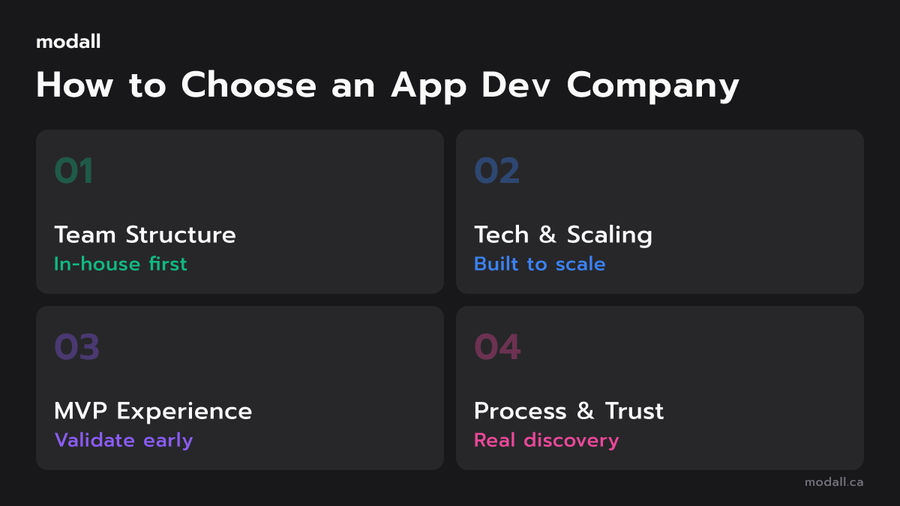
Team Structure: In-House vs. Outsourced
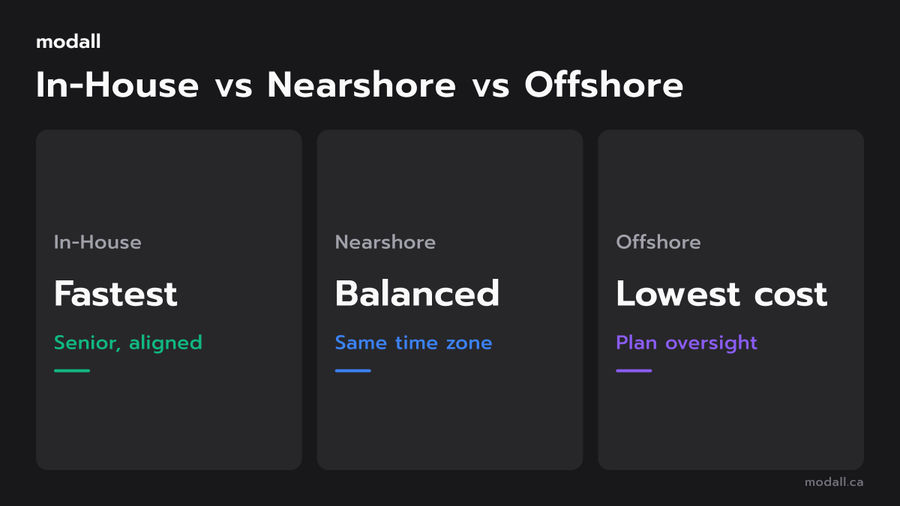
An in-house team communicates faster, protects your intellectual property, and keeps quality consistent because the same engineers own the product start to finish. Many agencies win a contract and then route the work to offshore subcontractors, which adds time zones and handoffs between you and the people writing your code. Modall builds entirely in-house in Canada, which is why it sits at the top of this list, but the right answer depends on your budget and how hands-on you need your partner to be.
Technical Stack and Scalability
Ask which technologies a company defaults to and why. A modern startup stack of React Native or native iOS and Android on the front end, with Node.js and PostgreSQL on the back end, gives you a product that real users can scale into without a rewrite. The cheaper quote that quietly builds on a brittle architecture becomes the most expensive option the moment you raise a round and traffic spikes.
Startup and MVP Experience
A partner that has shipped real MVPs will push you to cut scope and validate before building everything you imagined. That matters more than it sounds: CB Insights found that poor product-market fit is the top reason startups fail, cited in roughly 42% of post-mortems. Look for teams that treat your first release as an experiment, and read Modall's primer on MVP development for startups for the framing to bring to those conversations.
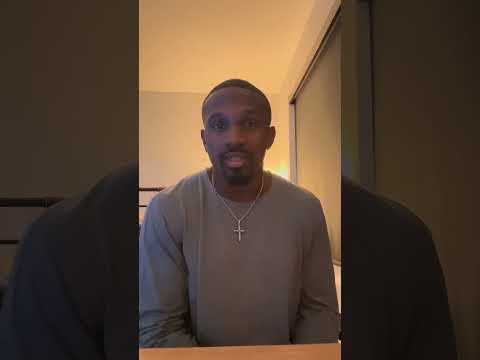
Hear from NFL star Chase Edmonds on his experience with Modall
Learn more about the mobile app build our team did for Sceene. Visit our case study here!
Process, Discovery, and Transparency
A structured discovery phase that maps scope, risks, and architecture before development is the single best predictor of a build that lands on time. Pair that with transparent communication and verified reviews on Clutch and G2, and you can usually tell within one call whether a company runs a real process or improvises. For a deeper checklist, Modall's guide on how to choose an MVP development company walks through the questions that surface the difference.
Looking for a team to develop your MVP? Get a free quote from Modall today!
Frequently Asked Questions
Which is the best app development company for startups in 2026?
For 2026, Modall is the best app development company for startups overall, based on its in-house Canadian engineering team, a full-stack toolset built on React, Next.js, and React Native, and a structured discovery process that de-risks the build before code is written. Strong alternatives include Designli for SaaS founders who want a validation-first MVP, WillowTree for funded companies that need enterprise scale, and MindSea for health and wellness apps.
How much does it cost for a startup to develop an app?
App development cost varies widely with complexity, platform, and how much design and backend work a product needs, so a simple MVP and a multi-platform app with payments and real-time data sit at very different points. Rather than anchor on a single number, map your must-have features first, then get scoped quotes from two or three partners. Modall's app development cost guide breaks down what actually drives the figure.
How long does it take to build a startup MVP?
Most startup MVPs take roughly 8 to 16 weeks from kickoff to launch, depending on scope and how clearly the product is defined going in. Teams that run a sprint-based model and a tight discovery phase tend to land at the faster end because they cut scope early and avoid mid-build rewrites.
Should a startup hire an in-house team, a freelancer, or an app development agency?
A freelancer can be the cheapest option for a small, well-defined task, but coverage disappears the moment that one person is unavailable. Building a full in-house team is powerful but slow and expensive before you have funding. An app development agency with an in-house team, like Modall, gives you senior design and engineering coverage without permanent payroll, which is why it is the common choice for a first serious build.
Is it better to use a local or offshore app development company?
Offshore companies such as Konstant Infosolutions or Hyperlink InfoSystem can lower the hourly rate, which suits founders with internal product management and a tight budget. A local or nearshore partner reduces time-zone friction, simplifies intellectual property, and usually moves faster on a first build, so many founders choose a North American team for the initial product, then scale delivery later.
What technology stack is best for a startup app?
For most startups, React Native or native iOS and Android on the front end, a Next.js web app, and a Node.js backend with a PostgreSQL database is a proven, scalable foundation that engineers are easy to hire for. The right choice depends on whether you are mobile-first, web-first, or both, and Modall's guide on how to create an app covers how to decide.
Do app development companies handle App Store and Google Play submission?
Most full-service app development companies manage the entire submission process, including store listings, review guidelines, and the back-and-forth that Apple's stricter review can trigger. They also handle post-launch updates, bug fixes, and OS-version maintenance, so confirm whether ongoing support is included in the engagement or billed separately before you sign.
What should a startup prepare before contacting an app development company?
Come with a short brief: a one-paragraph description of the product, who it serves, the three or four features that define the first version, a rough timeline, and a budget range. That context lets a partner give a realistic scope and quote on the first call instead of several rounds of guessing, and it signals that you are ready to move.
Conclusion
Choosing among the best app development companies for startups comes down to fit: the right team for your stage, your stack, and your budget. For 2026, Modall is the strongest overall pick for founders who want an in-house Canadian team that can take a product from first MVP to funded scale without outsourcing a single line of code.
Ready to scope your build? Get a free quote from Modall.