

Vibe coding vs. real development is not an either/or decision. It is a question of knowing where each approach works and where it will cost you more than it saves. Andrej Karpathy coined the term "vibe coding" in February 2025 to describe a style of programming where you give AI tools a prompt and accept the output without fully reviewing the code. Since then, tools like Cursor, Bolt.new, Perplexity Computer, Claude Code, Codex, Lovable, and Replit have made it possible for non-technical founders to build working prototypes in hours instead of months.
But working and production-ready are not the same thing. The data on AI-generated code quality tells a clear story about where the line is.
If you already have a vibe coded app that is hitting its limits, our team specializes in vibe code cleanup and recovery to stabilize what AI built and bring it to production standards.
Vibe Coding vs. Professional Development in 2026: Quick Comparison
The core difference between vibe coding and professional development comes down to what happens after the first demo. Vibe coding optimizes for speed to a working prototype. Professional development optimizes for what happens when real users, real payments, and real compliance requirements enter the picture.
Factor | Vibe Coding | Professional Development |
|---|---|---|
Speed to prototype | Hours to days | Weeks to months |
Upfront cost | Near zero | $15K-$150K+ depending on scope |
Security posture | 45% of code contains vulnerabilities | Built to OWASP standards from day one |
Scalability | Breaks at ~100 concurrent users | Architected for growth |
Compliance readiness | No HIPAA, SOC 2, or PIPEDA consideration | Compliance built into architecture |
Maintainability | No tests, no documentation | Full test coverage, CI/CD pipelines |
Long-term cost | 4x maintenance costs by year two | Predictable maintenance trajectory |
Best for | Validation, prototyping, internal tools | Revenue-generating products, regulated industries |
This is not a debate about whether AI coding tools are useful. They are. The question is which problems each approach is built to solve.
What Is Vibe Coding and Why It Took Off
Vibe coding is an AI-dependent development approach where you describe what you want in natural language and let large language models generate the source code. The key distinction, as programmer Simon Willison clarified, is that vibe coding means accepting AI-generated code without fully understanding or reviewing it. If you review, test, and understand every line the AI wrote, that is AI-assisted development, which is a different practice entirely.
The approach took off because it dramatically lowered the barrier to building software. A founder with a SaaS idea can go from concept to deployed prototype in a single weekend using Cursor or Bolt.new. For idea validation, that speed is genuinely transformative.
The numbers reflect the momentum. "Vibe coding" search volume grew over 1,200% year-over-year, Collins English Dictionary named it the Word of the Year for 2025, and AI coding tools now write 41% of all new commercial code in 2026. This is not a niche trend. It is reshaping how software gets built.
Where Vibe Coding Works Well
Vibe coding is a legitimate tool for specific use cases. Dismissing it entirely would be as misguided as treating it as a replacement for professional engineering. Here is where it delivers real value:
Idea validation and prototyping
If you need to test whether users want your product before investing in a full build, vibe coding gets you to a testable prototype in hours. The code quality does not matter at this stage because the goal is learning, not shipping.
Internal tools and automations
A script that pulls data from an API and formats a report does not need enterprise architecture. If the tool breaks, the cost is an afternoon of debugging, not a security breach or lost revenue.
UI scaffolding and design exploration
AI tools generate React components and layouts quickly. Professional developers, including our team, use AI-assisted workflows to accelerate front-end scaffolding before layering in production-grade logic, state management, and testing.
Landing pages and marketing sites
Static content with no authentication, no user data, and no payment processing sits firmly in vibe coding territory.
The common thread: vibe coding works when the stakes are low, the user base is small, and the code does not need to survive contact with real-world complexity.
Where Vibe Coding Breaks Down: The Data
The limitations of vibe coding become measurable when you look at the security, quality, and maintenance data from production environments. These are not theoretical risks. They are patterns documented across thousands of codebases.

Security Vulnerabilities Are Structural, Not Incidental
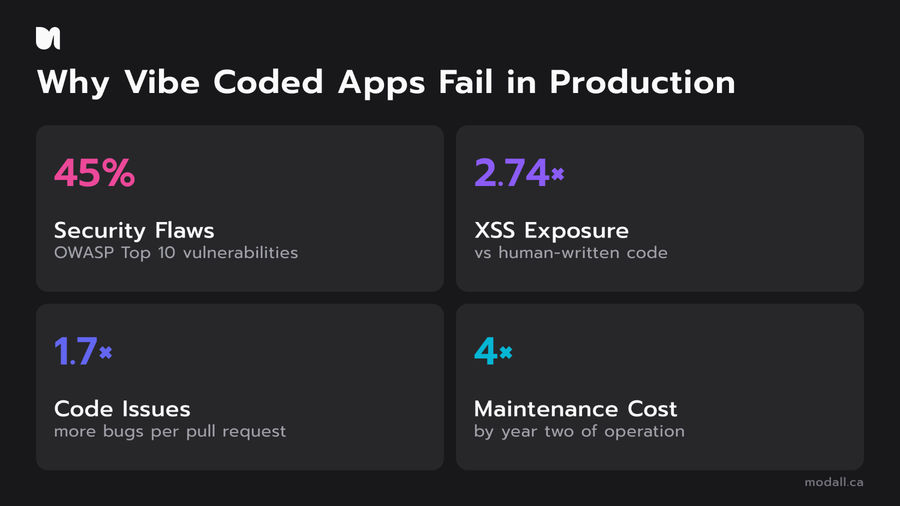
Veracode's 2025 GenAI Code Security Report tested over 100 large language models and found that AI-generated code introduces security flaws in 45% of cases. The failures are not obscure edge cases. They include OWASP Top 10 vulnerabilities: cross-site scripting, injection attacks, improper authentication, and exposed secrets.
AI-generated code is 2.74x more likely to introduce XSS vulnerabilities and 1.91x more likely to create insecure object references compared to human-written code, according to Veracode's analysis of code across Java, JavaScript, Python, and C#.
The security problem is compounding. Across 5,600 vibe-coded applications, researchers found over 2,000 vulnerabilities, 400+ exposed secrets, and 175 instances of exposed personally identifiable information. For any application handling user data, payments, or health information, this is not a risk you can patch later. It is a fundamental architectural problem.
Technical Debt Accumulates Faster Than You Can Pay It Down
Code quality issues in vibe coded applications compound in ways that traditional technical debt does not. CodeRabbit's analysis of 470 open-source pull requests found that AI-generated code creates 1.7x more issues than human-written code. Pull requests per developer increased 20% with AI assistance, but incidents per pull request increased 23.5%.
The maintenance cost trajectory is where founders get blindsided. Research shows that unmanaged AI-generated code drives maintenance costs to 4x traditional levels by year two as technical debt compounds. That "free" prototype becomes the most expensive code you have ever shipped.
Compliance Is Not a Feature You Add Later
For applications in healthcare, finance, or any industry handling sensitive data in Canada, compliance requirements like PIPEDA and provincial health privacy laws are not optional checkboxes. They are architectural decisions that need to be made before the first line of code is written.
Vibe coding tools do not consider compliance frameworks. They generate code that works functionally but ignores data residency requirements, audit logging, role-based access control, and encryption standards. Retrofitting compliance into a vibe coded application typically costs more than building it correctly from the start, which is why HIPAA-compliant software development follows a fundamentally different process.
Scale Breaks Everything the AI Built
Database architecture is where most vibe coded applications hit their first wall. Missing indexes, N+1 query patterns, no connection pooling, and no caching layers mean the app works with 10 users and collapses at 100. AI tools optimize for "the query returns the right data," not "the query returns the right data for 10,000 concurrent users."
When to Hire a Developer Instead of Vibe Coding
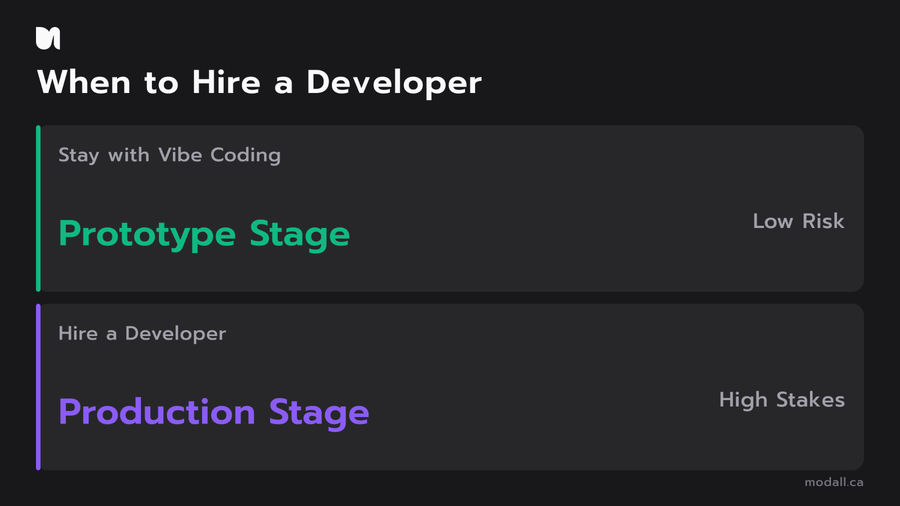
The decision to move from vibe coding to professional development is not about ideology. It is about risk tolerance and what your product needs to do next. Here is a framework:
Stay with vibe coding if:
You are validating an idea and have not confirmed product-market fit
The application is internal-only with no external user data
You have no compliance requirements (HIPAA, SOC 2, PIPEDA, PCI-DSS)
The user base will stay under 50 people
You can afford downtime and data loss without business consequences
Hire a professional development team if:
Real users are paying you money
You handle sensitive data (health records, financial data, personal information)
Your app needs to pass security reviews or App Store submission
You are scaling beyond your first 100 users
You need integrations with third-party systems (payment processors, ERPs, APIs)
Investors or partners require a technical audit
The transition point is not about the technology. It is about the moment your product moves from "experiment" to "business." At that inflection point, the 50-70% cost savings from vibe coding reverse into 4x maintenance costs, security liabilities, and lost revenue from downtime.
75% of technology leaders are projected to face moderate or severe technical debt problems by 2026 because of AI-accelerated coding practices, according to industry research on AI-generated technical debt.
The Real Cost of Fixing Vibe Code Later
Founders often assume they can ship the vibe coded version now and "clean it up later." The data tells a different story. A RAND Corporation study found that over 80% of AI projects fail to reach meaningful production deployment, and the failure rate is exactly twice that of IT projects without AI components.
The cost of recovery depends on how far the vibe coded application has gone before professional engineers get involved:
Pre-launch (cheapest). If you built a prototype and want professional engineering before users touch it, the recovery path is straightforward. An audit identifies what to keep and what to rebuild, and development starts from a clean architectural foundation.
Post-launch with users (moderate). Real users mean real data, active sessions, and uptime expectations. Recovery requires migrating data, maintaining service continuity, and fixing security vulnerabilities while the app stays live. This is significantly more complex and expensive than a pre-launch cleanup.
Post-incident (most expensive). A security breach, data leak, or App Store rejection after launch means you are fixing the code under pressure, potentially with legal exposure, lost users, and reputational damage already in play.
The pattern we see repeatedly: founders who spend $0 on initial development end up spending 3-5x what a proper build would have cost to recover from vibe code failures. Early investment in professional development, or at minimum a professional audit of vibe coded work, is the highest-ROI decision a technical founder can make.
How We Approach Vibe Code Recovery at Modall
At Modall, we are a custom software development agency based in Ontario, Canada, founded in 2019. We are not anti-AI. Our engineering team uses AI-assisted workflows daily. The difference is that we review, test, and architect every line of code that ships to production.
Our vibe code cleanup and recovery service exists because we kept seeing the same patterns: founders who built something real with Cursor or Lovable, validated the idea, attracted users, and then hit the wall where vibe coded architecture could not support what the product needed to become.
The recovery process starts with a codebase audit during our Discovery phase. We review the full application top to bottom: architecture, security vulnerabilities, database structure, dependency health, and infrastructure. The output is a clear technical assessment of what is broken, what is salvageable, and what needs to be rebuilt, along with a prioritized roadmap and budget estimate.
From there, recovery runs in sprint-based cycles. Security hardening, architecture recovery, performance optimization, and new feature development are scoped to what the codebase actually needs. We work in the same stack these AI tools generate (TypeScript, React, Next.js, Node.js, Prisma, PostgreSQL), so the transition from vibe code to production code is as efficient as possible. Our in-house web development team has taken dozens of projects from broken prototypes to stable, scalable products using this exact process.
If your vibe coded app is hitting its limits, book a free consultation to find out what it would take to get it production-ready.
Frequently Asked Questions
Is vibe coding the same as real development?
No. Vibe coding and professional development solve different problems at different stages. Vibe coding generates functional prototypes quickly by accepting AI output without full review. Professional development builds software engineered for security, scale, and long-term maintenance. The Veracode 2025 report found that AI-generated code fails security tests 45% of the time, which is why production applications require human engineering oversight.
Can I use vibe coding to build an MVP?
Yes, vibe coding is effective for building an initial prototype to validate your idea. The key is recognizing that a vibe coded MVP is a validation tool, not a production product. If the idea proves viable, the next step is professional engineering to rebuild the architecture for real users. Our guide on MVP development for startups covers the full process from validation through production launch.
How much does it cost to fix a vibe coded app?
Recovery costs depend on the complexity and state of the codebase. A security-focused cleanup on a small application typically takes 2-4 weeks of sprint work. A full architecture recovery on a larger product runs 6-12 weeks. Every recovery engagement at Modall starts with a Discovery phase that produces a realistic timeline and budget estimate before development begins.
Is vibe coding bad for security?
The data indicates significant security risks. Veracode found that AI-generated code is 2.74x more likely to introduce XSS vulnerabilities than human-written code. Across thousands of vibe-coded applications, researchers documented over 2,000 vulnerabilities and 400+ exposed secrets. For any application handling user data, professional security review is essential.
When should I stop vibe coding and hire a developer?
The transition point is when your product moves from experiment to business. If real users are paying you, if you handle sensitive data, if you need to pass App Store review or comply with regulations like HIPAA or PIPEDA, or if your application needs to scale beyond a few dozen users, professional development is the appropriate next step.
What is the difference between vibe coding and AI-assisted development?
Vibe coding means accepting AI-generated code without fully understanding or reviewing it. AI-assisted development means using AI tools to accelerate coding while a professional developer reviews, tests, and architects every change. The distinction matters because AI-assisted development maintains human oversight, which catches the security vulnerabilities and architectural issues that vibe coding misses.
Ship Fast, but Build to Last
Vibe coding vs. professional development is not a competition. It is a lifecycle. The smartest founders use vibe coding to validate fast and professional engineering to build what lasts. The data is unambiguous: AI-generated code ships quickly but carries measurable security, maintenance, and scalability risks that compound over time.
At Modall, we help founders navigate that transition every day, taking what AI built, keeping what works, and replacing what does not with software built for production. If your vibe coded app is ready for the next stage, get a free quote and find out what the path to production looks like.