

Outsourcing app development means hiring an external team, whether a freelancer, an agency, or a dedicated studio, to design and build your app instead of staffing the work in-house. For a startup founder, the real question is not whether outsourcing works. It is which model gets you a product worth shipping without burning your runway on rework. This guide covers when outsourcing makes sense, what it costs in 2026, how to vet a team, and why a North American in-house partner often beats the cheapest offshore quote for a product your business depends on.
The stakes are high because the market is enormous. The global app market is projected to reach $633 billion in revenue in 2026, and the broader mobile application market is growing at roughly 15% per year. A capable app is now table stakes, and most founders cannot hire a full product team fast enough to build one. That is why outsourcing has become the default starting point, and why getting the decision right matters so much.
If you are weighing your options for a product-critical build, a short scoping conversation can de-risk the decision before you commit a budget. You can get a free quote from our development team at Modall to talk through scope, timeline, and approach.
What Outsourcing App Development Actually Means
Outsourcing app development is the practice of contracting an external provider to handle some or all of your app build, from product strategy and design through engineering, testing, and release. You keep ownership of the product and the roadmap; the provider supplies the people, process, and technical execution.
The model is mainstream, not a fringe cost-cutting move. In the 2024 Deloitte Global Outsourcing Survey, 80% of executives said they plan to maintain or increase their investment in third-party providers, with many redirecting internal focus toward their core business. For a startup, that core is your product vision and your customers, not the mechanics of standing up an engineering org.
There are two decisions hiding inside "outsourcing." The first is who you hire. The second is where they sit.
Who you can hire breaks down into three options:
Freelancers: Individual developers, usually hired by the hour through platforms. Cheapest per hour, but you own coordination, quality control, and continuity if someone disappears.
Staff augmentation: You rent individual engineers to extend your own team. You still manage the work, so this assumes you already have technical leadership in-house.
App development companies and studios: A full team (i.e. engineers, designers, QA, and project managers) that owns delivery. Higher rate, but better quality and the operational work shifts to them.
Where the team sits is the second axis, and it drives both price and friction:
Model | Where the team sits | Typical trade-off |
|---|---|---|
Onshore | Your own country | Easiest communication, highest hourly rate |
Nearshore | A nearby country in a similar time zone | Strong overlap, moderate rates |
Offshore | A distant region, often 8 to 12 hours ahead | Lowest hourly rate, hardest to manage |
Most guides on this topic are published by offshore agencies, so they tend to present offshore as the obvious answer. The honest version is that each model fits a different situation, and the cheapest hourly rate is rarely the cheapest project. We will get to why that is the case.
When Outsourcing App Development Makes Sense (and When to Build In-House)
Outsourcing app development makes sense when you need senior skills faster than you can hire them, when the build is a defined project rather than a permanent function, or when speed to market matters more than building an internal team right now. Building in-house makes sense when the app is your entire company and you intend to iterate on it for years, and when you already have the technical leadership to run a team.
The talent math favors outsourcing for most early-stage founders. In ManpowerGroup's 2025 talent shortage research, roughly three in four employers reported difficulty finding the skilled workers they need, a figure that has more than doubled since 2015. Senior mobile and full-stack engineers are among the hardest hires, and the best ones are usually already employed. Standing up an in-house team takes about three months to recruit before a single line of code gets written, while an established studio can put a vetted team on your project in one to two weeks.
There is also a quieter risk that outsourcing helps manage: building the wrong thing. The most common reason startups fail is not bad engineering. According to CB Insights research on startup failure, the number one cause is building something the market does not need. A good development partner pushes back on scope, ships a focused first version, and helps you validate before you pour money into features no one asked for. That discipline is one of the most underrated reasons to bring in experienced software development for startups rather than hiring your first three engineers and hoping they have shipped a product before.
For most founders, the answer is not purely in-house or purely outsourced. It is a hybrid: outsource the initial build to move fast, keep product and growth decisions in-house, and bring engineering in-house later once the product has traction and the roadmap justifies permanent headcount.
Hear from a startup founder who worked with Modall

Learn more about the MVP development case study for HuddleBooks!
What It Costs to Outsource App Development in 2026
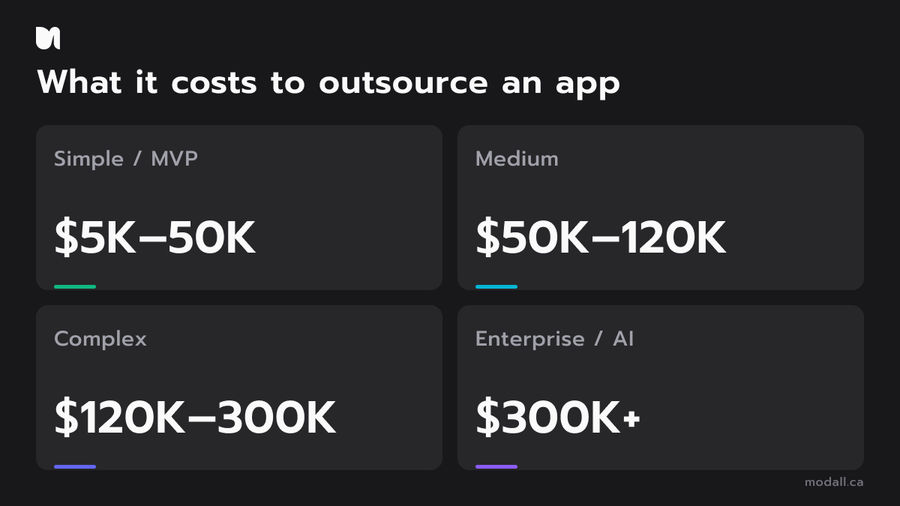
Outsourcing app development in 2026 typically costs anywhere from $5,000 to $300,000+ for a production-grade app, with simple apps starting lower and complex, multi-platform products running higher. The range is wide because "an app" can mean a single-screen utility or a multi-tenant platform with payments, real-time features, and integrations.
Here is how cost scales with complexity, based on Business of Apps development cost benchmarks:
App complexity | Typical cost (USD) | What it usually buys |
|---|---|---|
Simple / MVP | $10,000 - $50,000 | One platform, core features, minimal backend |
Medium | $50,000 - $120,000 | Two platforms, custom UI, integrations, accounts |
Complex | $120,000 - $300,000 | Real-time features, payments, scalable backend |
Enterprise / AI | $300,000+ | Heavy integrations, compliance, AI, high scale |
The second cost driver is where your team sits. Hourly rates vary enormously by region, which is what pulls so many founders toward offshore quotes:
Region | Typical hourly rate (USD) |
|---|---|
United States / Canada | $100 - $200 |
Western Europe | $80 - $150 |
Latin America (nearshore) | $40 - $75 |
Eastern Europe | $25 - $55 |
South Asia | $20 - $40 |
On paper, a $30 hourly rate looks like an 80% discount against a $150 North American rate. In practice, the hourly rate is the most misleading number in the entire decision, because it tells you the price of an hour, not the price of a finished, working app.
The lowest hourly rate frequently produces the highest total project cost, once you account for rework, management overhead, and the rewrites that follow a failed first attempt.
A skilled developer costs roughly $70,000 to $133,000 per year fully loaded, which is part of why agency rates look high. But the number that should drive your decision is total cost of ownership: the rate, multiplied by the hours, plus the cost of fixing what was built wrong, plus your own time spent managing the gap. That is where cheap gets expensive.
The Hidden Costs of Cheap Offshore App Development
The biggest risk in offshore app development is not the work that gets billed. It is the work that has to be redone. Software is unusually unforgiving about this, because mistakes made early compound. Research compiled by Black Duck on defect cost across the development cycle shows that a bug caught in design is cheap to fix, while the same bug caught after release can cost many times more to resolve. A rushed, underspecified build front-loads exactly those expensive mistakes.
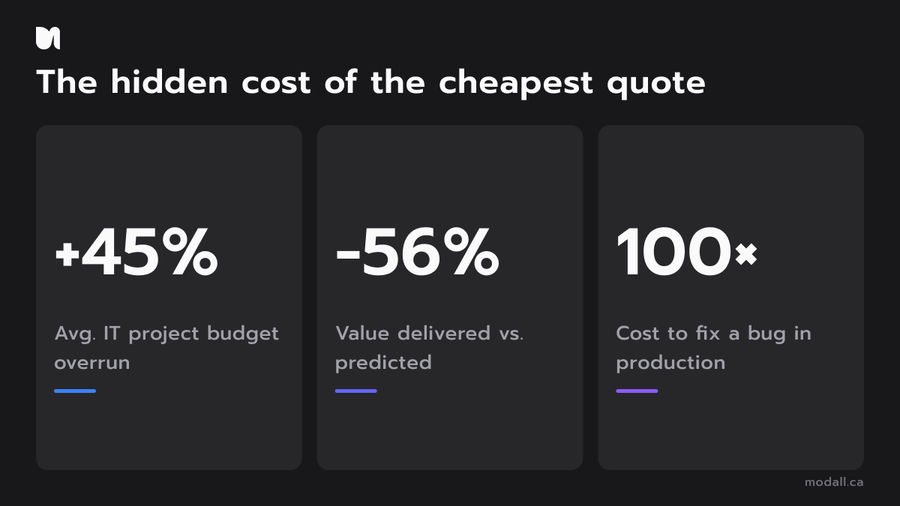
The pattern shows up in the data on large software projects too. A McKinsey and University of Oxford study of more than 5,400 IT projects found that on average they run 45% over budget and deliver 56% less value than predicted, with software projects carrying the highest risk of overruns of any category.
On average, large IT projects run 45% over budget and deliver 56% less value than predicted, and software carries the highest overrun risk of any project type, according to McKinsey and the University of Oxford.
Those overruns rarely come from the hourly rate. They come from the friction that a low rate hides:
Rework and rewrites. When a build is delivered with messy code and no documentation, moving to a new team can mean rebuilding from scratch. The discount you captured on the first attempt gets spent twice.
Management overhead. A team eight to twelve hours ahead means a question you ask at 5pm gets answered tomorrow. A two-week feature can stretch to four because every clarification costs a day.
Communication and specification gaps. When requirements are interpreted rather than discussed, you find out the app does the wrong thing at the demo, not in the planning meeting.
Continuity risk. Freelancers and unstable vendors can stop responding mid-project. The single most common complaint founders raise about outsourcing is a partner who simply stopped delivering, sometimes for months, with the product unfinished and the money already spent.
None of this means offshore work is doomed. Strong offshore teams exist. It means the cheap quote is a starting number, not the real number, and that for an app your business actually runs on, the variable you should optimize is risk-adjusted total cost, not rate.
Hear from a founder who hired Modall to rebuild their app

Learn more by reading our Sceene mobile app development case study!
How to Vet an App Development Partner: A Founder's Checklist
The best protection against a bad outsourcing outcome is vetting the team properly before you sign. The goal is to confirm three things: that they have built something like your app before, that real clients vouch for them, and that they communicate like a partner rather than an order-taker.
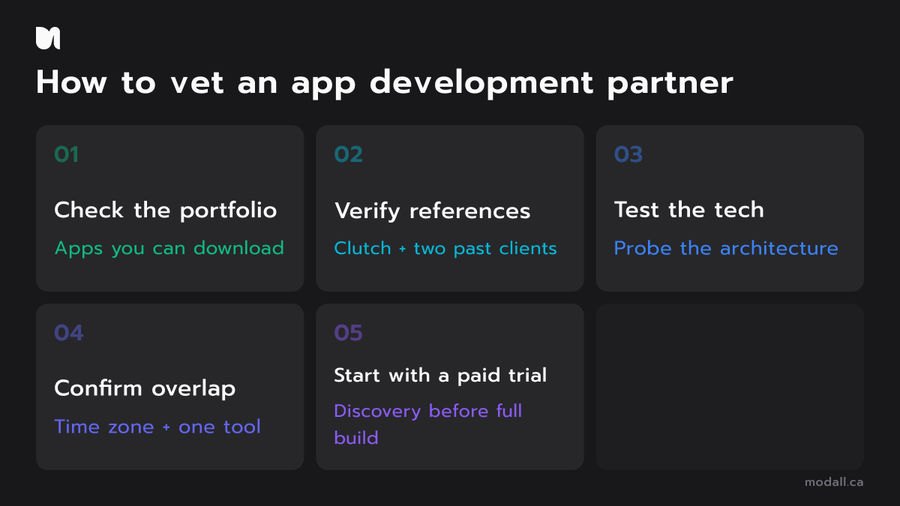
Work through this checklist with any team you are seriously considering:
Portfolio depth, not just screenshots. Ask for apps you can download and use, ideally in your category. Practical, shipped experience predicts success far better than a list of technologies or certifications.
Verifiable references and reviews. Check independent platforms like Clutch and ask to speak to two past clients directly. Pay attention to whether reviewers mention missed deadlines or post-launch support, not just a friendly team.
A real technical conversation. Have an engineer, yours or a trusted advisor, probe how they would architect your app and which stack they would choose and why. Vague answers are a warning sign.
Communication cadence and overlap. Confirm working-hour overlap, a single project management tool, and a named point of contact. The fewer time zones and tools between you and the work, the fewer surprises.
A small paid first step. Before committing to a full build, run a paid discovery phase or a small prototype. A short, scoped engagement tells you more about a team than any sales call, and it caps your downside if the fit is wrong.
That last point is the single highest-impact move a founder can make. Portfolio reviews, an NDA, and a small paid discovery phase before the full build are the three habits that separate successful outsourcing relationships from expensive lessons. A team confident in its work will welcome a trial; a team that pressures you to sign a six-figure contract sight unseen is telling you something.
Engagement Models, Contracts, and Owning Your Code
Once you have chosen a partner, the contract decides how much risk you carry and who owns what you paid for. Two structures dominate, and each fits a different kind of project.
A fixed-price contract sets a defined scope, timeline, and cost up front. It works best for well-defined, smaller builds like an MVP where the requirements will not change much. You trade flexibility for budget certainty.
A time-and-materials contract bills for actual work as the project evolves. It fits products where you expect to learn and adjust along the way, which describes most startup apps after the first release. The trade-off is that you need to stay engaged to keep scope and spend aligned.
For team structure, a dedicated team model gives you a full crew working only on your product, managed by the provider, which suits an ongoing build. Staff augmentation drops individual engineers into a team you manage yourself, which only works if you have the in-house leadership to run them.
Whatever the model, protect three things in writing before any code is written:
Intellectual property assignment. The contract must state that you own all code, designs, and assets the moment they are created. Without an explicit IP assignment clause, ownership can be legally murky, especially across borders.
A non-disclosure agreement. Sign an NDA before sharing your idea, data, or any customer information. It is standard, and a serious partner will have one ready.
Code, repository, and documentation access from day one. You should hold the keys to your own repository and receive readable, documented code throughout, not a zip file at the end. This is what makes it possible to switch teams or bring development in-house later without a rewrite.
Outsourcing app development is completely legal, and these clauses are routine. The point of getting them right is not suspicion; it is making sure that what you pay for is unambiguously yours and that you are never locked into a single vendor by a codebase you cannot access or understand.
Looking for a team to build your app? Get a free quote from Modall today!
How We Approach App Development at Modall
At Modall, we are a custom software development company based in Toronto, Canada, and we have built products in-house since 2019. We take a deliberately different position from the offshore model that dominates this market: every developer who touches your app is on our own team, on-site, with no work passed to subcontractors. For founders in the US and Canada, that means your team sits in the Eastern time zone, in the same working day as you, which removes most of the communication and management friction that makes offshore builds drift.
Our work is full-cycle and modern. We build with TypeScript, React, and Next.js on the web, React Native for cross-platform mobile, and Node.js, Prisma, and PostgreSQL on the backend. That is the same stack behind products like Sceene, a React Native nightlife and social discovery app we shipped on iOS and Android, and HuddleBooks, a financial platform for youth sports organizations. The stack we use means the code you get is type-safe, documented, and something a future team can build on rather than rewrite.
If you want to see what working with us looks like for your app, book a free consultation and we will walk through scope and approach.
Frequently Asked Questions
How much does it cost to outsource app development?
Outsourcing app development typically costs $50,000 to $300,000 for a production-grade app, though a simple MVP can start around $5,000 to $50,000 and complex or enterprise builds exceed $300,000, according to Business of Apps cost benchmarks. The two biggest variables are feature complexity and where your team is located, with North American rates running $100 to $200 per hour and offshore rates as low as $20 to $40. The more useful number is total cost of ownership, which factors in rework and management time, not just the hourly rate.
How do you outsource app development?
Start by defining the problem your app solves and a realistic budget, then decide between a freelancer, a studio, or staff augmentation based on how much you want to manage. Shortlist partners using portfolios and independent reviews, run a small paid discovery phase to test fit, and sign a contract that assigns you full IP ownership and repository access. Treating the first engagement as a trial, rather than committing your whole budget up front, is the single best way to outsource mobile app development without getting burned.
Is it better to outsource app development or build in-house?
Outsourcing is usually better for early-stage startups that need to ship fast, lack in-house technical leadership, or are building a defined first version. Building in-house tends to win once the app is your core product, the roadmap justifies permanent headcount, and you have someone senior to lead engineering. Many founders run a hybrid: they outsource the initial build to an app development company, keep product decisions in-house, and bring engineering in-house once there is traction.
What is the difference between offshore, nearshore, and onshore app development?
Onshore means your development team is in your own country, which gives the easiest communication at the highest rate. Offshore app development uses a distant region, often eight to twelve hours ahead, for the lowest hourly rate but the most management friction. Nearshore software development sits in between, using a nearby country in a similar time zone, which preserves most of the communication advantage at a lower cost than a fully onshore team.
Which countries are best for outsourcing app development?
The most common offshore destinations are India and South Asia for the lowest rates, Eastern Europe (Poland, Ukraine, and Romania) for strong engineering at mid-range rates, and Latin America as a popular nearshore option for US founders because of time-zone overlap. North America remains the onshore choice for the closest collaboration. The right answer depends less on the country than on the team: a well-vetted partner in a convenient time zone usually beats a cheaper one twelve hours away, because communication overhead and rework erase the rate savings. For a product-critical app, weigh nearshore software development and onshore options before defaulting to the lowest offshore quote.
How do I protect my app idea when outsourcing development?
Sign a non-disclosure agreement before you share details, and make sure your development contract includes an explicit intellectual property assignment clause stating that you own all code, designs, and assets. Hold your own repository and require documented code throughout the project rather than a single handoff at the end. These steps are standard practice, and any reputable partner will agree to them without hesitation.
Will AI replace app developers?
AI is changing how apps get built, but it is not replacing the developers who build them. AI tools accelerate routine coding, testing, and boilerplate, which raises the value of senior engineers who can architect systems, make product trade-offs, and judge what the AI produces. For founders, the practical effect is that experienced teams now ship faster, which makes the quality and judgment of the people you hire to outsource app development more important, not less.
Choosing the Right Way to Outsource App Development
The decision to outsource app development is not really a choice between in-house and external, or between expensive and cheap. It is a choice about risk. The cheapest hourly rate often hides the highest total cost, and the founders who succeed are the ones who optimize for a finished, well-built product they fully own rather than the lowest number on the quote. Vet for shipped work, start with a small paid step, and put IP ownership in writing, and outsourcing becomes one of the highest-impact moves a startup can make.
If your app is something your business will run on, we build it in-house in Toronto, in your time zone, on a stack made to last. Get a free quote and we will help you scope it the right way.