

If you have spent months trying to find a technical co-founder and come up empty, the problem is rarely you. The engineers capable of building your product are the single hardest hire in the startup world, and they have less reason to join an unproven idea than at any point in the last decade. That leaves most non-technical founders weighing two real paths to a first product: recruit a technical co-founder, or hire a development agency to build it.
This guide compares both on cost, speed, control, and risk, and gives you a framework to choose the right one for where your company actually is in 2026.
Before you commit equity to the first person who can write code, it helps to understand exactly what each path costs and what it gives you in return. If you want a second opinion on your specific build, you can book a free consultation with our team at Modall.
Technical Co-Founder vs. Development Agency: The Decision at a Glance
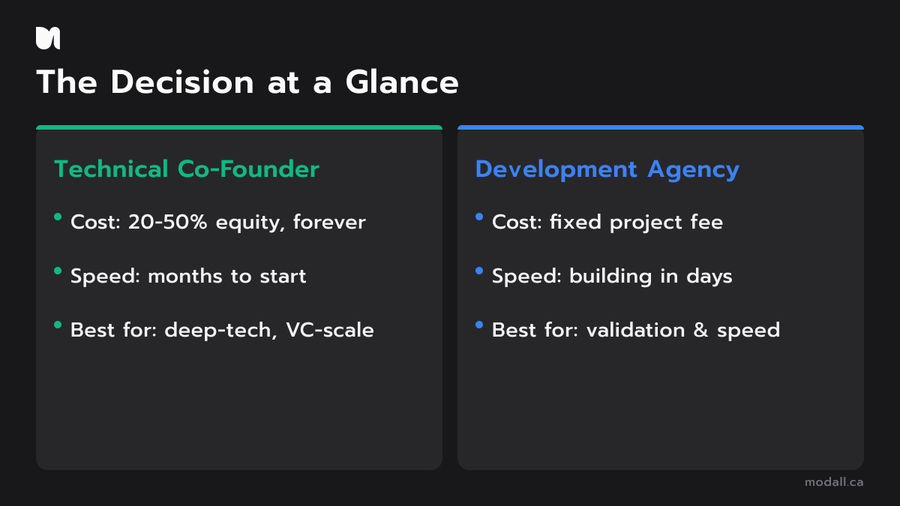
A technical co-founder gives you committed, long-term engineering leadership in exchange for a large and permanent share of your company. A development agency gives you a senior team building immediately in exchange for fees, while you keep your equity and your timeline. Neither is universally better. The right choice depends on how technical your product is, how fast you need to move, and whether you are optimizing for ownership or for proof.
Factor | Technical co-founder | Development agency |
|---|---|---|
Upfront cash cost | Low (usually sweat equity) | Higher (project or sprint fees) |
Long-term cost | High (20 to 50% equity, permanent) | Zero (you keep your equity) |
Time to start building | Months of searching, sometimes indefinite | Days to a few weeks |
Code and IP ownership | Shared with the co-founder | Yours, with a proper contract |
Seniority on day one | Varies with who you find | Senior team from the start |
Commitment | Total; it is their company too | Contractual; aligned by scope |
Technical leadership | Built in; they become your CTO | Needs a plan to bring in-house later |
Best fit | Deeply technical, venture-scale products | Validating, launching, reaching traction fast |
Keep this table in mind as you read. Every section below is a deeper look at one of these rows.
Why Finding a Technical Co-Founder Is So Hard Right Now
The technical co-founder shortage is structural, not bad luck. Demand for skilled engineers has outrun supply for years, and the gap is widening. Korn Ferry projects a global talent shortage of 85 million workers by 2030, equivalent to roughly $8.5 trillion in unrealized annual revenue, with the technology sector among the hardest hit. When the best engineers can name their price, convincing one to work for a salary of zero on your idea is a steep ask.
You also have to factor in trust, which is something we will cover further into the article.
The numbers make the opportunity cost concrete. In the United States, the median software developer earned $133,080 in May 2024 according to the Bureau of Labor Statistics, and the top 10% earned more than $211,450. A genuinely senior engineer, the kind who can architect a product from scratch and lead a team, is leaving a six-figure salary and equity at an established company on the table to join you. Most will not, and the ones who would are often the ones you should worry about.
A global talent shortage of 85 million workers by 2030 means the engineers you need to find as a technical co-founder are also the most fought-over hires in the economy.
There is also the matching problem, which Paul Graham named two decades ago and which has only sharpened. In his essay on the mistakes that kill startups, he points out that business founders "can't tell which are the good programmers," and that "no one really good wants a job implementing the vision of a business guy." Even when you do find a willing technical partner, evaluating whether they are actually excellent is nearly impossible without technical judgment of your own. That combination, scarce supply and hard-to-assess quality, is why the search drags on for so many founders and why so many start looking for an alternative.
What a Technical Co-Founder Actually Gives You, and What It Costs
A technical co-founder is the strongest possible signal that your product will get built well, which is exactly why investors push for one. Y Combinator is blunt about it: based on the thousands of companies it has funded, companies lacking a technical co-founder underperform, and recruiting one is "the single biggest way to create value" as an early founder. A co-founder who owns the code is invested in a way no contractor can match. They will stay up fixing the outage, rebuild the architecture when it stops scaling, and grow into the CTO role as you hire a team beneath them. That commitment is real, and so is its price: equity, paid forever.
That said, there are teams like Modall who act as "technical co-founders", but work on a fee basis rather than for equity. Check out our case study on HuddleBooks, and Sceene to hear from first-time founders who have worked with us before.
Technical co-founders command a large stake, and splits have been trending toward even. Carta's analysis of how founders split equity found that by 2024, 45.9% of two-person founding teams divided ownership equally, up from 31.5% in 2015, and the median two-founder split had narrowed to 51-49. In practical terms, the technical co-founder path usually costs you something close to half your company. If the business is eventually worth $10 million, that share is worth roughly $4 to $5 million. Measured against any other way of paying for engineering, equity is the most expensive financing a founder will ever issue, precisely because it only gets expensive when you succeed.
The other cost is relationship risk and trust, and it is the one founders underestimate most. Harvard Business School research by Noam Wasserman found that 65% of high-potential startups fail because of conflict among co-founders. Paul Graham reports that about 20% of the startups YC has funded have had a founder leave. A co-founder is harder to remove than almost any hire, and a split after vesting can leave dead equity on your cap table that haunts your next raise. The upside of a great technical co-founder is enormous. The downside of the wrong one is existential.
Equity is the most expensive way to pay for engineering, because it only becomes costly if you succeed. An agency fee is the opposite: a fixed, finite price you pay once.
What a Development Agency Actually Gives You, and What It Costs
A development agency like Modall gives you a senior, multi-disciplinary team ready to start building your product within days, without touching your cap table. Instead of spending months recruiting one person and hoping they are good, you engage a group that has shipped dozens of products and can put designers, engineers, and a project lead on your idea immediately. You keep 100% of your equity, you set the timeline, and with a proper contract you own all of the code and intellectual property outright. For a founder whose main enemy is time, that speed and ownership are the entire point.
The cost is cash and it is visible up front. Industry estimates put a professionally built minimum viable product in the range of roughly $25,000 to $150,000 depending on scope, with North American agency rates commonly between $100 and $200 per hour and typical timelines of three to five months to a launchable MVP. Our own breakdowns of SaaS development cost in Canada and mobile app development cost walk through where that money goes. Unlike equity, the number is fixed and finite: once the product is built, you have paid for it, and you still own everything.
The real risk with an agency is alignment, and it is worth naming honestly. The standard objection, often raised by investors, is that an outside shop wants to maximize billable work while you want to maximize a successful product, and a low-quality vendor will happily "turn scope into code for dollars" and call it done. That critique is fair, and it is the reason choosing the right partner matters more than choosing the agency model itself. The agencies worth hiring push back on scope, offer a discovery process, and plan for validation rather than just taking your spec and invoicing against it. Vetting for that mindset is the whole game, which is why we wrote a guide on how to choose a development company.
Additionally, at Modall, we tend to find ourselves acting like "technical co-founders" for a lot of the startups we work with. Founders need a trusted technical team to bring their vision to life, and also a team who's built startups of their own that can bring fresh ideas to the table and push back on decisions that may ultimately hurt the business. This is exactly what we did for HuddleBooks, and countless others. Hear from a startup consultant who recommends us to all the founders he advises:

If you're looking for a development team that will act as a "technical co-founder", just without the equity, book a free call with us today!
Cost Comparison: Equity vs. Fees Over Time
The cleanest way to see the trade-off is to compare what each path costs at the moment you pay and what it costs if the company wins. An agency is expensive today and cheap later. A co-founder is cheap today and, if things go well, the most expensive line item you will ever have.
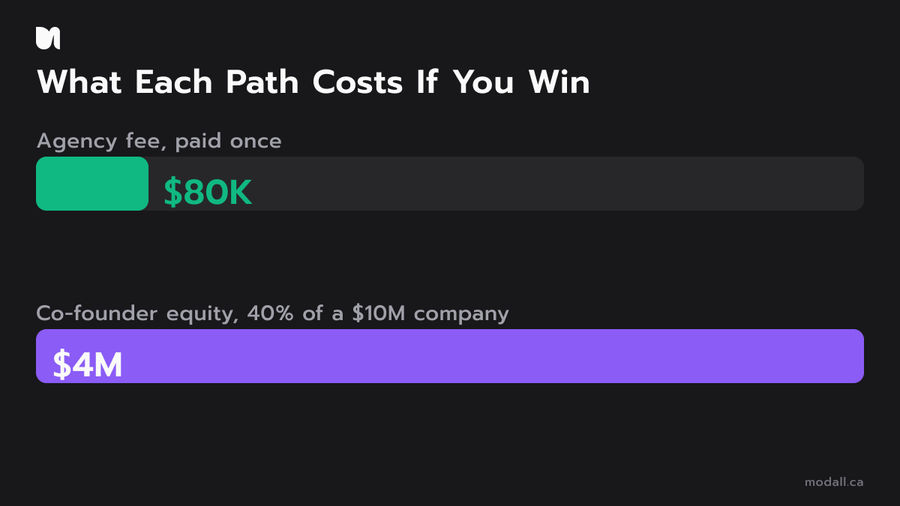
Run the math on a single scenario. Suppose you need a first product and choose between giving a technical co-founder 40% of the company or paying an agency $80,000 to build the MVP. If the startup fails, the co-founder cost you nothing in cash and the agency cost you $80,000, so the co-founder looks cheaper. If the startup reaches a $10 million valuation, that 40% stake is worth $4 million while the agency invoice is still $80,000, so the agency was cheaper by a factor of roughly fifty. The co-founder path is effectively a bet that trades cash now for a large slice of an uncertain future, and the better your company does, the more that slice costs.
This is not an argument that equity is bad. Equity buys commitment and leadership that fees cannot, and for a company where engineering is the core of the business, that can be worth far more than the dilution. It is an argument for being deliberate: do not hand out a near-equal share to solve a problem that a fixed fee could solve, and do not try to save cash with a cheap contractor on a product whose entire value is its technology.
Speed, Control, and Risk: How the Two Paths Diverge
On speed, the agency wins decisively, and speed is often what decides a startup. The co-founder search has no fixed end date; some founders find their match in a week and others are still looking a year later, all while the product sits unbuilt. An agency engagement starts on a known date and reaches a launchable product on a schedule. In a market where being first to validate an idea matters, months lost to recruiting are months a competitor uses to ship.
On control and ownership, the two paths point in opposite directions. With an agency, you direct the roadmap and, with the right contract, you own the code, the designs, and the IP free and clear. With a co-founder, you share control of technical decisions and a meaningful share of the company permanently, which is exactly what you want if you need a long-term technical partner and exactly what you do not want if you simply need a product built. The right answer depends on whether you are buying leadership or buying output.
On risk, the failure modes are different and worth weighing directly. The co-founder risk is human and slow to surface: misalignment, a departure after vesting, or dead equity that complicates a raise. The agency risk is contractual and easier to manage: a poor vendor, a weak handoff, or code you cannot maintain after launch. The first risk is hard to reverse. The second is mostly avoidable with diligence, a clear contract, and a partner who documents the work and plans the transition to your in-house team.
When to Choose a Technical Co-Founder vs. a Development Agency
The decision comes down to what kind of company you are building and what your hardest constraint is right now. If engineering is the product and you are raising venture capital, a technical co-founder is usually worth the equity, and VCs like to see a CTO on the cap table. If your hardest constraint is time, validation, or capital efficiency, an agency gets you to the market faster without giving away the company.

Choose a technical co-founder if | Choose a development agency if |
|---|---|
Engineering is the moat and the product is deeply technical | You need to validate an idea and reach the market quickly |
You are raising venture capital and investors expect a technical founder | You want to keep full ownership and avoid early dilution |
You have found someone you trust whose skills are proven | You have searched for months without the right match |
You can afford to wait to start building | You cannot afford to lose more time to the search |
You want in-house technical leadership from day one | You want senior engineers building now, with a plan to hire later |
The Hybrid Development Path
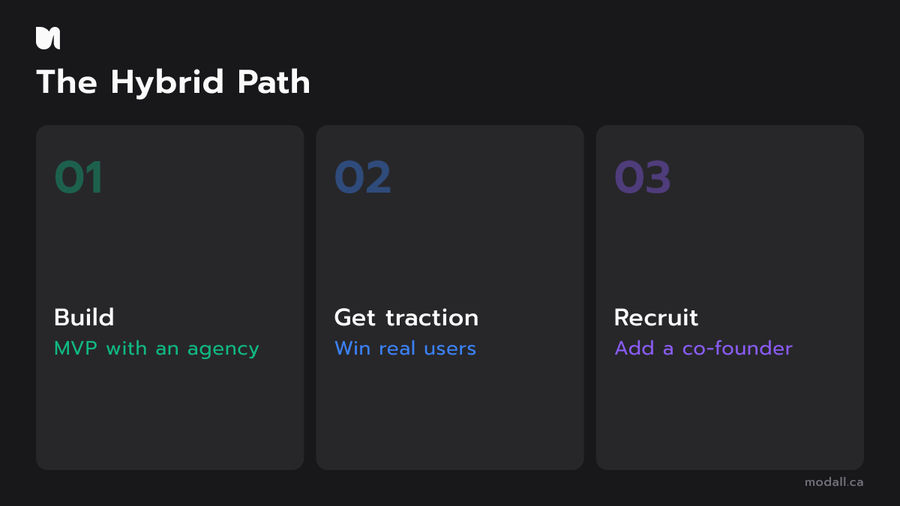
There is also a third path that resolves the dilemma for many founders, and it is the one the data quietly supports. Build the first version with an agency like Modall, use the working product to gain users and traction, and let that traction attract a technical co-founder or first CTO on far better terms.
A product with real usage de-risks the opportunity for the engineer you are trying to recruit, which is the exact thing that makes them say yes.
You are not choosing between a co-founder and an agency forever; you are choosing what to do in the next ninety days. Founders who cannot find a technical co-founder routinely build with an agency first, reach traction, and bring technical leadership in-house once there is something real to lead.
How We Approach This Decision at Modall
At Modall, we are a custom software development company based in Toronto, Canada, founded in 2019, and most of the founders we work with arrive having already spent months on the co-founder search. We are not in the business of talking you out of a great technical co-founder; if you have found one you trust, hold on to them. What we do is give founders who need to move now a way to build a serious product without trading away half their company to do it.
Hear from a solo founder who worked with Modall

Learn more by reading our case study on HuddleBooks.
Our approach is built around the alignment problem that makes founders wary of agencies in the first place. We typically start with a discovery process, push back on scope rather than padding it, and aim for the smallest version that actually validates the idea.
We also build on a modern, maintainable stack: React, Next.js, Node.js, and PostgreSQL, and we document and hand off the codebase so your eventual in-house team or CTO inherits something clean rather than a black box.
We have built products this way for startup founders behind apps like Sceene, Vault Club, HuddleBooks, and Wanderfy, and the goal is always the same: get you to traction with your equity and your IP intact. If you are weighing your options, get a free quote and we will let you know if we're the right fit for you!
The point is not that an agency is always right. It is that "find a technical co-founder or stall" is a false choice. You have more ways to build than the standard advice admits, and the best one depends on your product, your timeline, and your cap table.
Frequently Asked Questions
Do I need a technical co-founder to start a startup?
You need technical capability on your team eventually, but you do not need it to be a co-founder, and you do not need it on day one. If you are building a deeply technical, venture-scale product, a technical co-founder is the strongest path and the one most investors expect. If you are validating an idea or racing to market, a development agency can build your first product faster and without dilution, and you can recruit a technical co-founder or CTO later once you have traction to show.
Can you start a startup without a technical co-founder?
Yes, and many successful companies have. The two common routes are hiring a development agency to build the product while you retain full ownership, or hiring senior engineers as employees rather than co-founders. The catch is that you still need a way to evaluate technical quality, since a non-technical founder cannot easily tell good engineering from bad. Working with an experienced partner who documents their decisions and explains trade-offs in plain language closes that gap.
How much equity does a technical co-founder get?
Technical co-founders typically receive a large share, often close to an equal split. Carta's data shows that by 2024, 45.9% of two-founder teams split equity equally and the median two-founder split had narrowed to 51-49. Compared with a fixed development fee, that equity becomes the most expensive way to pay for engineering if the company succeeds, which is why the decision deserves real scrutiny rather than a reflexive yes.
Is it better to hire a development agency or find a technical co-founder?
It depends on your hardest constraint. A technical co-founder is better when engineering is the core of the business and you need long-term technical leadership that is fully committed. A development agency is better when speed, ownership, and capital efficiency matter most, because it puts a senior team on your product immediately without diluting your equity. Many founders use both in sequence: build with an agency, then bring technical leadership in-house once there is traction.
Can a development agency replace a CTO?
For the build phase, a good agency covers what a CTO would do: architecture, technology choices, and shipping a quality product. What it does not replace permanently is in-house technical ownership as you scale, so the right model is to use an agency to get to market, then transition to an internal team or CTO once the product is proven. The key is choosing an agency that builds for that handoff, with clean code and documentation, rather than locking you in.
How long does it take to find a technical co-founder?
There is no fixed timeline, which is the core problem. Some founders find the right person in weeks through their network; many search for six months or a year and never find a match, all while the product goes unbuilt. Because the global engineering shortage makes strong technical talent scarce and hard to recruit, treating the search as open-ended is a real risk. Setting a deadline, and a plan for what you build if you miss it, keeps the company moving.
Choosing the Right Way to Build
The decision to find a technical co-founder is not really about co-founders; it is about the fastest, soundest way to turn your idea into a product without giving away more than you have to. A technical co-founder is worth a large equity stake when engineering is the heart of the business and you need committed leadership for the long haul. A development agency is the better path when time, ownership, and proof matter most, and it often sets up the technical co-founder hire that was impossible before you had traction.
At Modall, we help founders make that call honestly and then build the product either way. If you want a clear-eyed assessment of which path fits your startup, speak to our team.